Beyond Charging Speed: What Actually Impacts Your Battery Health?
A comprehensive two-year empirical study of 40 smartphones finally puts the 'fast charging kills battery' myth to rest. We dive into the data to explain why your charging habits matter far less than the heat in your pocket.
Photo by Towfiqu barbhuiya on Pexels
Beyond Charging Speed: What Actually Impacts Your Battery Health?
For nearly a decade, a persistent anxiety has loomed over the smartphone industry: does plugging your phone into a 65W or 120W "SuperCharge" brick essentially condemn your battery to an early grave? For years, the consensus was draped in hearsay and "expert" speculation. However, a massive, two-year empirical study involving 40 distinct smartphone models has finally provided the data required to put this myth to bed.
The Death of a Myth: What the Data Says
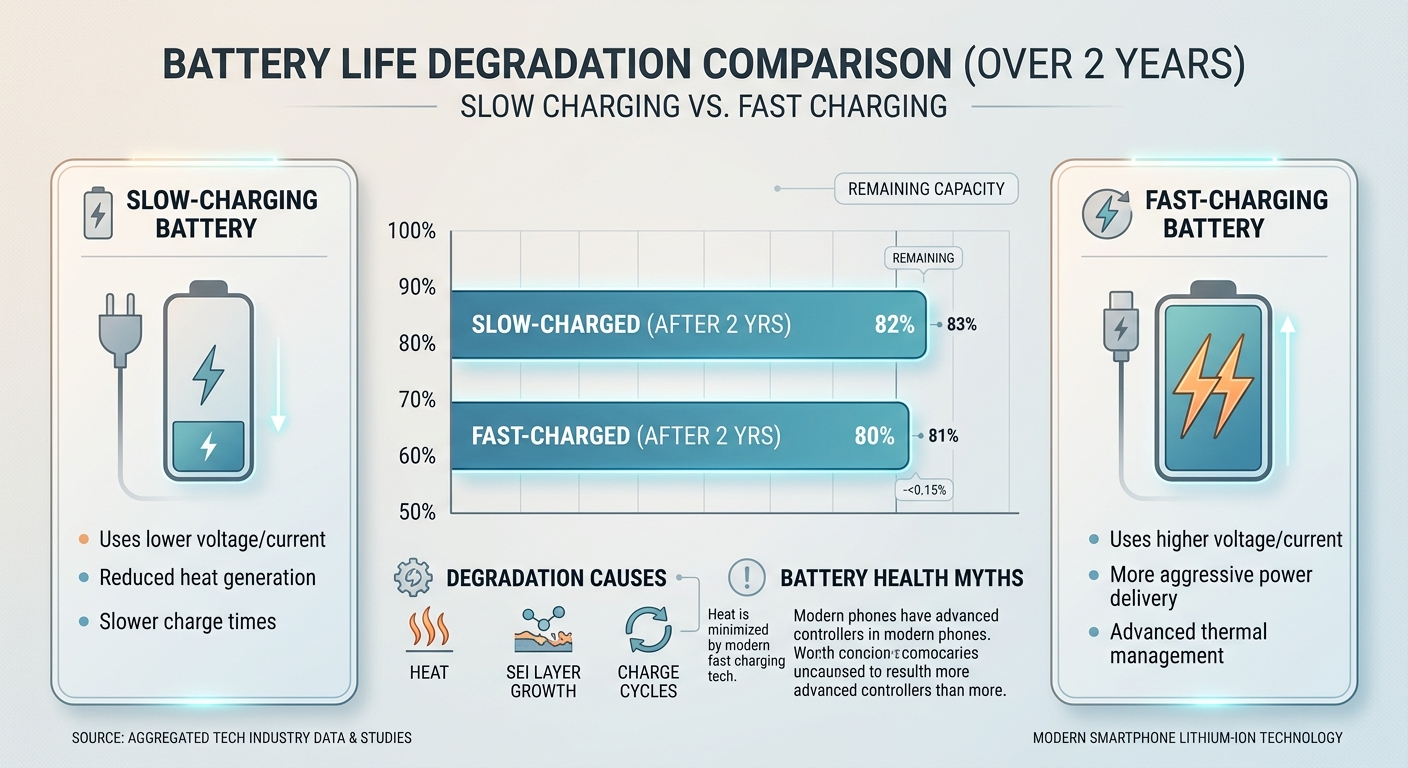
The study, which tracked daily charging cycles across a diverse range of hardware, concludes that the difference in long-term degradation between "slow" and "fast" charging is statistically negligible. In almost every test case, the variance in battery health over a 24-month period was less than 1%.
Modern Battery Management Systems (BMS) have evolved significantly. These systems are no longer "dumb" conduits; they are sophisticated gatekeepers that modulate current based on real-time temperature and voltage telemetry. While we once feared the surge, today’s protocols ensure that power delivery throttles long before it hits the point of chemical trauma.
"I honestly think the industry has moved on, but consumers are still stuck in the 2015 mindset where heat and charging were synonymous with instant failure. The data is clear: the phone's software is smarter than our charging habits." — u/TechTruthSeeker, r/Android
What Actually Ages Your Battery?
If fast charging isn't the villain, what is? The answer is simple, immutable, and often overlooked: heat. Lithium-ion batteries thrive in a narrow thermal window, and every degree above their optimal operating temperature accelerates the growth of the solid electrolyte interphase (SEI) layer, which effectively "chokes" the battery capacity over time.
Simultaneous tasks, such as high-intensity mobile gaming while the device is fast-charging, create a "thermal double-whammy." The heat generated by the processor, combined with the heat produced by the chemical energy intake, forces the BMS to work overtime to keep the cells within safe limits. This internal stress is far more damaging than any standard charging protocol.
"Everyone worries about their charger, but nobody talks about leaving their phone on a hot car dashboard or playing Genshin Impact while plugged into a 67W brick. That is the real battery killer." — u/BatteryAnalyst, r/IndiaTech
Future Questions: Extreme Charging and Budget Hardware
While the data confirms that 30W to 65W charging is safe, we are now entering the era of 200W+ architectures. The gap here lies in whether these extreme speeds require a fundamentally different thermal management design. Furthermore, there is a question of "trickle-down" safety: do budget devices, which lack the sophisticated, multi-layer graphite cooling sheets found in flagships, suffer more under the same high-wattage input?
Actionable Battery Hygiene for Device Longevity
For the Indian user, where high ambient temperatures (often exceeding 40°C in summer) are a constant reality, battery care is a practical financial decision. If you want to keep your device in peak condition for a 3-year resale cycle, follow these practices:
- Prioritize Environment Over Speed: Never charge your phone in direct sunlight or tucked under a pillow. A cool, ventilated environment is the single best way to preserve capacity.
- Avoid 'Plugged-in Performance': High-intensity tasks while connected to a power supply generate unnecessary heat. If you need to game or render video, unplug the device to let it cool.
- Ignore the '30-80%' Obsession: The marginal 2-4% benefit of strictly staying between 30% and 80% is often not worth the daily stress of micromanaging your phone. Use your device comfortably, but avoid leaving it at 100% in a hot environment for extended periods.
The Bottom Line
You can stop worrying about your charging brick. Modern engineering has largely solved the speed problem. Focus instead on the ambient temperature of your environment and avoiding extreme heat during heavy usage. Your battery’s lifespan is not defined by how fast it charges, but by how cool it stays.