Beyond Chat: How Cursor-Trained Grok 4.5 Shifts AI From Autocomplete to Agentic Partner
SpaceXAI has officially launched its 1.5 trillion parameter Grok 4.5 model, leveraging a proprietary $60B dataset from the Cursor IDE acquisition. This move signals a seismic shift toward 'agentic' workflows, fundamentally changing how developers interact with code.
Photo by UMA media on Pexels
The $60 Billion Data Play Behind Grok 4.5 and Cursor
SpaceXAI's launch of Grok 4.5 is not simply another foundation model release. It represents a calculated attempt to own the entire software development lifecycle. The company now controls the model, the integrated development environment through Cursor, and the inference infrastructure behind it. That combination changes the competitive landscape far more than another benchmark victory ever could.
The strategy became clear after SpaceX acquired Anysphere, the maker of Cursor, for $60 billion shortly after its IPO. Imagine a developer debugging a sprawling microservices repository with hundreds of files. Traditional coding assistants wait for prompts and respond one interaction at a time. Cursor, paired with Grok 4.5, continuously observes repository structure, developer intent, failed attempts, tool usage, and eventual solutions. That workflow generates training signals that no public code repository can capture. The acquisition was not just about buying an editor; it was about securing exclusive access to the world's largest stream of real-world software engineering decisions.
The New Competitive Moat: Owning Developer Intent
Most large language models train primarily on publicly available code, documentation, and synthetic datasets. Grok 4.5 extends that foundation with Cursor developer interaction data, capturing how programmers actually solve problems across multi-file repositories.
That distinction matters.
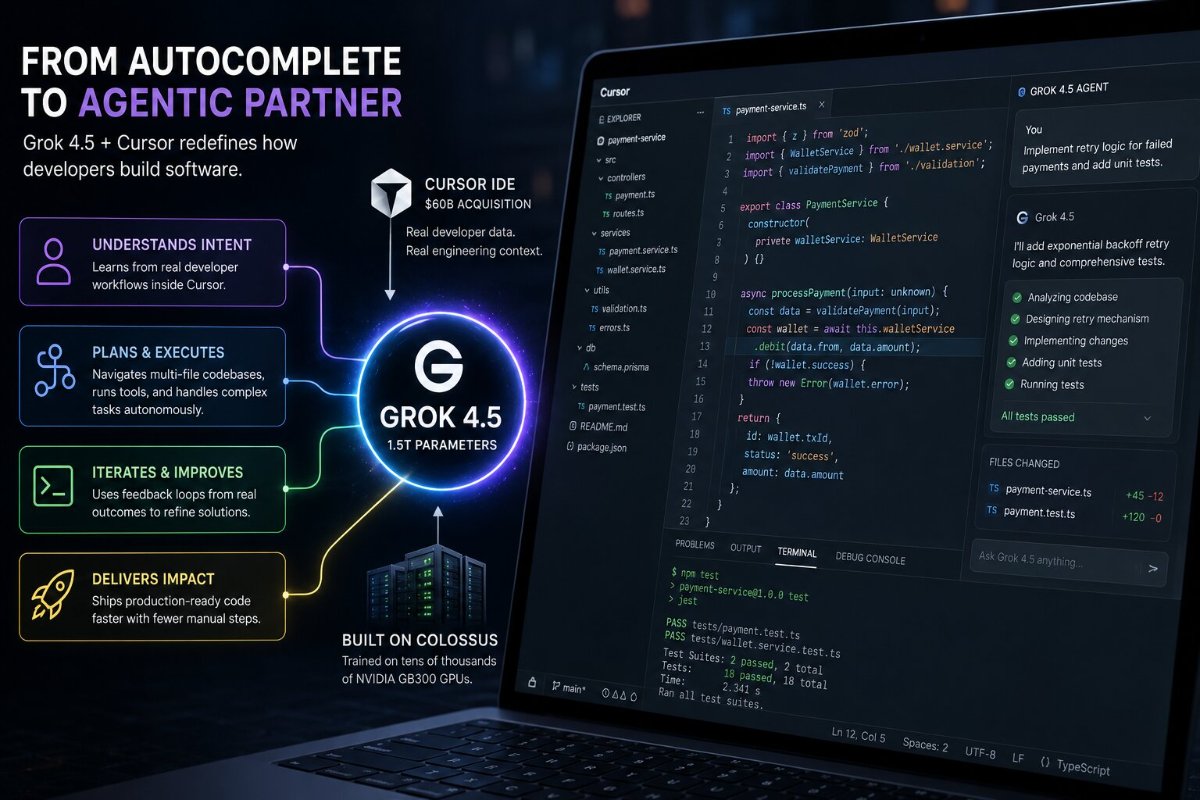
Code repositories reveal the final answer. Cursor reveals the entire reasoning journey—the abandoned approaches, debugging cycles, refactoring decisions, and tool interactions that ultimately produce working software. Those behavioral signals allow reinforcement learning systems to optimize not only correctness but also execution strategy.
SpaceXAI says Grok 4.5 uses highly scaled reinforcement learning across hundreds of thousands of multi-step engineering tasks, enabling longer autonomous workflows while improving per-token intelligence. Instead of generating isolated code snippets, the model can navigate repositories, execute asynchronous tasks, and coordinate changes across multiple files with limited human intervention.
Bigger Is Only Part of the Story
Under the hood, Grok 4.5 runs on xAI's V9 mixture-of-experts architecture with 1.5 trillion parameters, triple the scale of the previous 500-billion-parameter V8 architecture. Training relied on tens of thousands of NVIDIA GB300 GPUs powered by infrastructure including the Colossus supercluster.

Raw parameter count, however, no longer defines competitive advantage.
The more significant innovation lies in combining large-scale reinforcement learning with proprietary developer workflows. SpaceXAI appears to believe that exclusive interaction data produces greater long-term gains than merely expanding model size. If that assumption proves correct, future AI competition may revolve less around publicly available datasets and more around exclusive behavioral data collected through vertically integrated products.
Pricing That Pressures the Entire Market
SpaceXAI also attacked from another direction: pricing.
By offering Grok 4.5 at $2 per million input tokens, the company undercuts premium coding models while remaining competitive on output costs. That creates immediate pressure on rivals serving enterprise development teams.
| Model | Input Price (per Million Tokens) | Output Price (per Million Tokens) |
|---|---|---|
| Grok 4.5 | $2.00 | $6.00 |
| Claude Opus 4.8 | $5.00 | $25.00 |
| GPT-5.6 Sol | $1.00 | $6.00 |
The pricing strategy looks less like a standalone revenue decision and more like an ecosystem play. If developers adopt Cursor because Grok performs best inside it, SpaceXAI benefits at every layer—the IDE subscription, API usage, inference infrastructure, and future training data. Every interaction strengthens the platform's competitive advantage.
Benchmarks Tell Only Part of the Story
Independent evaluations paint a more measured picture than marketing headlines. On the Artificial Analysis Intelligence Index, Grok 4.5 currently ranks fourth overall, behind Claude Fable 5, GPT-5.5, and Claude Opus 4.8.
Yet several specialized benchmarks reveal why developers may still pay attention. Grok 4.5 leads the τ³-Banking benchmark, tops AutomationBench-AA by completing over half of SaaS workflow tasks cleanly, and reportedly requires 4.2× fewer output tokens than Claude Opus 4.8 on SWE Bench Pro. Lower token consumption translates directly into faster execution and lower inference costs for large engineering teams.
Those efficiency gains may matter more than absolute benchmark rankings in production environments where latency and operating cost often outweigh marginal improvements in reasoning scores.
The Questions That Still Remain
The launch also raises legitimate concerns.
Critics argue that Cursor's $60 billion valuation reflects the strategic value of proprietary developer data rather than the economics of an IDE business. Others note that Cursor interactions entered Grok 4.5 through supplemental post-training, not during initial V9 pre-training. Machine learning researchers generally view integrated pre-training as a stronger approach because the model develops representations from the beginning instead of adapting later through fine-tuning.
Transparency presents another challenge. Many of Grok 4.5's strongest claims depend on closed datasets, proprietary developer interactions, and internal evaluation environments that outside researchers cannot independently reproduce.
That uncertainty does not diminish the broader signal. SpaceXAI has shifted the AI race beyond building larger models. The company is building an ecosystem where every developer interaction improves the next generation of models. The next battle may not focus on who builds the smartest chatbot, but on who owns the richest stream of human problem-solving.