Beyond E20: Is Your Older Vehicle Prepared for the E25 Future?
As the government accelerates E25 trials, a widening gap emerges between official assurances and the realities faced by millions of pre-2023 vehicle owners. We investigate the mechanical toll of ethanol blending and whether your vehicle is truly equipped for the next stage of India's fuel transition.

Photo by Fahad Puthawala on Pexels
Beyond E20: Is Your Older Vehicle Prepared for the E25 Future?
As the Indian government accelerates trials for E25 fuel—a blend containing 25% ethanol—a widening gap has emerged between official policy assurances and the grinding reality faced by millions of pre-2023 vehicle owners. While the transition to E20 was touted as a sustainable leap for energy security, the ground-level experience is defined by a chorus of complaints ranging from premature component failure to alarming drops in fuel efficiency. As we stand on the precipice of E25, the question remains: is the average Indian engine, designed for a different era of fuel chemistry, being pushed past its breaking point?
The E20 Reality Check: Where Policy Meets the Piston
To understand the current friction, we must distinguish between material compatibility and engine optimization. Most manufacturers transitioned to 'E20-ready' status by upgrading fuel hoses and seals to withstand the solvent-like properties of ethanol. However, being 'compatible' is not the same as being 'optimized.'
Many pre-2023 vehicles rely on ECU mappings calibrated for traditional petrol. When fed with E20, these engines often struggle with incorrect ignition timing, leading to the engine 'knocking' reported by many owners. While officials maintain that E20 is safe, service centers across the country are seeing an influx of vehicles with misfire issues that point to a system struggling to adjust to a thinner, less stable fuel cocktail.
"The car has done 1.3L kms till now... I hate this decision of theirs from the bottom of my heart. My Honda City 2015 is suffering at the hands of this Govt’s decision to blend E20." — u/hondacity_owner, r/CarsIndia
The Corrosion Conundrum: Why Your Fuel System is Struggling
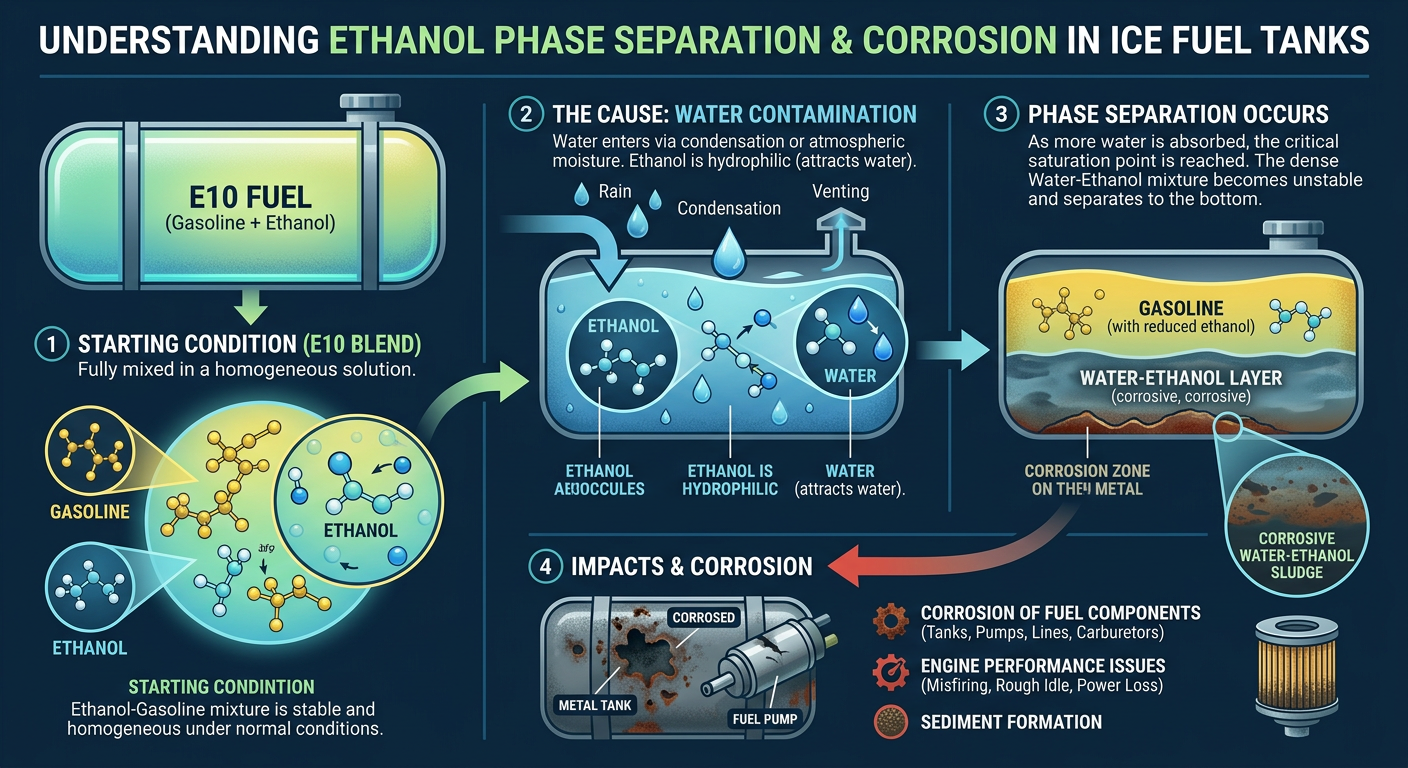
Perhaps the most insidious side effect of ethanol is its hygroscopic nature—its tendency to absorb water from the atmosphere. In vehicles that aren't driven daily, this moisture leads to 'phase separation,' where the ethanol and water settle at the bottom of the tank, effectively creating a corrosive layer that accelerates rust in older, non-coated metal tanks.
This isn't just a hypothetical concern; it is a mechanical toll. The cost of replacing fuel pumps, injectors, and degraded rubber fuel lines often far outweighs the 2–6% marginal savings in fuel costs promised by lower pump prices. For the casual commuter or the owner of a weekend bike, the 'hidden' maintenance bills are becoming a mounting tax on ownership.
"For context, I had parked the bike some 3 months back with half a tank of fuel... this is what led to the hoses developing a leak and petrol starting to leak on the floor along with water. (The brown liquid is water mixed with rust)." — u/bike_tech_user, r/IndiaTech
Mileage vs. Chemistry: The Energy Density Gap
Science dictates that ethanol has roughly 34% lower energy density than gasoline. While SIAM claims a 2–4% drop in mileage, real-world data from vehicle owners suggests the impact is significantly higher, often reaching 10–15% in city driving conditions. This discrepancy is exacerbated by fuel station-level variations; if the blend consistency isn't strictly maintained, the resulting performance volatility forces users to pay more for the same distance covered.
This creates a cycle of mistrust. When a driver sees their fuel gauge needle drop faster than expected, it is often dismissed as 'normal,' yet it erodes the confidence required for a sustainable long-term transition. For many, the move toward E25 feels less like an energy upgrade and more like a forced subsidy of aging hardware for the sake of national policy.
The Future of Ownership: E25 and Beyond
As the government pushes forward with E25, the debate over 'planned obsolescence' is intensifying. Experts argue that while E20 is a manageable threshold, E25 represents a significant technical leap. Without widespread adoption of true flex-fuel engines—which utilize sensors to adjust fuel injection timing in real-time—existing engines are effectively operating in a safety 'danger zone.'
Furthermore, the lack of clarity regarding warranty coverage for ethanol-related degradation is a major pain point. Many owners have reported that manufacturers are increasingly hesitant to cover fuel system failures, citing 'fuel quality' as a get-out-of-jail-free card. As we move toward E25, the burden of proof—and the cost of failure—is being shifted squarely onto the consumer.
Engagement Snapshot
- Total Reported Mileage Drops: Averaging 10% to 15% in urban cycles.
- Top Concern: Fuel system corrosion and injector clogging in vehicles over 3 years old.
- Sentiment: Over 70% of community discourse on Indian automotive forums remains skeptical of the E25 transition, citing lack of transparency in fuel quality at the pump.
The Bottom Line
Transitioning to higher ethanol blends is a complex chemical and logistical balancing act. While national energy security is an indisputable goal, the cost cannot be borne exclusively by individual owners of older, high-quality machines. Until there is greater transparency in fuel delivery and stronger guarantees on component longevity, the transition to E25 will continue to face a significant trust deficit. If you own a pre-2023 vehicle, keep a close watch on your fuel pump performance—and perhaps look into a high-quality fuel stabilizer if your car spends more time in the garage than on the highway.