Beyond Outsourcing: Are GCCs Incubators or Dead-ends for the Next Indian Unicorn?
As Indian-born founders dominate the global unicorn landscape, India faces a critical choice: continue fueling the talent pipeline for foreign enterprises or engineer a 'Talent PLI' to retain innovators. We investigate whether Global Capability Centers are upskilling the next generation or simply stalling domestic entrepreneurship.
Photo by fauxels on Pexels
Beyond Outsourcing: Are GCCs Incubators or Dead-ends for the Next Indian Unicorn?
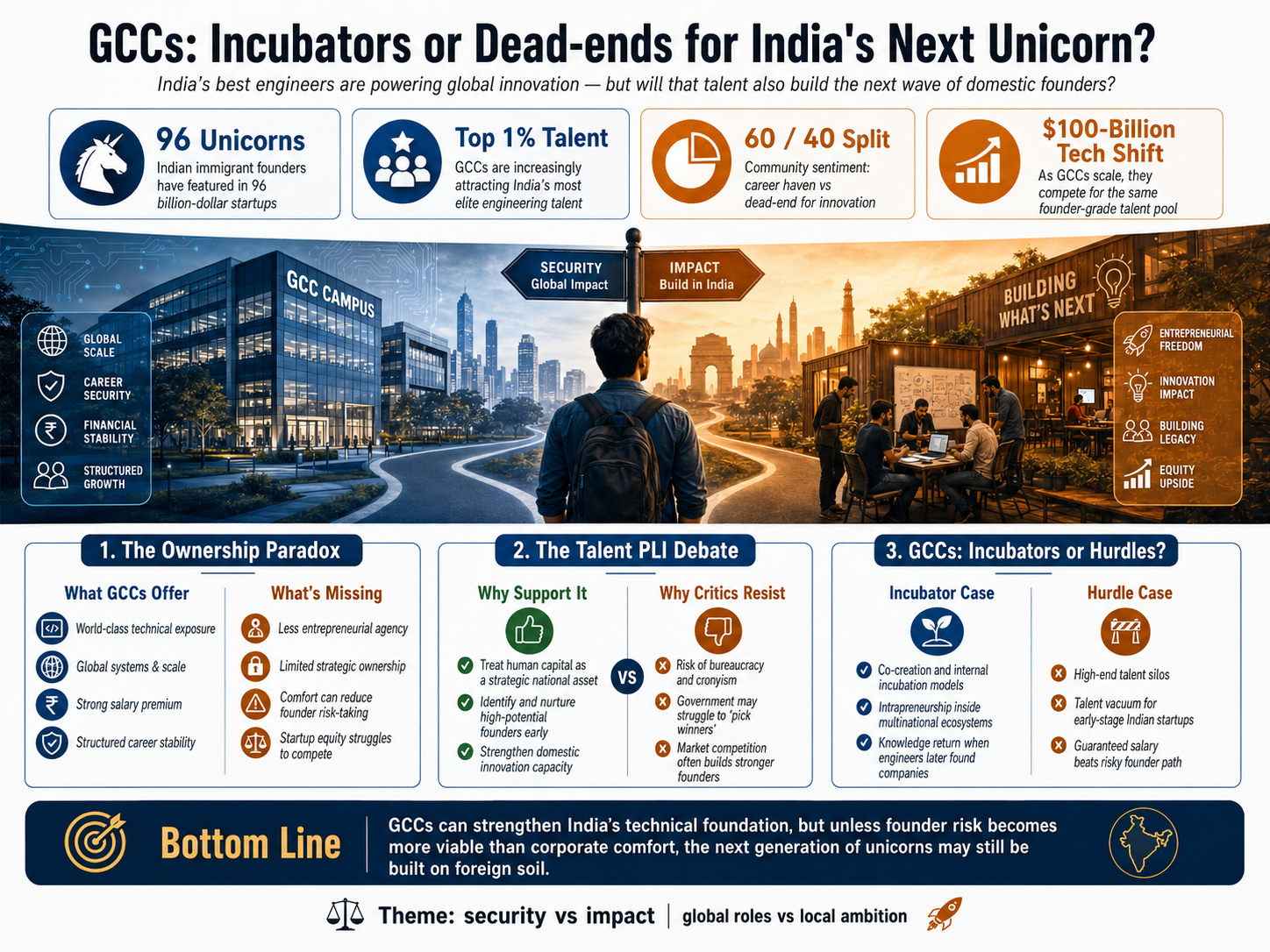
As Indian-born founders continue to command the global unicorn landscape—with data showing 96 billion-dollar startups featuring at least one Indian immigrant founder—India faces an existential economic question. For decades, the country has served as the world’s back office; today, it is the world’s R&D hub. But as Global Capability Centers (GCCs) tighten their grip on the top 1% of Indian engineering talent, we are left wondering: are these centers building a pipeline for future domestic innovation, or are they effectively institutionalizing a ceiling for India’s next generation of founders?
The Ownership Paradox: Global Roles vs. Local Ambition
There is a palpable "Ownership Paradox" emerging within the glass-walled offices of Bengaluru and Hyderabad. Engineers at GCCs are frequently tasked with architecting complex global systems for Fortune 500 giants, gaining world-class technical exposure that is arguably unmatched by early-stage domestic firms. However, this technical mastery rarely translates into strategic decision-making agency. While the work is high-impact, it is rarely entrepreneurial.
"Indian immigrants founded more US unicorns than any other nationality. It raises the question: why are we celebrating the export of our most innovative minds while our domestic ecosystem struggles to match the security of these MNC roles?" — u/TechAnalystInd, r/IndiaTech
This creates a clear "Talent Arbitrage" shift. GCCs are no longer just seeking cost-efficiency; they are securing "formed" talent—experienced engineers who are already battle-tested. This salary-premium, often backed by the stability of global balance sheets, makes it increasingly difficult for local startups to compete. When a fresh engineering graduate is offered a base salary at a GCC that dwarfs the total cost-to-company (CTC) plus equity package of a seed-stage startup, the risk-reward ratio for entrepreneurship becomes mathematically prohibitive.
The Talent PLI Debate: Market Meritocracy or Bureaucratic Trap?
As the Indian government contemplates a potential "PLI for Talent" (Production Linked Incentive for human capital), the debate is fierce. The existing "Startup India" initiative has successfully provided a broad-based safety net, but critics argue it lacks the surgical precision required to identify and foster high-potential "unicorn-grade" innovators.
"A national mission to identify, fund, mentor and fast-track exceptional talent before the rest of the world does seems like a pipe dream. Can we really expect a bureaucratic layer to be better at 'discovering' talent than the market itself?" — u/VentureVault, r/IndiaInvestments
Proponents of a Talent PLI suggest that India must stop treating human capital as a commodity and start treating it as a strategic national asset. The concern, however, remains the risk of cronyism. If the government picks winners, does it stifle the very meritocratic competition that breeds resilience in founders? Moreover, skeptics point out that the "brain drain" is not merely about capital; it is a symptom of internal institutional biases that favor pedigree over raw grit—barriers that a government policy may never truly dismantle.
GCCs: The New Incubators or Competitive Hurdles?
The narrative that GCCs are purely obstructive is being challenged by a new wave of "co-creation" models. Some of the largest multinational entities in India are now actively running internal incubation programs, effectively spinning off ventures or investing in their own employees’ ideas. This shift aims to keep the "intrapreneurial" spirit alive within the walls of the GCC.
However, for the broader startup ecosystem, the impact remains a double-edged sword. While some GCCs provide a "knowledge return" loop—where engineers eventually leave with specialized skills to start their own ventures—many others function as high-end silos. The $100-billion tech shift currently underway confirms that as GCCs scale, they consume the same talent pool that domestic founders rely on to survive.
Engagement Snapshot: The Sentiment
- Community Consensus: Users on major tech forums are split 60/40 between viewing GCCs as a "career haven" versus a "dead-end for innovation."
- Key Friction Point: The massive gap between "guaranteed MNC salary" and "startup equity risk" is cited as the #1 barrier to founder motivation.
- Emerging Trend: Increasing support for "Return to Roots" policies, where experienced expats provide mentorship to domestic incubators.
Bottom Line
Is the path to the next Indian unicorn paved by government intervention, or must we rely on the organic churn of the market? The reality is likely a mix of both. GCCs provide the technical foundation that India needs to scale, but they must evolve from being mere "talent vacuums" into true partners of the domestic ecosystem. If India cannot create a financial and cultural environment where the risk of starting a company is lower than the comfort of a comfortable corporate role, the next generation of founders will continue to build their empires on foreign soil.