Beyond the 10 Trillion Yen Goal: Assessing the Reality of Doubling Japanese Business in India
As Prime Minister Sanae Takaichi and Narendra Modi unveil a landmark 16-agreement pact, the promise of a ¥10 trillion investment looms large. We analyze whether the structural shifts in AI, defense, and manufacturing are enough to overcome persistent regulatory hurdles and finally bridge the gap between diplomatic ambition and corporate reality.

Photo by Pramod Tiwari on Pexels
Beyond the 10 Trillion Yen Goal: Assessing the Reality of Doubling Japanese Business in India
As Prime Minister Sanae Takaichi and Narendra Modi unveil a landmark 16-agreement pact at Hyderabad House, the promise of a ¥10 trillion investment looms large over the Indo-Pacific landscape. While diplomatic warmth is at an all-time high, the core challenge remains: can this ambitious target survive the friction of India’s regulatory landscape and the inherent risk-aversion of Japan’s corporate giants?
The Strategic Pivot: From Buyer-Seller to Industrial Alliance
The most significant departure from previous summits is the shift from procurement to genuine co-development. The announcement of the first joint defence project—centered on Naval Radio Antenna technology—marks a transition from a buyer-seller relationship to a true industrial alliance. By marrying Japanese hardware precision with India’s burgeoning software stack, both nations are attempting to build a buffer against supply chain volatility.
""List of outcomes (16 in total) : Meeting between PM @narendramodi and PM @takaichi_sanae of Japan on her Official Visit to India ⬇️ 🇮🇳 🇯🇵 https://t.co/jgxHibuxVW" — @MEAIndia
The ¥10 Trillion Question: Feasibility vs. Ambition
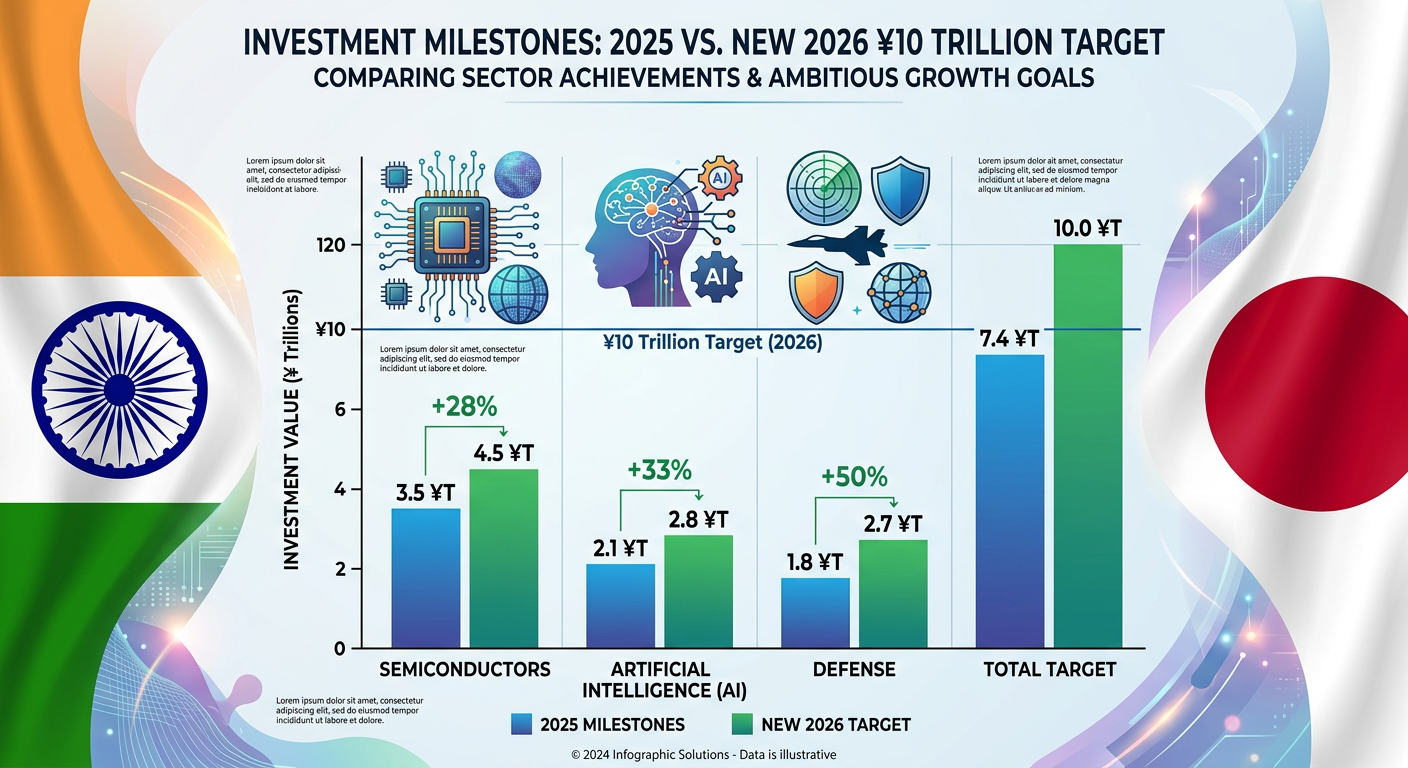
Reaffirming the ¥10 trillion investment target requires more than just political will; it demands a radical recalibration of how Japanese SMEs view the Indian market. The recent depreciation of the Japanese yen has made outbound capital expenditure significantly more expensive, creating a headwind for the very companies needed to drive this growth. Furthermore, while the "Make in India" narrative is compelling, Japanese firms often cite bureaucratic inertia and complex compliance hurdles as reasons for their measured pace.
Beyond Automobiles: New Frontiers in AI and Critical Minerals
The partnership is moving well beyond the automotive dominance of Suzuki and Toyota. A key focus area is the integration of Japanese monozukuri—the art of precision manufacturing—with Indian AI-driven software stacks to accelerate pharmaceutical R&D timelines. Additionally, the new frameworks for critical mineral supply chain security suggest that both Tokyo and New Delhi are moving to de-risk their dependencies on regional rivals.
""India, Japan sign pacts on AI, metals, and energy after Modi-Takaichi talks https://t.co/0KocWJYU9H" — @ReutersAsia
Navigating the Regulatory Landscape: A Reality Check
Despite the optimism, structural barriers persist. Investors are watching closely to see if the new financial services agreement acts as a genuine catalyst for de-risking or merely as another layer of administrative overhead. While defense cooperation is a massive milestone, critics argue that the geographic and strategic distance between the two nations may limit the real-world utility of a military pact, potentially inviting regional instability by signaling a more aggressive stance in the Indo-Pacific.
The Bottom Line
The India-Japan partnership has clearly entered a new phase of industrial maturity. However, the path to doubling Japanese business presence requires more than just MoUs; it requires a sustained, multi-year effort to harmonize India's regulatory environment with the high-trust, high-precision requirements of Japanese corporate culture. If these 16 agreements can clear the hurdle of implementation, they will redefine the technological backbone of the region.