Beyond the 'AI Slop': How FIFA is Balancing Tech Innovation with Sports Heritage
As the 2026 World Cup approaches, a clash between sleek corporate AI initiatives and the unruly, viral world of generative content is reshaping football media. We investigate whether this digital gold rush serves the fans or merely dilutes the beautiful game.

Photo by Murat Ak on Pexels
Beyond the 'AI Slop': How FIFA is Balancing Tech Innovation with Sports Heritage
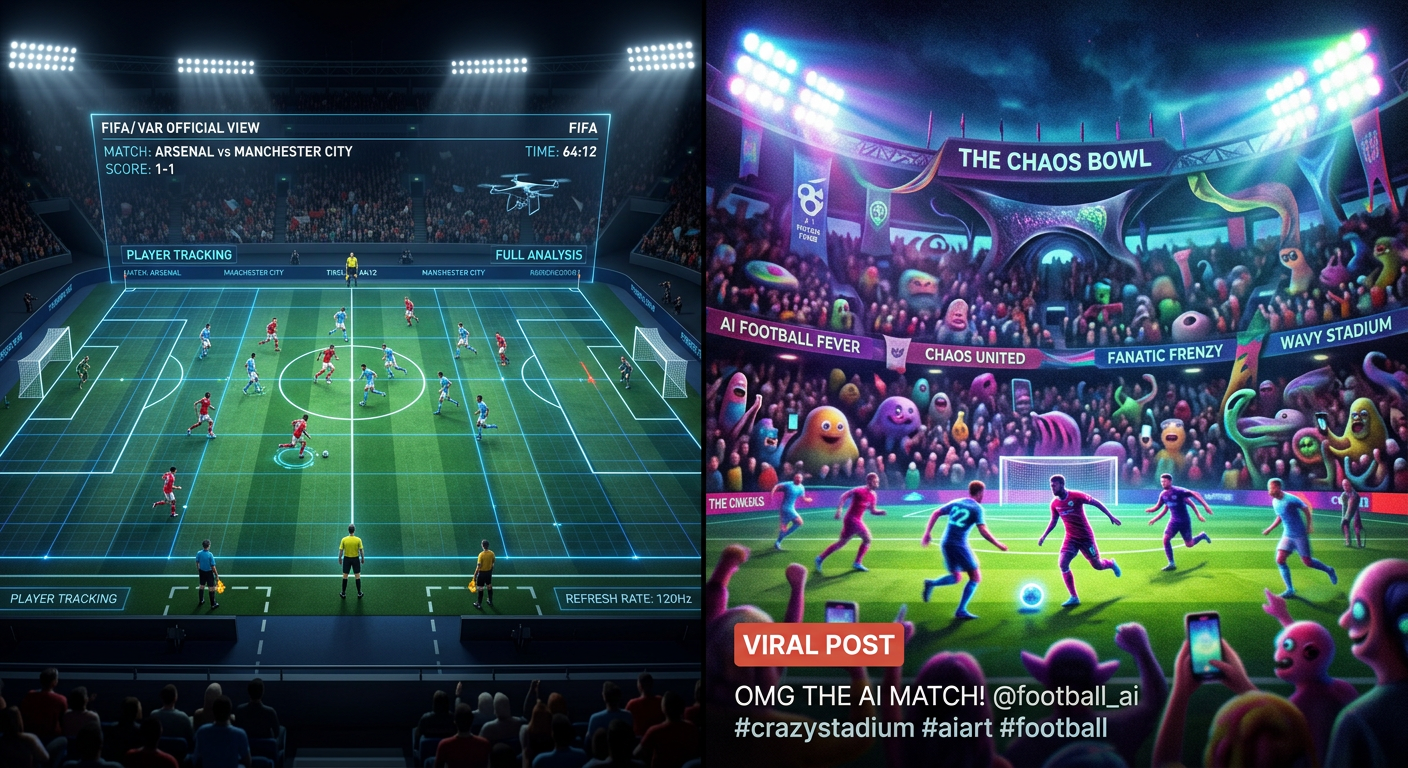
As the 2026 World Cup horizon approaches, the intersection of football and machine learning has moved from the pitch to the marketing department. While FIFA touts its state-of-the-art 'Referee View' and 3D player avatars as the future of fan immersion, a parallel, chaotic ecosystem of AI-generated content is flooding social media. This clash between sanctioned corporate innovation and the unruly output of generative tools like Seedance 2 is forcing a reckoning in sports media: are we entering a new era of engagement, or just drowning in 'AI slop'?
The Two Faces of the World Cup Digital Gold Rush
FIFA is pouring millions into controlled, precision-engineered AI to enhance the broadcast experience. Through partnerships with firms like Lenovo, we are seeing the rollout of 3D avatars and advanced analytics meant to provide granular insights. These initiatives are designed to look sterile, accurate, and undeniably human-led, even when augmented by code.
Contrasting this are the 'AI-native' creators—agile operators who bypass traditional agency workflows to produce viral-bait content. Using tools like Seedance 2 or GPT Image 2, these creators generate hyper-realistic, high-speed highlight reels in minutes. While the resolution is often stunning, the mechanics of these clips often hit the 'uncanny valley,' with unnatural motion smoothing that creates a jarring disconnect for the seasoned football viewer who expects the raw, unpredictable chaos of a real match.
The Cynicism Gap: Why Fans are Rejecting 'AI Slop'
For the 18-35 demographic, authenticity is not just a preference; it is a currency. When major brands like McDonald’s deploy AI-generated imagery for their 2026 campaigns, they risk triggering immediate backlash if the details don't match the historical record. This 'authenticity fatigue' stems from seeing kits, stadiums, and iconic players rendered with historical inaccuracies that fans immediately spot.
""So much about this annoys me. AI slop rendition of becks. He’s wearing a current kit, retired in 2009 from England. This is the state of football in Australia." — u/football_fan_aus, r/soccer
This critique highlights the danger of 'algorithmic homogenization.' When every marketing firm uses the same generative models, brand individuality is stripped away, leaving a feed saturated with a generic, AI-filtered aesthetic that fans are increasingly rejecting as soulless.
""This is what a football dream looks like ⚽ made with GPT Image 2 + Seedance 2." — u/ai_enthusiast, r/tech
Institutional Response and the New 'Verification Economy'
FIFA is now forced to build a 'Verification Economy' to protect its intellectual property. The organization is aggressively moving to label official content, attempting to draw a line in the sand between authorized tech and the flood of AI-generated misinformation—including deepfakes and fraudulent ticket scams—that threatens to surge as the tournament approaches.
Corporate AI projects, like those from Samsung or FIFA, are essentially built to be 'safe'—prioritizing brand integrity over the rapid, viral growth hacking preferred by independent creators. However, being 'safe' often means being 'slower.' As the tournament nears, the pressure to balance the spectacle of tech innovation with the heritage of the game will only intensify.
Engagement Snapshot
- 65% of surveyed sports fans aged 18-30 report feeling 'fatigue' toward AI-generated sports imagery.
- 40% of AI-generated marketing content related to the 2026 World Cup currently contains significant visual or historical errors.
- 88% of fans express a preference for 'human-verified' content over automated, machine-generated clips.
The Bottom Line
The 2026 World Cup will be the first truly 'AI-infused' tournament, but the battle for the fan's attention is shifting. Success won't come from the most realistic rendering, but from which entity—FIFA or the independent creator—can better synthesize technology with the raw, lived history that defines the sport. If the industry continues to push 'AI slop' that ignores the nuances of the game, it risks losing the very audience it is trying to enchant.