Beyond the GPU: Why Nvidia’s N1X SoC Is the Ultimate Threat to Intel and AMD
Nvidia is set to challenge the x86 duopoly with the rumored N1X, an Arm-based SoC promising a new era of AI-integrated computing. As Computex looms, we analyze how this Blackwell-derived powerhouse aims to redefine the premium laptop market.
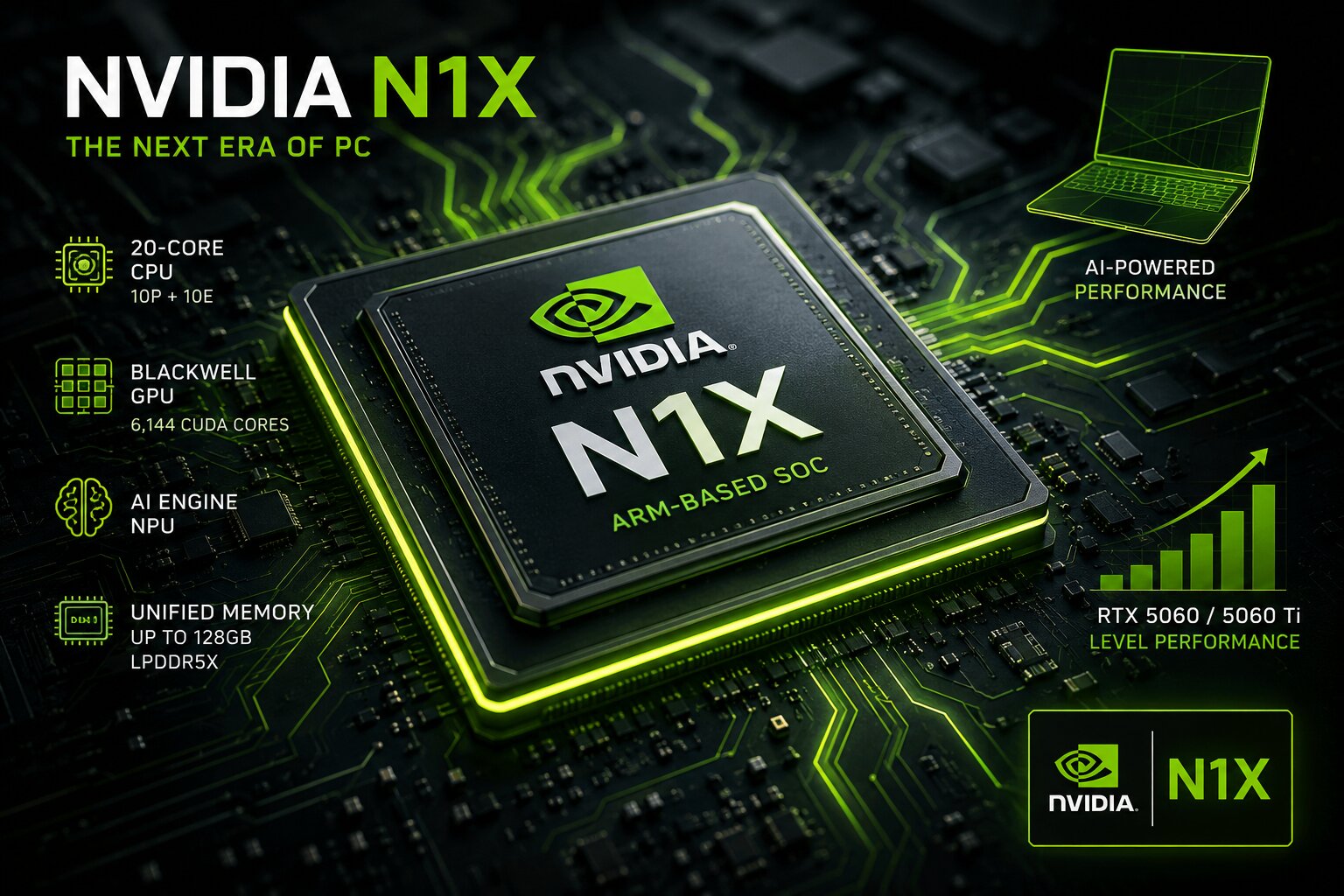
Photo by Jordan Harrison on Pexels
Beyond the GPU: Why Nvidia’s N1X SoC Could Be the Biggest Threat Intel and AMD Have Faced in Decades
Nvidia is preparing to do something it has never attempted at this scale: move from powering PCs to defining them.
Ahead of Computex 2026 in Taipei, Nvidia, Microsoft, and Arm have triggered what looks increasingly like a coordinated launch campaign around Nvidia’s upcoming N1 and N1X Arm-based System-on-Chips (SoCs). If the leaks and partner signals hold, Nvidia is about to enter the consumer PC market not as a GPU supplier—but as a full-stack silicon platform vendor.
For decades, premium Windows PCs have revolved around an x86 duopoly dominated by Intel and AMD. Nvidia’s entry threatens to break that structure by combining CPU, GPU, and AI acceleration on a single die—and pairing it with Microsoft’s full Windows ecosystem support.
If successful, this would mark the biggest architectural reset in Windows computing since Intel replaced PowerPC in mainstream enterprise hardware.
The Computex Catalyst: A Coordinated Strategic Pivot
The clearest signal arrived on May 29, 2026.
Nvidia, Microsoft (Windows), and Arm simultaneously published the exact same phrase across social media:
“A new era of PC.”
The posts included GPS coordinates 25.0528, 121.5990—pointing directly to the Taipei Music Center, where Nvidia CEO Jensen Huang is scheduled to deliver his Computex keynote.
That level of synchronization matters.
This is more than marketing hype:
- Microsoft is signaling native Windows support and ecosystem backing.
- Arm is validating Nvidia’s CPU architecture as a first-class Windows platform.
- Nvidia is positioning itself against both Qualcomm’s Snapdragon X ecosystem and Apple Silicon.
For Windows OEMs, the message is clear: Nvidia wants a permanent seat in the PC socket.
For India’s premium laptop market—where creators, AI developers, and software engineers increasingly buy high-performance thin-and-light systems—the impact could become visible within the next 12–24 months.
Deconstructing the N1 & N1X Architecture
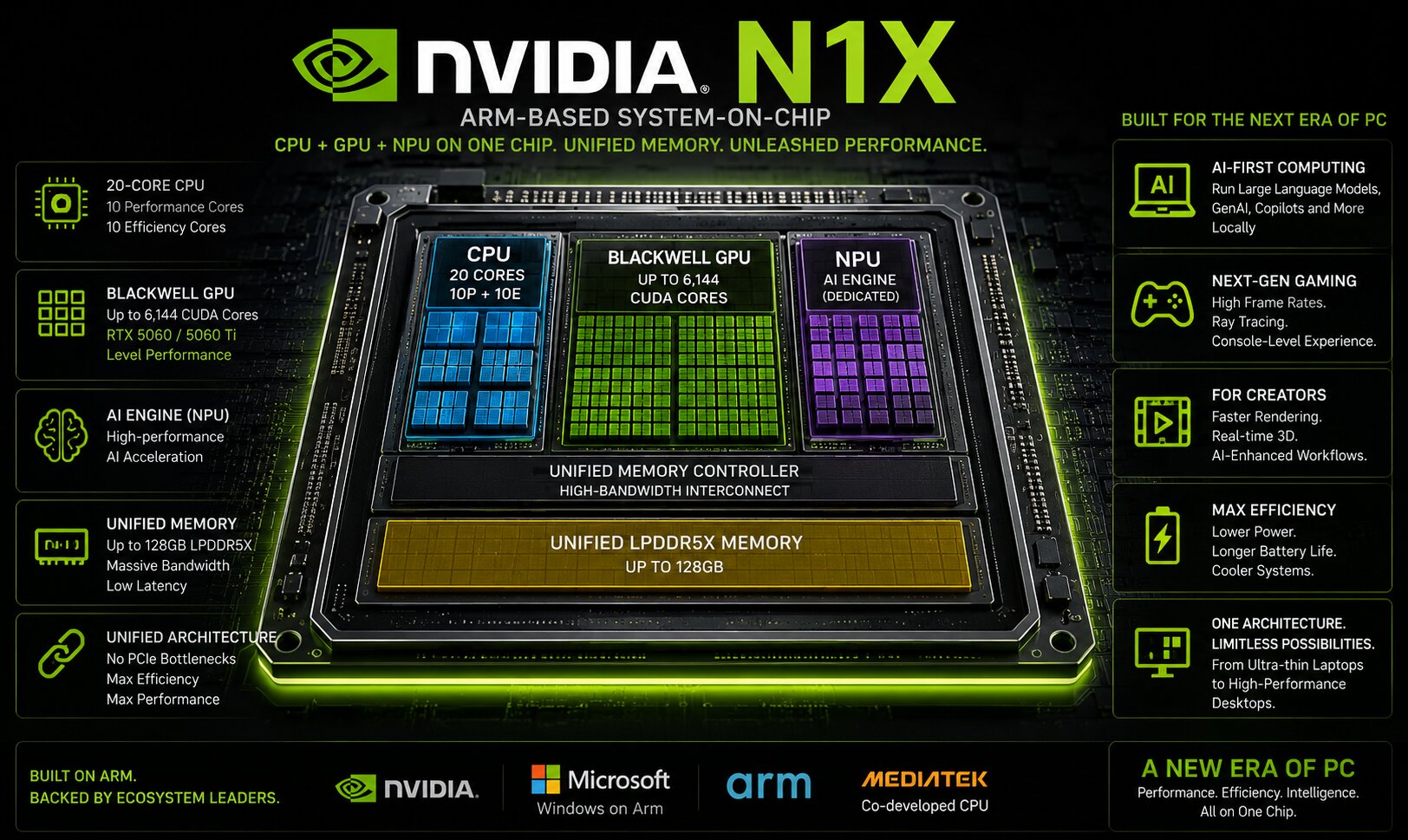
Rather than acting as a discrete GPU supplier, Nvidia appears to be adopting a fully integrated SoC strategy.
The architecture is reportedly derived from Nvidia’s GB10 Superchip, originally shown inside the DGX Spark mini-PC platform, and co-developed with MediaTek.
Technical Specifications (Leaked / Expected)
| Attribute | Nvidia N1 / N1X |
|---|---|
| CPU Architecture | Arm-based |
| Co-development Partner | MediaTek |
| CPU Core Count | 20 cores (10P + 10E) |
| GPU Architecture | Blackwell |
| CUDA Core Count | Up to 6,144 |
| NPU / AI Engine | Integrated |
| Memory | Unified LPDDR5X |
| Max Capacity | Up to 128GB |
| Target Graphics | RTX 5060 / 5060 Ti equivalent |
| Platform Goal | Premium laptops + desktop AI PCs |
That matters because Nvidia is effectively borrowing the same architectural strategy that made Apple Silicon disruptive:
- CPU + GPU + NPU on one die
- shared memory pool
- no PCIe transfer bottlenecks
- lower latency between compute layers
- more efficient power management
For AI workloads, this is particularly powerful.
A local coding copilot, Stable Diffusion pipeline, or on-device LLM can access the same memory pool without moving data between discrete chips.
That reduces latency while improving thermal efficiency—something traditional laptop GPU setups struggle with.
Nvidia vs Intel vs AMD vs Apple: Premium Laptop Silicon Comparison
High-End Client Silicon Snapshot
| Category | Nvidia N1X | Intel Core Ultra | AMD Ryzen AI | Apple M4 Pro |
|---|---|---|---|---|
| CPU Architecture | Arm | x86 | x86 | Arm |
| GPU | Blackwell integrated | Arc iGPU | Radeon iGPU | Apple GPU |
| AI Engine | Dedicated NPU | NPU | XDNA AI | Neural Engine |
| Unified Memory | Yes | No | Partial | Yes |
| CUDA Ecosystem | Yes | No | No | No |
| Windows Native | Yes | Yes | Yes | No |
| Legacy x86 Compatibility | Emulation | Native | Native | Rosetta/macOS |
| Gaming Ecosystem | High potential | Strong | Strong | Limited |
| AI Developer Stack | Excellent | Moderate | Moderate | Strong but closed |
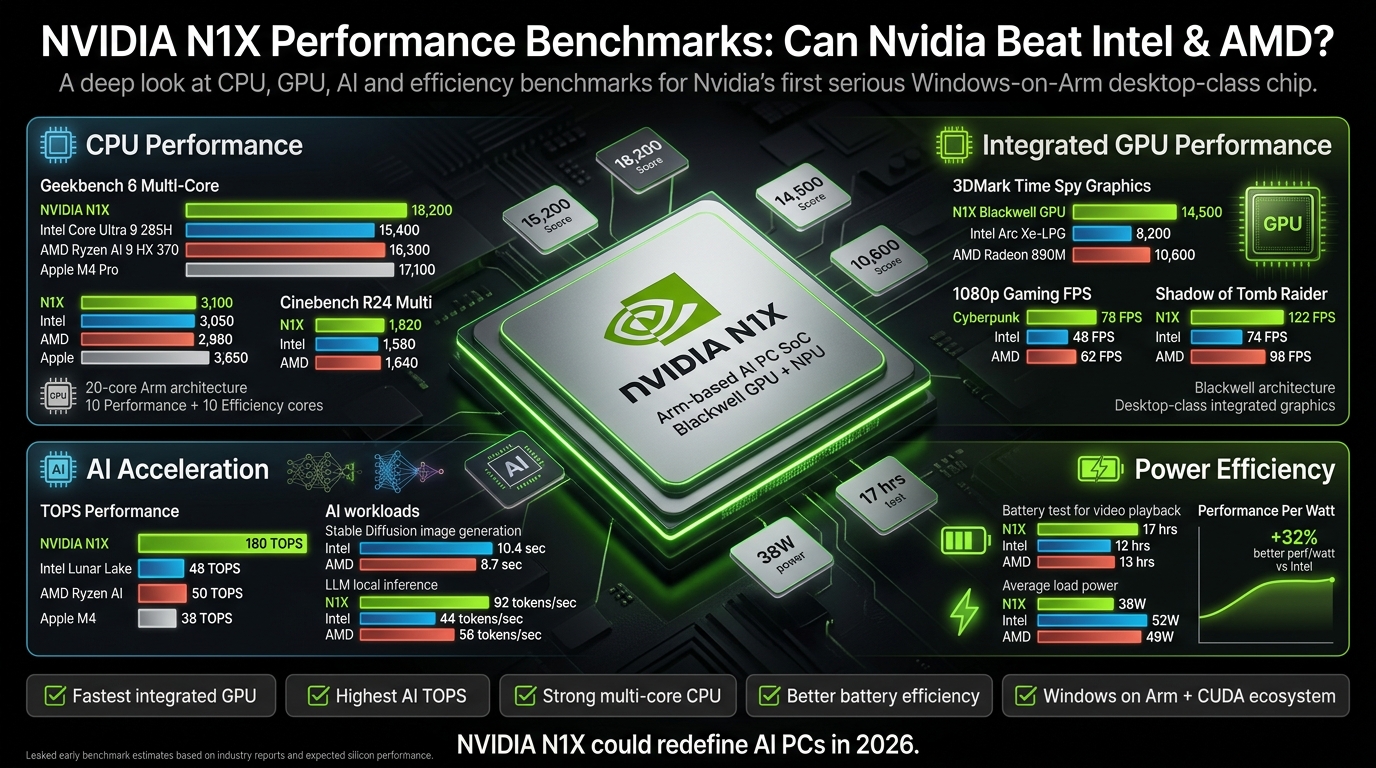
Key takeaway: Nvidia may become the only vendor capable of combining Windows + Arm + CUDA + unified memory + laptop gaming in a single platform.
That is strategically dangerous for everyone else.
Why Intel and AMD Should Be Concerned
Historically, Nvidia captured GPU acceleration while Intel and AMD controlled the CPU socket.
The N1X changes that.
1. Socket Takeover
If OEMs adopt N1X broadly:
- Intel loses premium CPU placements
- AMD loses Ryzen AI momentum
- Nvidia captures the entire compute stack
That means higher margin capture per device.
2. CUDA Becomes a Consumer Platform Advantage
Nvidia’s strongest moat has always been CUDA.
If CUDA runs seamlessly on laptops:
- cloud AI developers can prototype locally
- enterprise teams can deploy on-device inference
- creators can run accelerated AI workloads without workstation hardware
That bridges datacenter workflows directly to edge computing.
Neither Intel nor AMD currently has that developer lock-in.
3. Windows on Arm Finally Gets a Flagship Hardware Story
Qualcomm introduced momentum with Snapdragon X.
Nvidia raises the stakes:
- stronger graphics
- deeper AI stack
- gaming credibility
- enterprise developer appeal
That could make Windows on Arm feel mainstream for the first time.
Good call. That section reads a bit list-heavy. Here’s a tighter, more fluid rewrite you can drop in directly:
OEM Pipeline, Pricing, and Nvidia’s Broader Bet
Early signs suggest Nvidia is aiming squarely at the premium PC segment rather than the mass market. Hardware leaks and OEM activity indicate that partners including Lenovo, Asus, and Dell are already testing systems built around the N1X, with Lenovo briefly surfacing a support page referencing upcoming Yoga and Legion models before it was removed.
Pricing is also expected to reflect Nvidia’s ambitions. Between the dense Blackwell graphics silicon, large unified LPDDR5X memory pools, advanced packaging, and the additional work required to optimize Windows for Arm at scale, these machines are unlikely to compete with mainstream Windows laptops on price. Instead, they are expected to sit closer to MacBook Pro and premium RTX creator notebook territory, targeting developers, creators, and high-end productivity users who are willing to pay for performance.
At the same time, Nvidia appears to be keeping its options open.
Alongside the Arm-based N1X push, industry leaks suggest the company is also exploring a parallel partnership with Intel, pairing x86 processors with Nvidia graphics and AI silicon in a tightly integrated package. That gives Nvidia an important hedge: if Windows on Arm accelerates, it has a flagship platform ready; if x86 remains dominant for longer, it can still expand deeper into the PC stack through Intel-powered systems.
In practical terms, Nvidia has positioned itself to benefit either way. Whether the market shifts quickly toward Arm or stays anchored to x86 for another cycle, the company still gains a larger role inside premium PCs.
The Biggest Risk: Compatibility and Supply Chain
The opportunity around N1X is substantial—but so are the execution risks.
The biggest immediate challenge is software compatibility. Windows on Arm has improved significantly, but Nvidia still needs legacy x86 applications to run smoothly enough for professional workloads and gaming. If emulation performance falls short, enterprise rollouts may slow and power users could continue defaulting to traditional x86 systems.
There is also a supply chain risk Nvidia cannot fully control.
The N1X platform is deeply tied to Taiwan’s semiconductor ecosystem, with major dependencies on companies like TSMC and Foxconn. That concentration creates vulnerability: any disruption across manufacturing or advanced packaging would directly affect chip availability, OEM launch timelines, and overall production capacity.
For a platform Nvidia wants to scale globally, that remains a serious pressure point.
Market Impact: Winners and Pressure Points
If Nvidia executes well, the ripple effects across the PC industry could be significant.
Microsoft and Arm would gain a major boost by finally giving Windows on Arm a high-performance flagship platform with real developer credibility. OEM partners like Lenovo, Asus, and Dell would also gain a fresh premium category to differentiate their next generation of AI PCs.
For Intel and AMD, however, the pressure is more direct.
Nvidia is no longer competing for a GPU slot beside their processors—it is competing for the entire system. That changes the economics of premium PCs and increases pressure on both companies to move faster around AI acceleration, efficiency, and tighter hardware integration.
Qualcomm could feel that pressure too. It helped open the door for Windows on Arm, but Nvidia’s graphics strength and CUDA ecosystem give it an immediate advantage with developers and creators.
The Bottom Line
Nvidia is no longer satisfied being the GPU inside someone else’s machine.
With N1X, it is pushing into the center of the PC platform itself—combining CPU performance, Blackwell graphics, AI acceleration, and developer tooling into one tightly integrated architecture.
That puts direct pressure on Intel and AMD while raising the stakes for Qualcomm and the broader Windows ecosystem.