Beyond the Headlines: What the Tata-ASML Deal Actually Changes for India's Fab Ambitions
Tata Electronics has announced a landmark partnership with ASML, the Dutch titan of semiconductor equipment. But beneath the geopolitical fanfare, what does this actually mean for India's ability to produce cutting-edge chips, and does it move the needle on technology transfer?

Beyond the Headlines: What the Tata-ASML Deal Actually Changes for India's Fab Ambitions
When the news broke that Tata Electronics had inked a strategic partnership with Dutch semiconductor titan ASML, the reaction was immediate and polarized. On one side, a celebration of India’s growing footprint in the global silicon race; on the other, a cautious skepticism regarding the actual depth of this collaboration. As India pivots from being a consumer of technology to a manufacturer, the ASML deal is being positioned as a cornerstone. But in the world of nanometer-scale fabrication, the difference between a 'deal' and 'capability' is measured in light, wavelength, and years of engineering experience.
The Anatomy of the Deal: Equipment vs. Technology Transfer
It is vital to distinguish between a service-level agreement and a genuine transfer of intellectual property (IP). ASML is not a foundry; it is the manufacturer of the world's most complex lithography machines. The current partnership, while significant, is primarily framed as an equipment and support procurement pipeline rather than a research-sharing pact.
Industry analysts note that Tata Electronics is essentially securing a seat at the table with the world’s most crucial hardware supplier. This does not mean Tata is suddenly absorbing the decades of R&D that keep ASML in a league of its own. It is a commercial arrangement to ensure that when the Dholera and other fab projects go live, they are equipped with the industry-standard tooling required to achieve yield efficiency—the percentage of functional chips on a wafer.
"Those who know ASML would realise how big of a deal this can be. ASML has the monopoly over EUV lithography in the entire world. They are the only company which makes these machines which are needed for miniaturization of chips. If Tata can get hold of these machines we can become the next Taiwan." — u/RedditUser1, r/India
Lithography 101: Why ASML is the Industry Gatekeeper
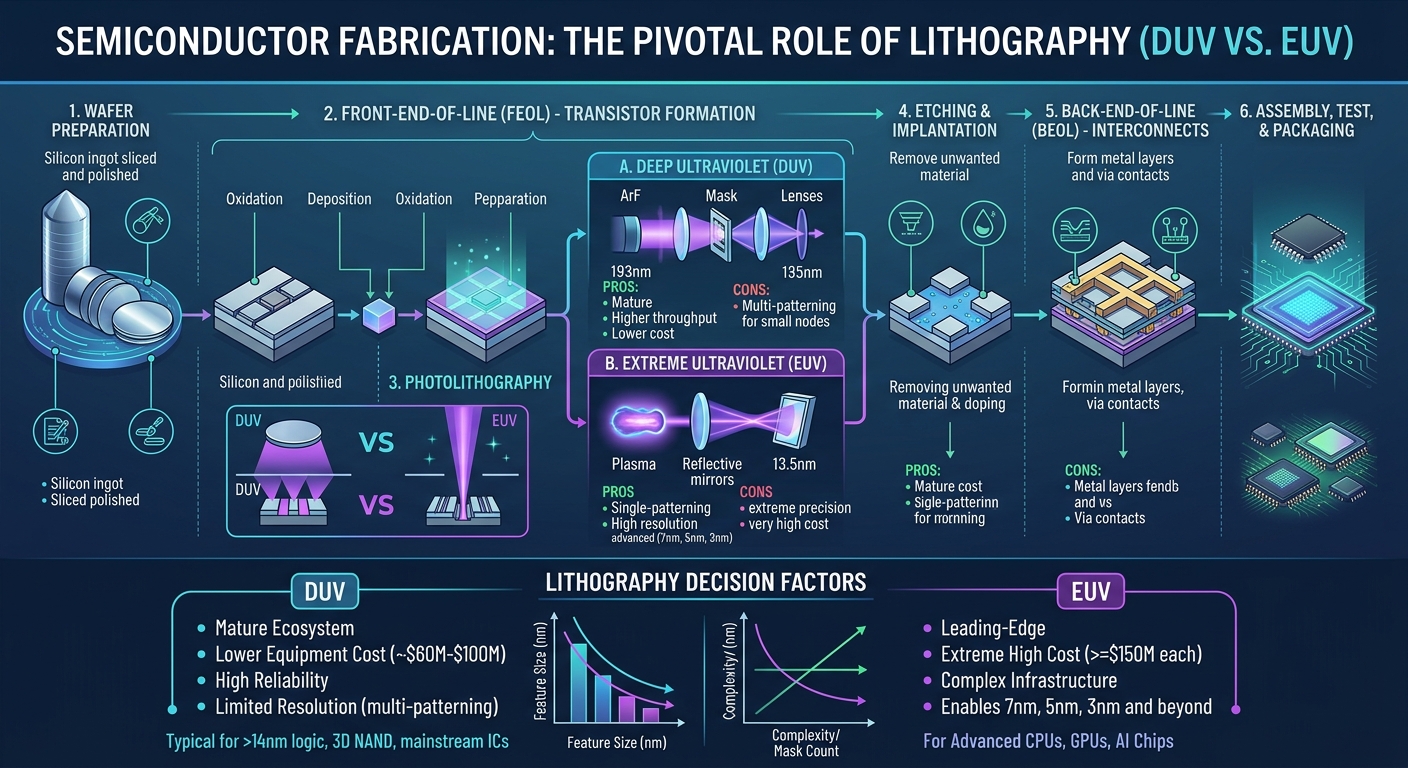
To understand the gravity of this, one must understand the lithography hierarchy. Lithography is essentially the 'printing' process of chip manufacturing. ASML sits at the apex, producing both Deep Ultraviolet (DUV) and the elusive Extreme Ultraviolet (EUV) systems. While DUV is used for mature nodes (the chips in your car or household appliances), EUV is the gatekeeper for the bleeding-edge, 3nm and 2nm chips powering the latest AI accelerators and smartphones.
Currently, India’s roadmap is focused on establishing a sustainable manufacturing base. Most experts suggest that the initial hardware moving into Indian facilities will likely be advanced DUV systems. Achieving the leap to EUV requires not just the machine—which can cost upwards of $200 million per unit—but a massive, highly specialized ecosystem to support the extreme precision required for sub-7nm fabrication.
Geopolitics, State Intervention, and Market Reality
The narrative that this deal was born solely from high-level diplomacy ignores the pragmatic reality of the semiconductor market. ASML operates under strict export controls, including the Wassenaar Arrangement, which dictates what technology can be shipped to which nations. The Indian government’s diplomatic efforts have undoubtedly cleared the runway, but the flight is being piloted by Tata’s capital and operational mandate.
"This isn't because the Indian PM visited. You don't need a PM to make such deals. Tata has a fab and ASML will sell their lithography tools to them. FYI, ASML was eager to sell its bleeding-edge machines to even the Chinese despite the constant pressure from the EU and USA." — u/IndustryWatcher, r/IndiaSpeaks
There is a healthy tension between those who see this as a state-driven triumph and those who view it as a necessary commercial pivot by the Tata Group. The reality is that both are correct. Without the government’s Production Linked Incentive (PLI) schemes and diplomatic legwork, the commercial viability of building a fab in India would be significantly lower. Conversely, without Tata’s massive capital commitment, ASML would have little incentive to prioritize support for an emerging market player.
Engagement Snapshot
The sentiment across Reddit and tech forums remains cautiously optimistic. Discussions on r/India and r/IndiaSpeaks indicate a 70/30 split between excitement over 'Made in India' silicon and skepticism regarding the timeline for reaching production-grade output.
The Bottom Line
Does this deal move the needle? Absolutely. Securing a partnership with ASML is a prerequisite for any nation wishing to join the global semiconductor value chain. However, it is the first step of a marathon. Tata Electronics now faces the challenge of integrating these machines into a domestic ecosystem that is still finding its footing. The true test will not be the arrival of the first machine, but the successful, high-volume production of the first commercially viable, advanced-node semiconductor on Indian soil.