Beyond the Viral Clips: The Legal Reality of Perjury in False Harassment Cases
Viral podcast admissions and high-profile acquittals have ignited a fierce debate over the weaponization of gender-centric laws in India. We deep dive into the legal mechanisms for prosecuting false accusers and why the judiciary remains deeply hesitant to enforce them.

Photo by Nahmad Hassan on Pexels
Beyond the Viral Clips: The Legal Reality of Perjury in False Harassment Cases
In the digital age, the courtroom of public opinion often moves faster than the halls of justice. Recently, a series of viral podcast admissions—where individuals have openly recounted orchestrating false harassment claims—has collided with the cold, deliberate pace of the Indian judiciary. These moments of digital transparency have fueled a fierce national debate: is India’s legal framework for sexual violence being weaponized, and why does the law seem so paralyzed when it comes to holding false accusers accountable?
The Viral Catalyst: When Social Media Confessions Meet the Courtroom
The phenomenon of the "viral confession" has created a unique tension in the legal landscape. When a podcast guest casually admits to fabricating a charge, the internet erupts, yet the courtroom remains largely indifferent. This is the "Viral-to-Court" paradox. To a judge, a social media clip is hearsay, often lacking the context of cross-examination and the rigorous authentication required under the Indian Evidence Act.
Online, the sentiment is one of profound frustration. On forums like Reddit, the consensus often leans toward a feeling of total impunity for complainants, regardless of the veracity of their claims.
Anatomy of a False Case: Section 182 and 211 IPC
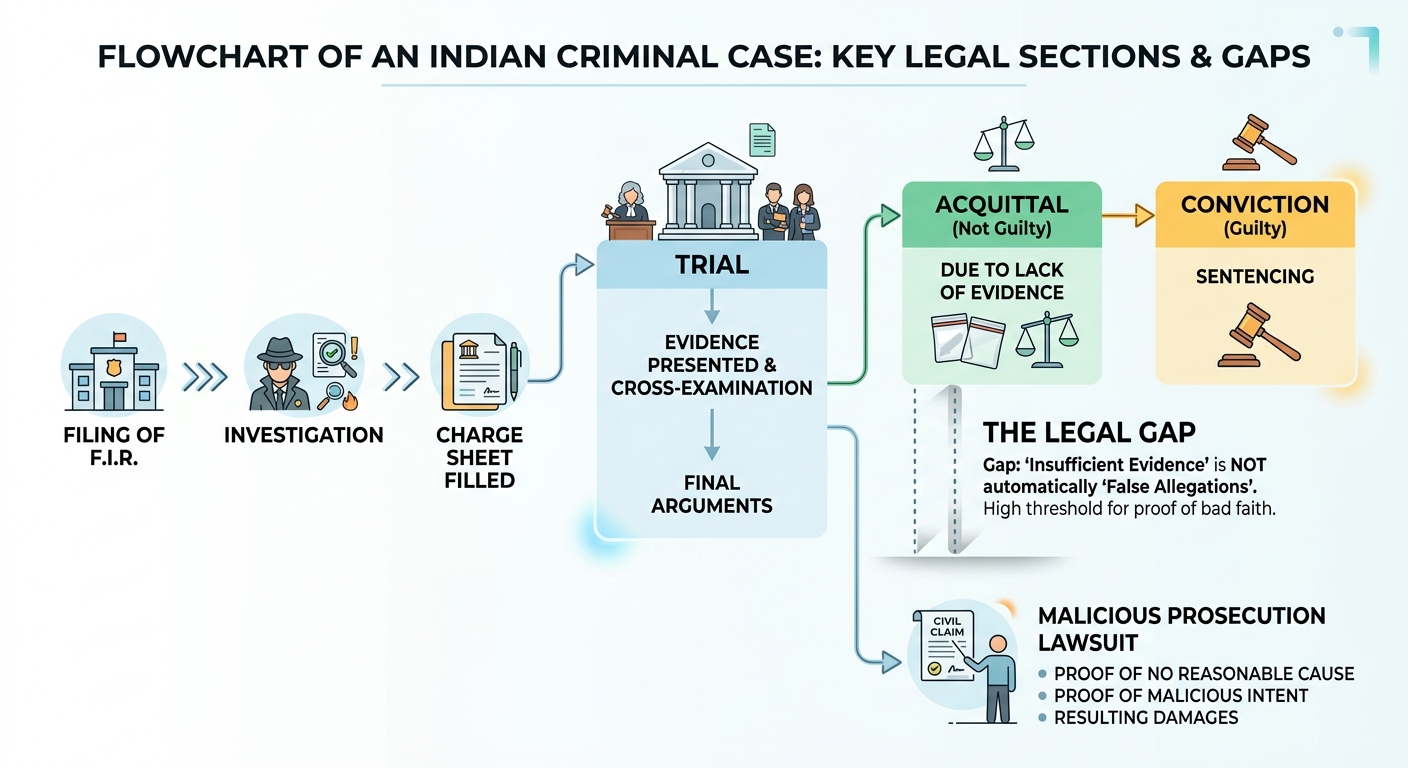
Legally, the threshold for prosecuting a false accuser is remarkably high. Under Section 211 of the Indian Penal Code (IPC), one can be prosecuted for "false charge of offence made with intent to injure," and Section 182 covers providing false information to a public servant. However, there is a fundamental legal chasm between an acquittal due to "lack of evidence" and a proven "malicious prosecution."
For a case to qualify as malicious, the defense must prove that the complainant initiated the proceedings with the specific knowledge that they were baseless and with the malicious intent to cause harm. Most acquittals in India are the result of insufficient evidence or the "benefit of the doubt," which does not automatically trigger perjury proceedings. Furthermore, as India transitions from the IPC to the Bharatiya Nyaya Sanhita (BNS), lawyers are bracing for a period of procedural uncertainty, as the application of these new statutes to pending perjury litigation remains untested.
The 'NGO Effect' and Litigation Entrepreneurs
Beyond individual actors, a more systemic concern has emerged: the role of "litigation entrepreneurs." Recent judicial interventions have begun to pull the curtain back on NGOs that may be overstepping their role as advocates.
In a landmark case in Jammu, a man was acquitted after spending 19 months in jail for a rape charge that was found to be entirely fabricated. The court went a step further, ordering an investigation not just into the complainant, but into the specific NGO that facilitated the filing.
"Niece Files False Rape Case Against Her Uncle, Landing Him In Jail For 19 Months. Jammu Court Acquits Him Citing Absence Of IOTA of Evidence, Orders Action Against IO, SHO and Complainant U/S 182 IPC, Also Orders Enquiry Into Role of a Women's NGO That Helped The Woman" — u/NewsBot, r/LegalAdviceIndia
The Judicial Hesitancy: Protecting Victims vs. Punishing Lies
The judiciary's reluctance to punish complainants is rooted in a fundamental fear: the chilling effect. Courts worry that by criminalizing "false" accusations, they may deter genuine victims—who already face immense societal stigma and low conviction rates—from approaching the police.
Statistics show that while the public perception of "rampant" false cases is high, the actual conviction rate for sexual violence cases in India remains significantly low, often hovering in the 20-30% range. Critics of this judicial leniency argue that by refusing to prosecute known perjurers, the system devalues the testimony of actual victims. Conversely, reformers argue that the solution is not to make it easier to prosecute complainants, but to fix the investigative deficiencies that allow baseless cases to reach the trial stage in the first place.
The Bottom Line
The friction between viral confessions and legal reality highlights a broken bridge in the Indian justice system. While the law must remain protective of the vulnerable, it cannot exist in a vacuum that ignores the demonstrable harm of malicious litigation. Until the courts create a clear, streamlined path for prosecuting proven perjury without discouraging legitimate claims, the digital discourse will continue to thrive in an environment of cynicism and deep distrust of the legal status quo.