Can You Retrofit for E20? Fact-Checking Additives and Myths for Older Vehicles
With the government labeling E20 ethanol-blended fuel an 'experimental' rollout, owners of older vehicles are left questioning the integrity of their fuel systems. We break down the technical reality of engine compatibility, the limitations of additives, and what you can actually do to protect your engine.

Photo by Fahad Puthawala on Pexels
Can You Retrofit for E20? Fact-Checking Additives and Myths for Older Vehicles
With the Indian government officially labeling the rollout of E20 (20% ethanol-blended) fuel as an 'experimental' initiative to be assessed next year, millions of vehicle owners are caught in a crossfire of policy and mechanics. As E20 becomes the new standard at pumps nationwide, owners of pre-2023 vehicles are increasingly vocal about the lack of long-term validation. The primary question shifting from policy debate to garage floors: Is your car safe, and can you truly 'retrofit' it for the new blend?
The E20 Reality: Why Your Older Vehicle Is at Risk
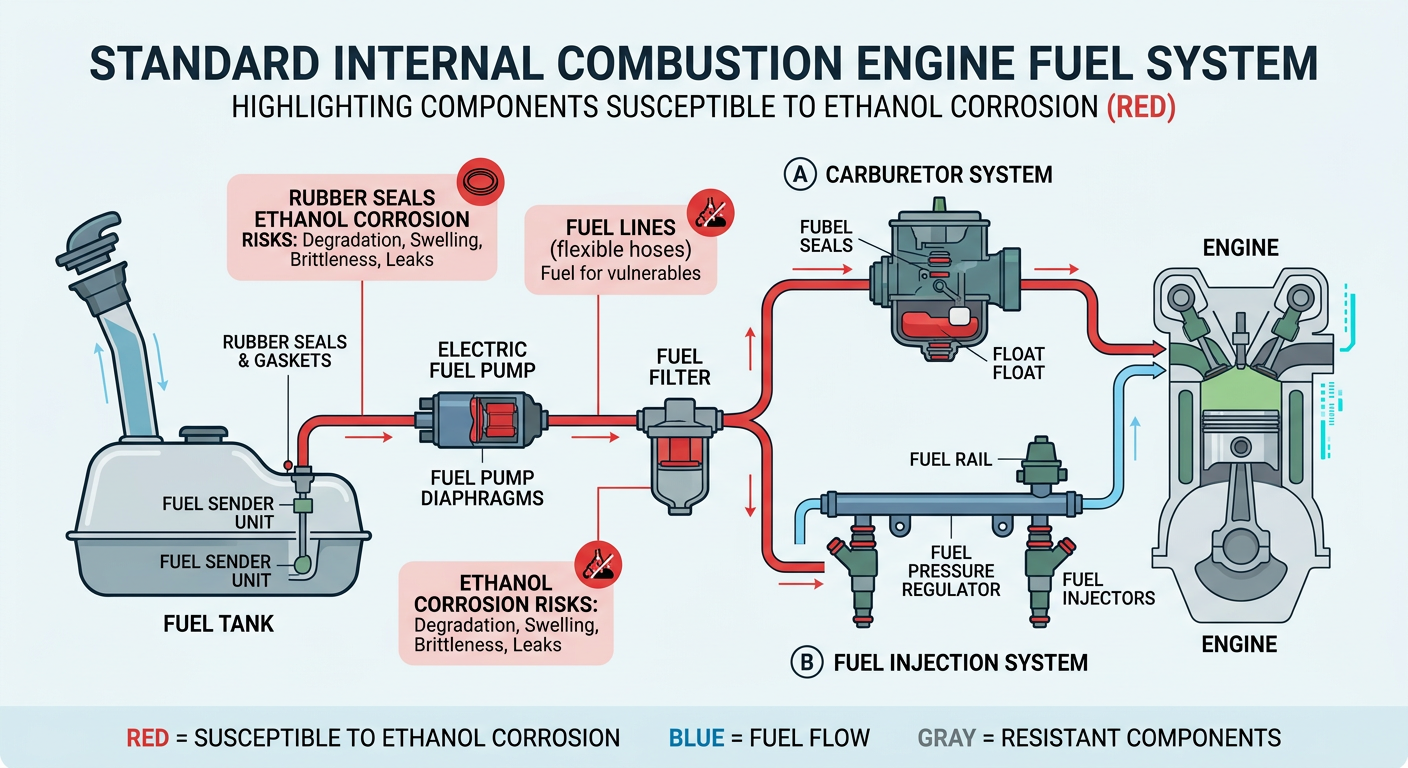
For the average consumer, the shift to E20 is not merely a change in fuel composition; it is a fundamental shift in the chemistry their engine was designed to handle. Ethanol is a solvent, and in concentrations of 20%, it is significantly more corrosive than the traditional E5 or E10 blends. In vehicles manufactured prior to 2023, components not specifically engineered with fluorocarbon elastomers or ethanol-resistant polymers are susceptible to premature degradation.
This includes the swelling and eventual disintegration of rubber fuel lines, the accelerated corrosion of metal fuel tanks, and the potential for varnish buildup on fuel injectors. The government’s recent admission in a Supreme Court filing—that this is effectively a nationwide experiment—has left many feeling like involuntary test subjects. Without a phased transition period or a robust compensation framework, owners of older vehicles are left to gamble on the longevity of their fuel systems.
""My vehicle was designed for E5. Now I'm being forced to run E20 without any guidance on how to preserve my injectors or fuel pump. It’s an unconsented experiment on our wallets." — @AutoDiscontent, X
Retrofitting vs. Additives: Separating Fact from Fiction
In online forums and local workshops, a wave of misinformation suggests that fuel additives can 'convert' an engine to be E20-compliant. Let us be clear: no chemical additive can transform a non-compatible fuel system into one that is E20-ready. Fuel system cleaners may help mitigate some deposit buildup, but they cannot reverse the chemical degradation of rubber seals or the structural corrosion of internal fuel system parts.
If you own a pre-2023 vehicle, a true 'retrofit' requires a hardware overhaul, not a software patch or a bottle of additive. This involves replacing the fuel pump, fuel lines, gaskets, and seals with materials rated for high-ethanol tolerance. While this is technically possible, the cost-to-benefit ratio for an older car often makes it impractical. Relying on anecdotal DIY fixes in the face of these complex chemical reactions is a recipe for catastrophic engine failure.
Liability and the Path Forward for Consumers
As of today, there is no centralized compensation framework for vehicle owners who face mechanical damage due to E20 usage. The government’s status of the rollout as an 'experimental phase' complicates legal recourse under the Consumer Protection Act, 2019. While consumers can file complaints citing 'deficiency in service' or failure to provide accurate product usage warnings, the burden of proof rests heavily on the vehicle owner to link the fuel directly to the failure.
For now, the best defense is diligent documentation. Maintain detailed service records, keep receipts of fuel purchases, and monitor your fuel system components during routine maintenance. If you notice a persistent drop in mileage or engine performance, have your fuel system inspected by an authorized service center immediately. Do not ignore warning signs, as they could be the difference between a minor repair and a total engine replacement.
The Bottom Line
The reality is that E20 is here to stay, and the 'experimental' nature of the mandate places the risk squarely on the shoulders of the consumer. Additives are no substitute for engineering; if your vehicle was not built to handle higher ethanol percentages, treat your fuel system as a high-maintenance component. Keep a close watch on your fuel lines, report performance irregularities to your manufacturer, and push for greater transparency from regulatory bodies regarding the long-term impact of this fuel policy.