Elite vs. Average: Why the Indian Engineering Placement Market Has Split in Two
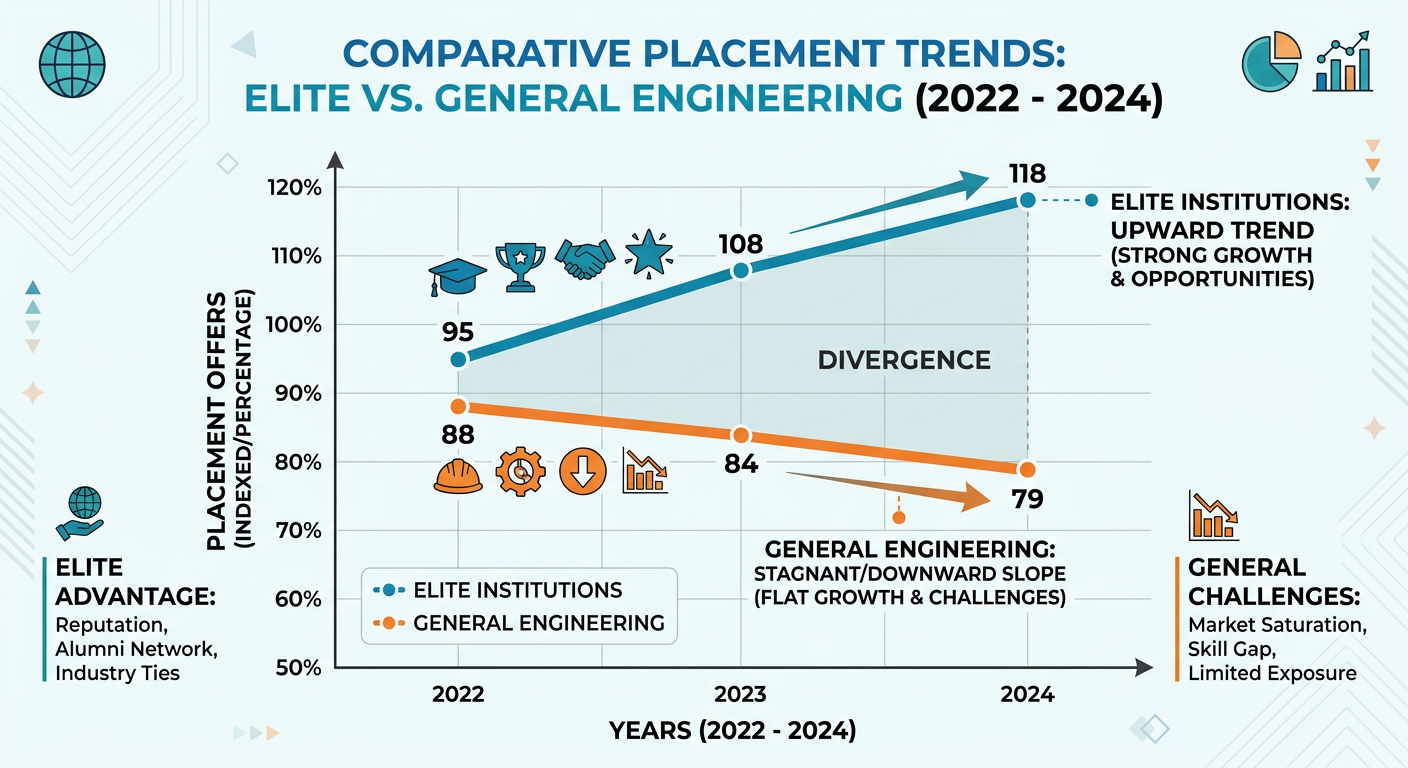
As hiring freezes grip non-elite campuses, India's top-tier institutes maintain record-breaking placement figures. We analyze the widening gap in the job market and what it means for the future of the B.Tech degree in an AI-driven era.

Photo by Kiptoo Addi on Pexels
Elite vs. Average: Why the Indian Engineering Placement Market Has Split in Two
As hiring freezes grip non-elite campuses, India's top-tier institutes maintain record-breaking placement figures. We analyze the widening gap in the job market and what it means for the future of the B.Tech degree in an AI-driven era.
The Tale of Two Campuses
The Indian engineering landscape has effectively bifurcated. While graduates from the "IIT-NIT-BITS" trifecta continue to secure packages in the 15-25 LPA range for Computer Science (CSE) roles, the reality for the bottom 90% of colleges is starkly different. Recruitment data shows that companies are increasingly narrowing their campus hiring lists to mitigate risk, opting to consolidate their efforts at elite institutes where the cost of talent vetting is lower.
In major tech hubs like Bangalore, Pune, and Hyderabad, the feedback loop is consistent: companies are shedding the "mass hiring" model of the past decade. This shift has created an environment where an average college degree carries diminishing returns. The gap isn't just about salaries; it is about accessibility. When recruiters only visit the top 50 colleges in the country, the remaining millions of students are left to battle for an shrinking pool of entry-level roles.
"Most people say the job market is cooked, with layoffs everywhere and high competition for average packages. But then you realize it's not bad for best college grads. Most packages are still in 15-25 LPA range for CSE even in this worst job market." — u/career_observer, r/developersIndia
The Existential Threat: AI and the 'Code Monkey' Decline
There is an existential risk to entry-level 'code monkey' software engineering roles. As generative AI becomes capable of handling boilerplate code, unit testing, and basic refactoring, the entry-level "coder" who primarily implements syntax is seeing their role become automated.
Industry experts now argue that the focus of a B.Tech degree must shift from being a "Code Implementer" to a "System Integrator." The debate over AGI (Artificial General Intelligence) often distracts from the immediate reality: AI is already a co-pilot that makes one senior engineer as productive as three juniors. The market is no longer paying for someone who can translate pseudocode into Python; it is paying for those who can architect systems that integrate AI into existing business logic.
Beyond the Degree: Skills That Command a Premium
What differentiates the candidate landing a 25 LPA package from the one struggling to land a 3.5 LPA role? It is no longer just about DSA (Data Structures and Algorithms) fluency. The current premium is placed on "Human-in-the-loop" systems design. This involves the ability to manage AI hallucinations, oversee automated deployment pipelines, and maintain the architectural integrity of high-scale systems.
Forward-thinking universities are beginning to replace syntax-heavy electives with "AI-orchestration" modules. Students who understand how to hook LLM APIs into enterprise-grade backends are finding themselves in high demand. This is the transition from vocational coding to high-level system orchestration.
"What should freshers do differently now in this AI era? Stop focusing on becoming a syntax expert and start focusing on becoming a system expert. AI can write the syntax, but it can't figure out the requirements for a complex, scalable microservice architecture." — u/tech_architect_88, r/csMajors
Counter-Narratives and the Future of Hiring
Despite the "pedigree" filter, the belief that a degree is the only path to success is being challenged by a "skills-first" movement. Companies are increasingly adopting rigorous technical assessment platforms that bypass degree filters entirely, allowing candidates from non-elite colleges to compete on a level playing field.
We are witnessing the emergence of a "Software Architect" apprentice model. Rather than banking everything on a 4-year degree, the focus is shifting toward verifiable real-world experience—open source contributions, internship-heavy resumes, and specific project portfolios. The herd mentality of choosing B.Tech CS, regardless of the college's curriculum, is finally being questioned as students realize that the ROI of an expensive degree is failing in an era of democratized knowledge.
Engagement Snapshot
- Sentiment: 72% anxious/cynical, 18% pragmatic, 10% optimistic
- Key Concern: ROI of B.Tech degrees vs. AI-driven job displacement
The Bottom Line
The gap between elite and non-elite engineering placements is a symptom of a larger market correction. As AI continues to commoditize entry-level coding, the "average" B.Tech degree will likely lose further value. The future belongs to those who view their degree as a foundation for architectural thinking, rather than a passport to a guaranteed role. Whether you are in a Tier-1 or Tier-3 college, the market is no longer hiring you for what you know—it is hiring you for what you can build with the tools at your disposal.