How Aarogya Setu 2.0 Aims to Build India's Digital Health Backbone
Transitioning from a pandemic-era contact tracing tool, the new Aarogya Setu 2.0 leverages Google's Gemma 4 and an open-source toolkit to digitize India's fragmented health data. We explore the implications of this pivot for privacy, utility, and the future of the ABHA ecosystem.

Photo by JW MEDICARE PVT LTD on Pexels
Aarogya Setu 2.0: How India Plans to Build a Unified Digital Health Record System
A Pandemic-Era App Gets a New Mission
Aarogya Setu is no longer just the app many Indians associate with pandemic-era contact tracing. The National Health Authority (NHA), under the Ministry of Health and Family Welfare, has relaunched the platform as Aarogya Setu 2.0, positioning it as a central gateway to the Ayushman Bharat Digital Mission (ABDM).
The shift reflects a much larger ambition. Rather than focusing on disease monitoring, the platform now aims to help citizens manage, store, and access their health information through a unified digital framework built around the Ayushman Bharat Health Account (ABHA).
The scale of that ambition is already visible. More than 90 crore ABHA accounts have been created across India. The government's next challenge is turning those digital identities into a connected healthcare ecosystem that can support patients, hospitals, insurers, and public health systems.
Solving India's Medical Record Problem
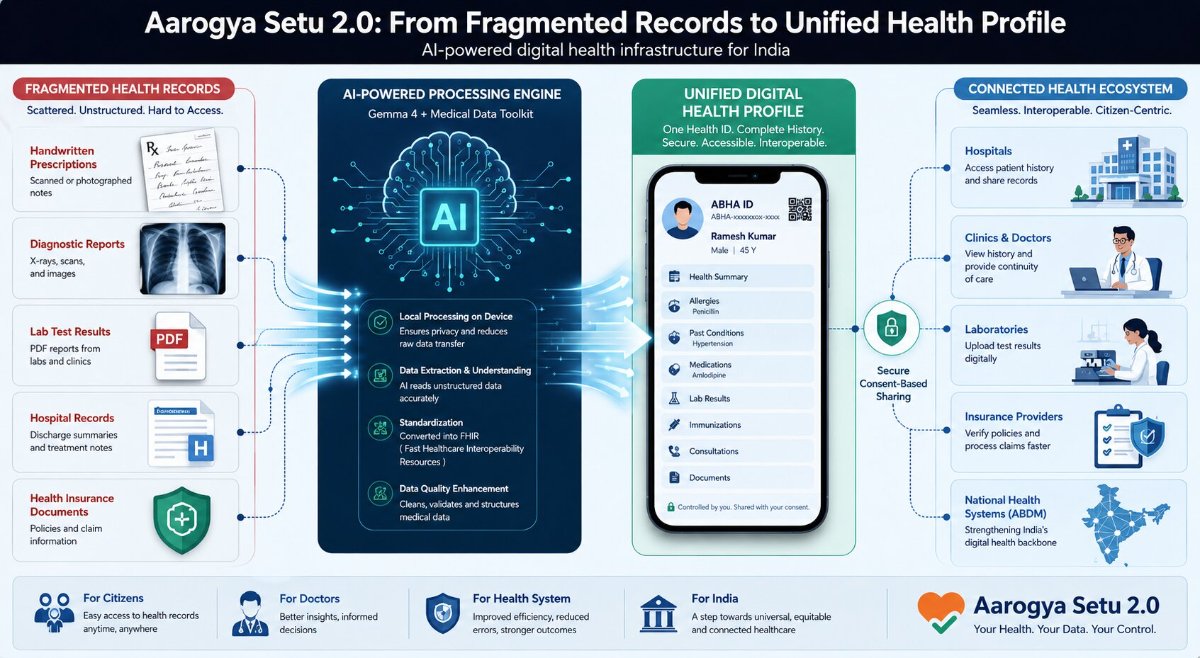
Consider a common healthcare journey in India. A patient may visit a local clinic, receive a handwritten prescription, undergo diagnostic tests at a separate laboratory, and later consult a specialist at a private hospital. Each interaction generates records, but those records often remain scattered across paper files, PDFs, and disconnected databases.
This fragmentation creates friction for both patients and healthcare providers. Medical histories become difficult to access. Important information can get lost. Healthcare providers frequently operate without a complete picture of a patient's treatment history.
Aarogya Setu 2.0 targets this problem directly. The platform aims to aggregate health information into a single digital profile linked to an individual's ABHA account, making records easier to access and share when needed.
The AI Layer Behind the Upgrade
The most significant technical component of the rollout is the integration of Google's Gemma 4 model through an open-source Medical Data Toolkit.
Healthcare data rarely arrives in a clean, structured format. Prescriptions may be handwritten. Laboratory reports often appear as scanned PDFs. Diagnostic records can vary significantly between providers.
The toolkit is designed to process these diverse formats and convert them into standardized Fast Healthcare Interoperability Resources (FHIR) bundles. Standardization matters because healthcare systems can only exchange information efficiently when they use a common format.
According to the launch details, much of this processing occurs locally on the user's device before data moves into the broader digital health ecosystem. That design choice serves two purposes. First, it improves the quality and usability of health records. Second, it reduces dependence on transmitting large volumes of raw, unstructured medical documents.
Building a Connected Health Ecosystem
The relaunch signals a broader transition in India's digital health strategy.
The original Aarogya Setu focused on a specific public health challenge. Aarogya Setu 2.0 focuses on infrastructure. The platform now functions as an entry point into a growing network of digital health services, including personal health records, insurance-related information, and healthcare provider discovery.
For policymakers, the objective extends beyond convenience. Digital health systems become more valuable as participation grows. Every hospital, clinic, laboratory, insurer, and patient added to the network increases the usefulness of the entire ecosystem.
India has already demonstrated this model in digital payments through UPI. Health data presents a far more complex challenge, but the underlying principle remains similar: create interoperable standards and encourage widespread adoption.
The Questions That Remain
Technology alone cannot guarantee success.
The effectiveness of Aarogya Setu 2.0 will depend heavily on adoption across India's healthcare landscape. Large private hospital networks may possess the resources to integrate quickly with ABDM standards. Smaller clinics and healthcare providers could face a more difficult transition.
Digital literacy also remains a practical concern. Managing health records through a smartphone application may prove straightforward for urban users who already rely on digital services. The experience may look very different for citizens with limited digital access or limited familiarity with health technology platforms.
Trust represents another critical factor. Citizens must feel confident that their health information is handled securely and transparently. As digital health infrastructure expands, questions around governance, consent, and data management will continue to attract scrutiny from policymakers, technologists, and the public.
More Than an App Upgrade
Aarogya Setu 2.0 represents one of India's most ambitious attempts to create a nationwide digital health infrastructure. The initiative combines AI-powered data processing, standardized health records, and the ABDM framework in an effort to connect a healthcare system that has historically operated through fragmented records and disconnected providers.
The launch marks the beginning of a much larger test. Success will depend not only on the performance of the underlying technology but also on whether hospitals, clinics, insurers, and citizens embrace a shared digital health ecosystem. If they do, Aarogya Setu 2.0 could become one of the most significant public digital infrastructure projects in Indian healthcare.