Inside 'Tau Scaling': How Huawei's New 'LogicFolding' Architecture Stacks Up Your Next Phone Chip
Huawei’s announcement of 'Tau Scaling' at ISCAS 2026 suggests a pivot from physical lithography to architectural design. We examine whether this 'time constant' approach can truly deliver 1.4nm-class performance without the world's most advanced chipmaking machines.
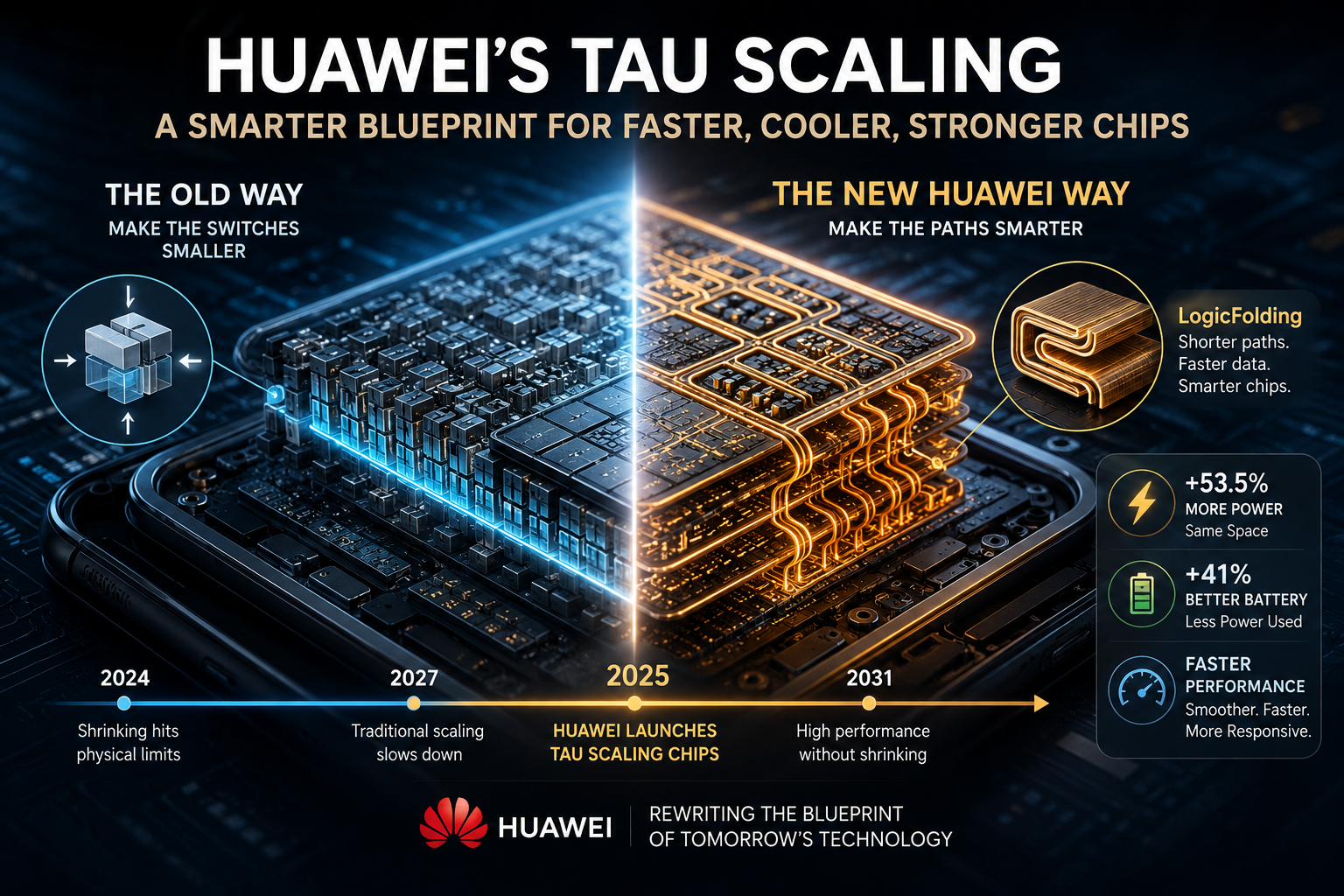
The Smarter Brain: How Huawei is Rewriting the Blueprint Inside Your Phone
We all know our smartphones are fast, but we rarely think about the tiny engine inside that makes it happen: the microchip.Inside every microchip are billions of microscopic light switches called transistors. Every time you open an app, snap a photo, or play a game, these tiny switches flip on and off billions of times per second to process your data.
For the last 50 years, the rule for making phones faster was simple: make these tiny switches smaller so you can pack more of them inside the chip.
But the tech world is hitting a massive wall. Making things any smaller is becoming almost physically impossible. This is where Huawei’s new announcement comes in.
At a major tech conference in Shanghai, Huawei introduced a radical new concept called "Tau Scaling." Instead of trying to make the switches smaller, they figured out a way to make them faster by completely changing the way the chip is wired.
The Secret: Shortening the Digital Highway
To understand how Huawei's technology works, think about a crowded city. If you want people to get to work faster, you have two choices:
- The Old Way: Shrink all the houses and cars so you can pack them tighter together on the same flat ground.
- The New Huawei Way: Keep the houses the same size, but build smarter highways, hidden tunnels, and custom overpasses so nobody gets stuck in traffic.
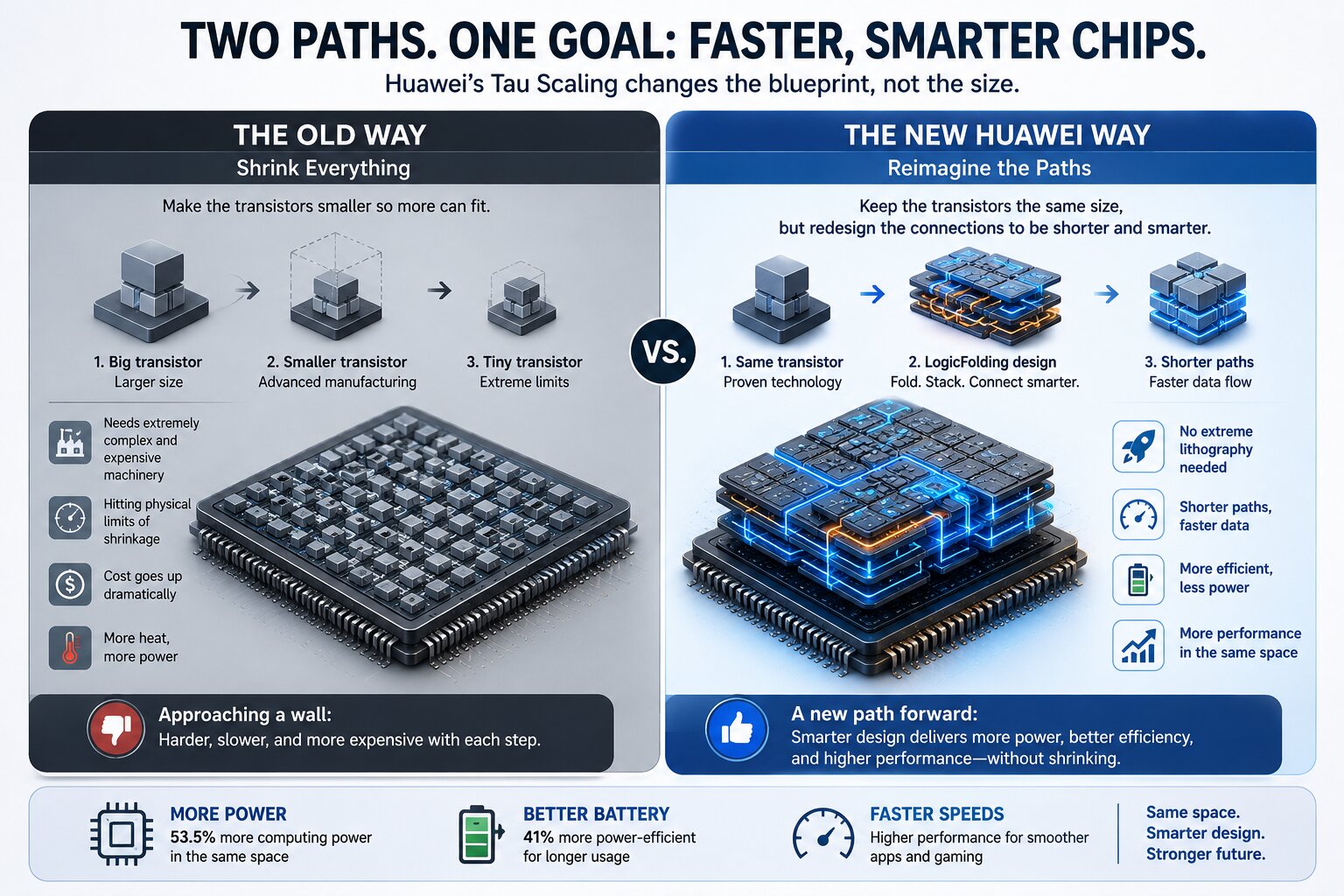
Huawei calls this new design trick LogicFolding. Instead of laying everything out on a single, flat surface, they are physically folding and reorganizing the internal pathways. This drastically shortens the distance that electricity has to travel to get from one switch to another. Less distance means the data moves much faster.
💡 The Apartment Analogy:
Imagine trying to fit more things into a small studio apartment.
The traditional way is to buy miniature, tiny furniture. Huawei’s new way keeps the furniture normal-sized but uses custom folding walls, loft beds, and hidden sliding doors so you can use the exact same room twice as efficiently.
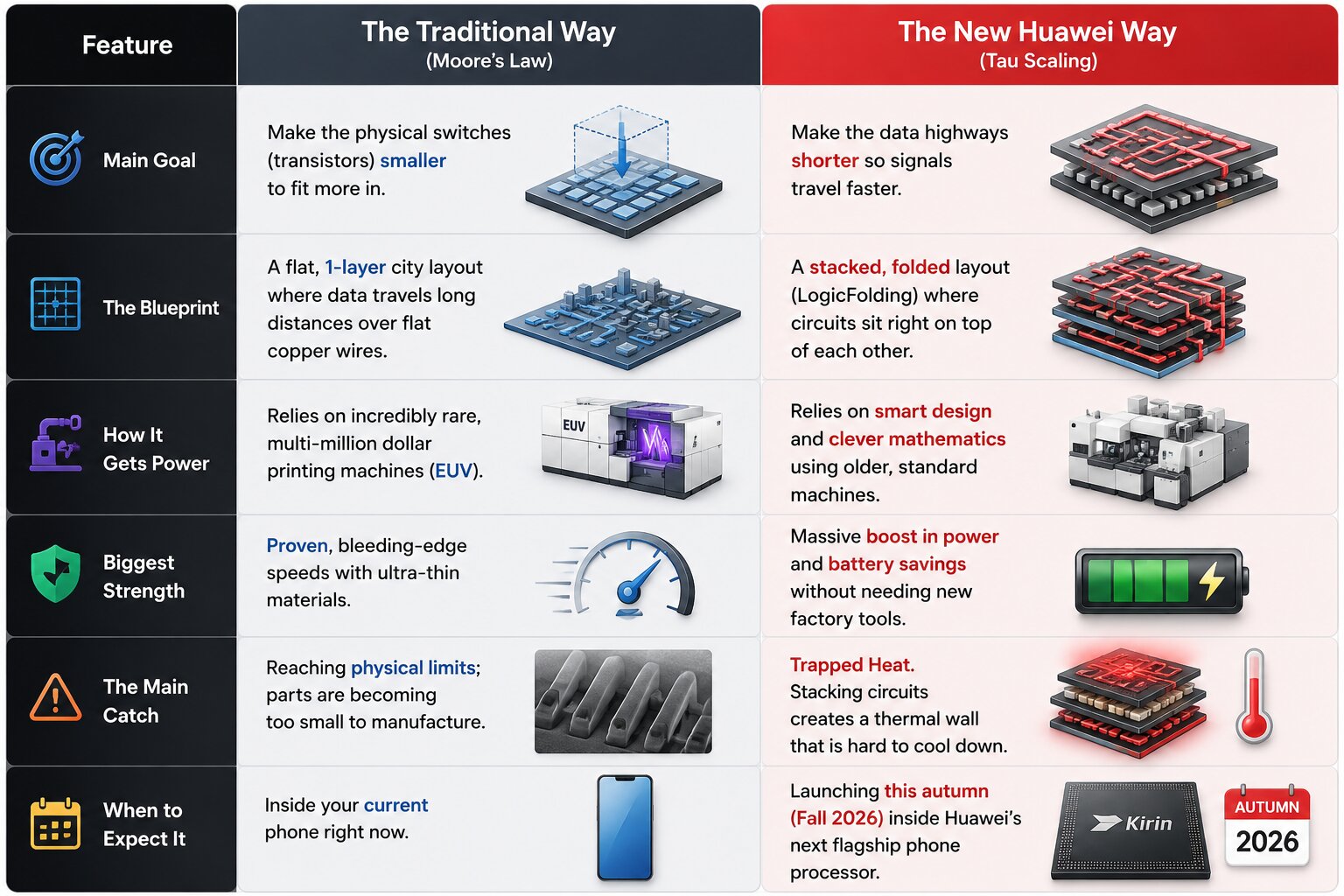
Quick Comparison: Standard Chips vs. Huawei's Folded Chips
What This Means for Your Next Phone
This isn't just a future science experiment. Huawei announced that they have already quietly tested this layout trick on 381 different types of chips over the last few years to make sure it works perfectly.
Even better, the first real phone chip using this "folded design" is launching this autumn inside their next flagship smartphone processor (the Kirin chip).
By using this clever layout instead of physically shrinking the parts, Huawei's new phone chip achieves some massive upgrades:
- More Power: It fits 53.5% more computing power into the exact same space compared to standard chip designs.
- Better Battery: It is 41% more power-efficient, meaning your phone's battery won't drain as fast when doing heavy tasks.
- Faster Speeds: The chip can run noticeably faster, making apps open instantly and games run smoother.
The One Major Challenge: Handling the Heat
While this "folding trick" is incredibly smart, it does face one major hurdle: heat.
Think about your laptop or phone when you play a heavy 3D game—it starts to get warm. When you pack data pathways incredibly tight and layer them on top of each other to get extra speed, the chip generates a lot of heat in a very small space.
Because the physical switches aren't actually smaller, keeping these folded chips cool so they don't slow down during long gaming sessions or heavy video recording will be the ultimate test for Huawei's engineers.
The Bottom Line
For decades, the tech industry thought the only way to build a faster phone was to make chip parts microscopically smaller. Huawei’s new "Tau Scaling" approach proves that smart design matters just as much as physical size. By rewriting the blueprint of how a chip connects internally, phones can continue to get faster, smarter, and more efficient.
We will see exactly how well it works in the real world when the first phones using this technology hit store shelves this autumn.