Policy vs. Tradition: How the PM’s ‘Gold Appeal’ is Reshaping Market Sentiment
Prime Minister Modi’s recent, highly publicized call for Indians to exercise restraint in gold consumption has sent shockwaves through the domestic markets. In a sector where sentiment is intrinsically linked to tradition and festive demand, the Prime Minister’s appeal has triggered a sharp market correction, erasing billions in market value across the board. As retail investors grapple with the sudden downturn, the central question remains: Is this a temporary panic induced by political rhetor

The Market Reaction: Anatomy of a 12% Correction
The market’s response to the May 10, 2026, announcement was swift and merciless. Within hours of the appeal, jewelry sector stalwarts experienced a massive sell-off. Titan, Kalyan Jewellers, Senco, and Sky Gold saw share prices plummet by as much as 9%, reflecting a sudden evaporation of investor confidence. The total market wipeout, estimated at ₹6.5 lakh crore across broader indices, highlights just how sensitive the Indian equity market remains to macroeconomic messaging from the top.
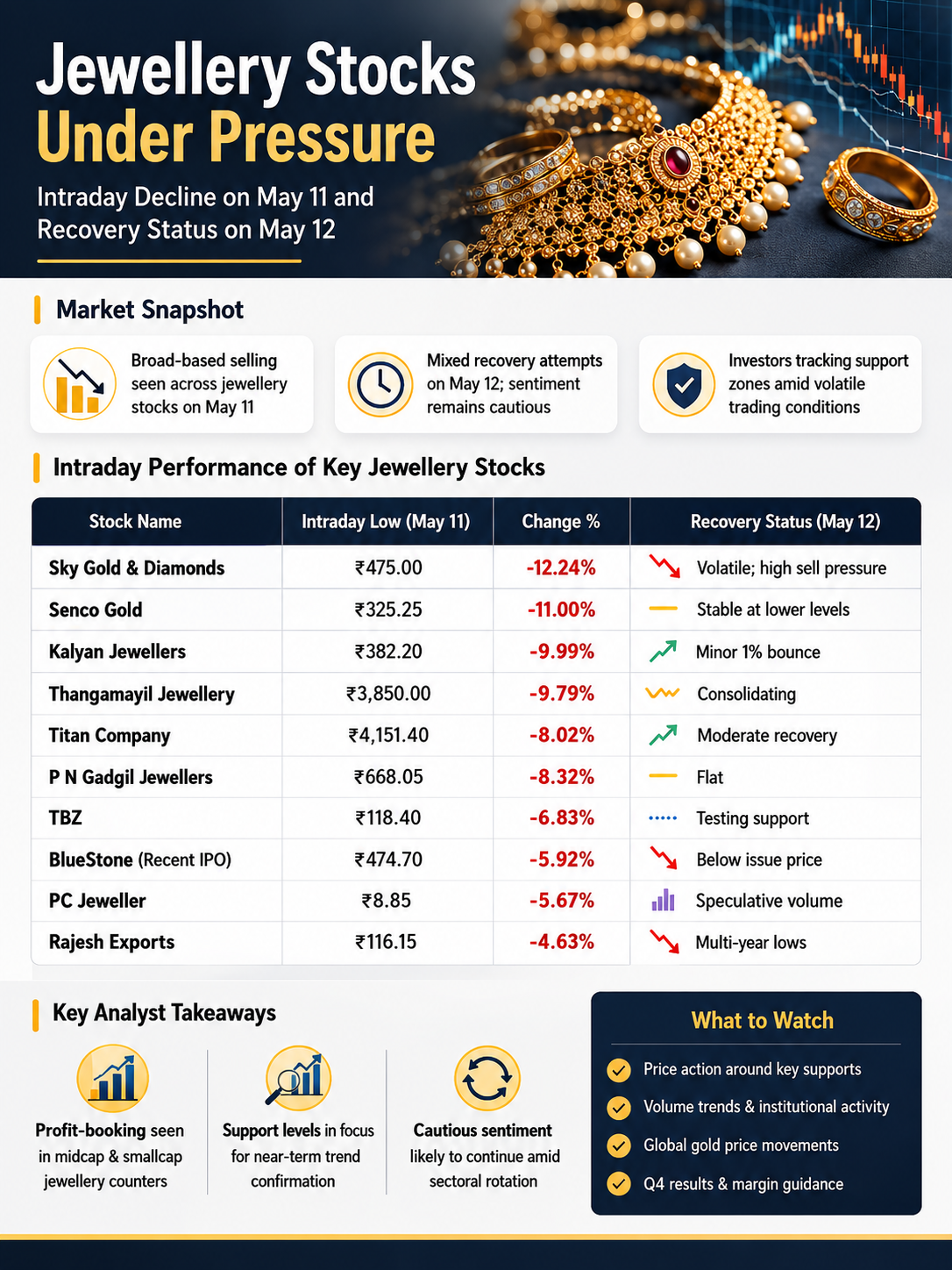
The market’s response to the May 10, 2026, announcement was swift and merciless. During the trading session on Monday, May 11, jewelry sector stalwarts experienced a massive sell-off. While some stocks dipped 9%, others like Sky Gold and Diamonds plummeted by as much as 12.24%. Titan Company, the sector leader and a Nifty 50 heavyweight, emerged as a top loser, dragging down the broader index.
The total market wipeout, estimated at ₹6.5 lakh crore across broader indices, highlights just how sensitive the Indian equity market remains to macroeconomic messaging from the top. While the market reaction captures the immediate panic, analysts are urging a differentiation between short-term sentiment and fundamental valuation. Major players like Titan and Kalyan Jewellers recently reported strong Q4 FY26 earnings—with Titan's profit up 35% and Kalyan's more than doubling—yet even these robust figures failed to provide a floor for the falling prices.
Post-Appeal Pulse: Tracking Intraday Volatility Across the Jewelry Sector (May 11-12)
The following image tracks the movement of key jewelry stocks in the 48 hours following the Prime Minister's appeal. While the "Blue Chip" retailers saw high volume selling, mid-cap stocks faced the steepest percentage declines.
Voluntary Appeal or Policy Precursor?
The thin line between "moral suasion" and impending fiscal intervention is where the real risk lies. Historically, Indian gold demand has been a perennial thorn in the side of the Current Account Deficit (CAD). India's gold import bill hit a staggering $72 billion in FY26, straining foreign exchange reserves which recently dropped to $690.69 billion.
Investors are now rightfully nervous that this verbal appeal is a precursor to more stringent measures, such as further hikes in import duties or mandatory purchase disclosures. If the government follows this up with concrete policy, the current correction may just be the beginning. The fear is that the "year of abstinence" requested by the PM to protect foreign exchange amid the West Asia crisis could translate into a long-term drag on top-line growth for organized retailers.
Beyond the Big Players: The Unorganized Sector Paradox
While the stock market dominates the headlines, the impact on the unorganized sector—comprising millions of local goldsmiths and nearly 35 million people dependent on the trade—is precarious. Industry bodies are already pushing for a revamp of the Gold Monetization Scheme (GMS) as a counter-proposal to the PM's appeal. They argue that mobilizing the 25,000 tonnes of idle gold in Indian households is a better solution for forex than a total "year of abstinence" that could trigger mass layoffs among karigars (artisans).
Investment Strategy: Contrarian Opportunity or Value Trap?
The temptation to "buy the dip" is strong, but caution is warranted. In an environment where the government is actively working to temper consumer demand to stabilize the Rupee (which recently weakened past 95 against the dollar), the regulatory tailwind is currently facing the wrong way.
Gold remains a quintessential hedge in the Indian household portfolio, and this structural reality will not vanish overnight. However, investing in jewelry equities requires a clear distinction between the asset class (gold) and the companies (retailers). While physical gold may hold its value, jewelry stocks are hostage to the political economy of the day. Investors should consider keeping dry powder on the sidelines until the government clarifies whether this was merely a symbolic appeal or the start of a new, restrictive trade policy.