Sec-Gemini v3: Google's Cybersecurity AI Is Building India's First Line of Defense for the Agentic Era
As India pivots toward an agentic AI future, Google is embedding critical safety layers into the ecosystem. Through new cybersecurity protocols and institutional partnerships, the tech giant aims to secure the next wave of autonomous digital transactions and enterprise operations.
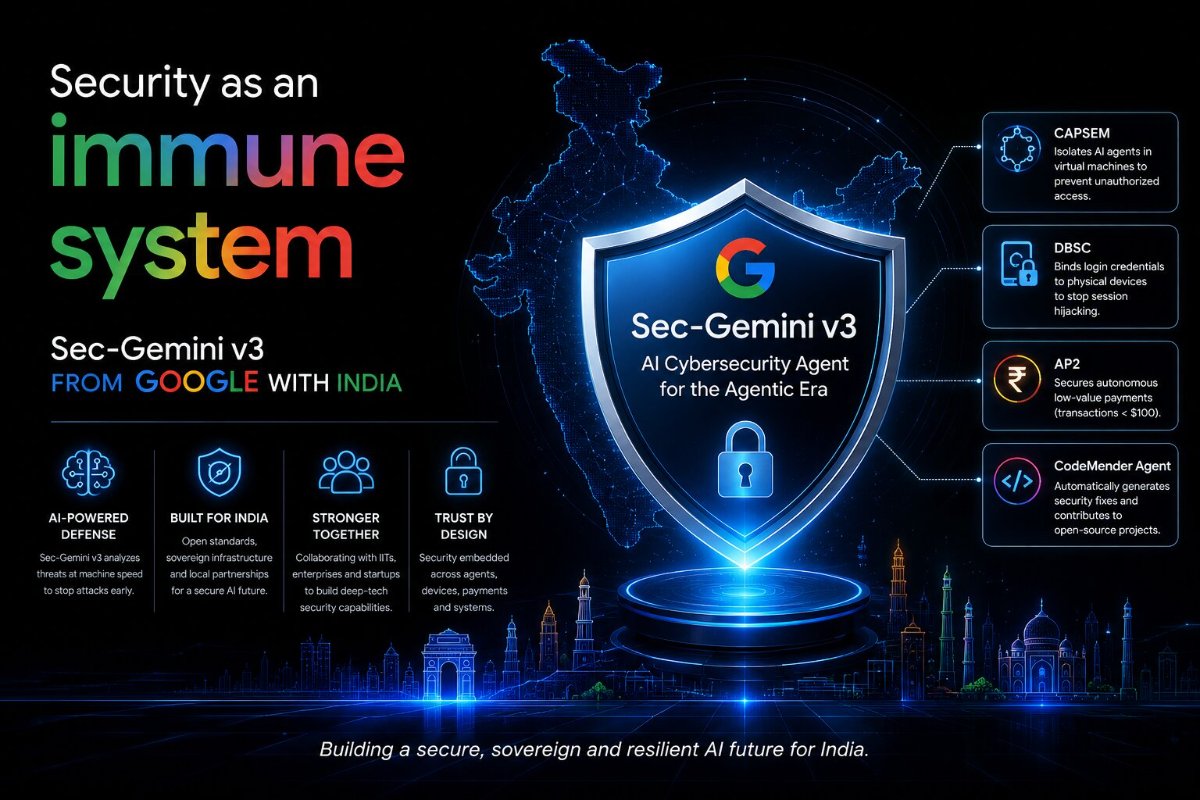
Photo by Markus Winkler on Pexels
At I/O Connect India 2026, Google shifted its India AI strategy from building better models to building secure AI systems. The centerpiece wasn't Gemini—it was Sec-Gemini v3, a cybersecurity agent designed to defend enterprises before autonomous AI becomes ubiquitous.
The biggest obstacle to India's AI ambitions is no longer model performance. It is trust.
Indian enterprises are rapidly moving beyond chatbots and copilots toward agentic AI—software that can investigate cyberattacks, execute workflows, approve transactions, manage infrastructure, and interact with enterprise systems without constant human supervision. That shift fundamentally changes cybersecurity. Every autonomous action expands the attack surface, making traditional security models insufficient.
Recognizing this challenge, Google used I/O Connect India 2026 to unveil what may become its most strategically important India initiative: a security-first architecture centered around Sec-Gemini v3, supported by open security standards, academic partnerships, and enterprise deployments. Rather than competing solely on larger AI models, Google is attempting to become the security layer that enables autonomous AI adoption across India's digital economy.
Why Agentic AI Needs a Different Security Model
- Traditional AI answers questions.
- Agentic AI takes action.
- That distinction changes everything.
An enterprise AI agent might investigate ransomware alerts, access confidential customer records, submit code changes, authorize payments, or communicate with other AI agents. Identity verification alone cannot secure those workflows because the risk shifts from who accesses a system to what the AI is permitted to do.
Google calls this broader initiative its Safety Charter for India's AI-led Transformation, reflecting a move away from reactive cybersecurity toward security embedded throughout the AI lifecycle. Instead of treating safety as another API feature, Google is positioning it as the foundation upon which enterprise AI should operate.
Sec-Gemini v3: An AI Analyst for Security Operations
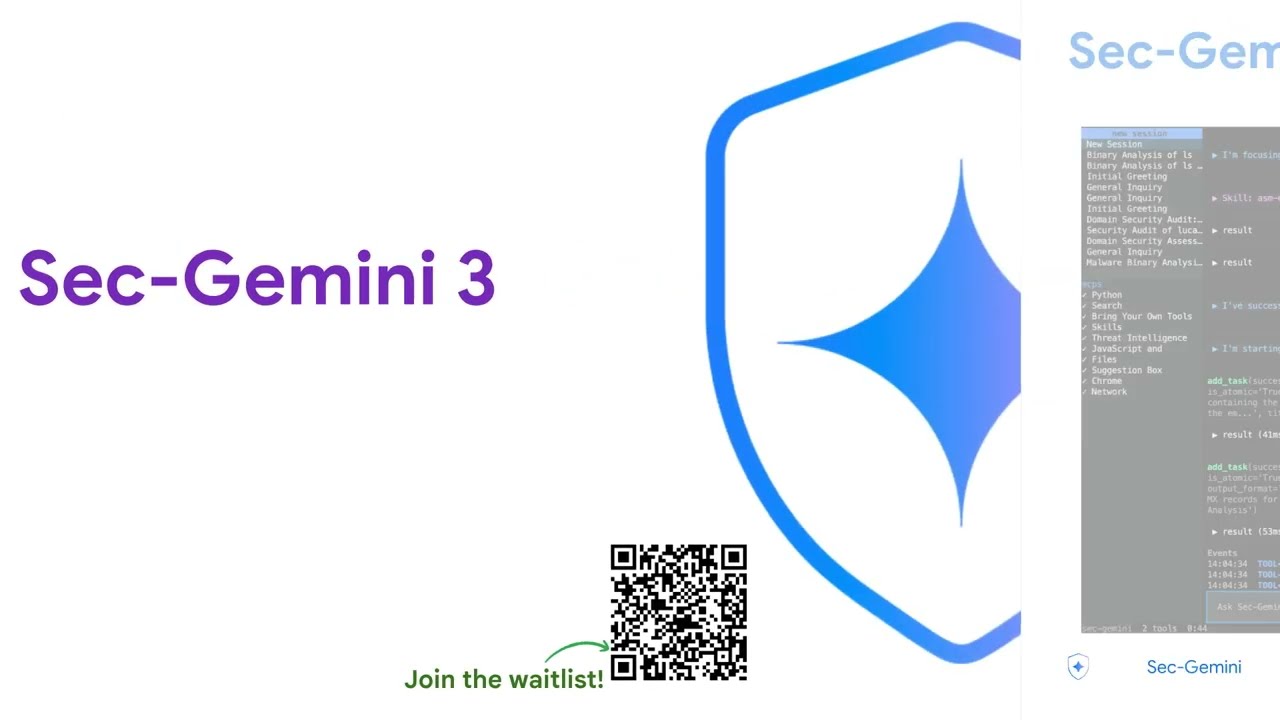
The centerpiece of Google's announcement is Sec-Gemini v3, a specialized cybersecurity AI agent now rolling out to trusted Indian government organizations and enterprise testers, including Flipkart.
Unlike general-purpose language models, Sec-Gemini v3 focuses exclusively on Security Operations Centers (SOCs). It processes massive volumes of security telemetry and automates time-consuming tasks that normally consume experienced security analysts.
Its core capabilities include:
- Incident investigations
- Malware analysis
- Digital forensics
- Security log correlation
- Threat intelligence analysis
Instead of analysts manually reviewing thousands of alerts every day, Sec-Gemini v3 rapidly connects evidence across multiple security systems, identifies likely attack paths, and helps prioritize investigations.
This matters particularly in India, where digital transformation continues to outpace the availability of skilled cybersecurity professionals. Banking, healthcare, ecommerce, government services, and manufacturing all face growing attack volumes while competing for limited security talent.
Google's strategy is not to replace analysts.
It aims to eliminate repetitive investigations so security teams can focus on high-impact decisions and incident response. (The Times of India)
Building Security from Firmware to Payments
Sec-Gemini v3 is only one layer of Google's broader architecture. Google also introduced several open standards designed specifically for autonomous AI systems.
| Initiative | Primary Function | Security Benefit |
|---|---|---|
| Sec-Gemini v3 | AI-powered cybersecurity operations | Automates investigations, malware analysis, and digital forensics |
| CAPSEM | Runtime isolation for AI agents | Prevents malicious prompts from accessing host systems and credentials |
| DBSC | Device Bound Session Credentials | Links authentication tokens to physical hardware, reducing session hijacking |
| AP2 | Secure agent payments | Enables AI agents to perform trusted low-value transactions (under $100) |
| CodeMender Agent | Automated vulnerability remediation | Generates security fixes and contributes patches back to open-source projects |
Taken together, these initiatives protect nearly every layer of an autonomous AI workflow—from authentication and execution to software maintenance and financial transactions.
Among them, CAPSEM may prove especially significant. It isolates AI agents inside virtual machines, ensuring that even if an attacker succeeds with prompt injection, the compromised agent cannot freely access enterprise credentials or sensitive infrastructure.
That approach mirrors decades of operating-system security principles while adapting them for autonomous AI.
India Becomes Google's Security Research Hub
Google's announcement also highlighted a long-term investment in India's research ecosystem.
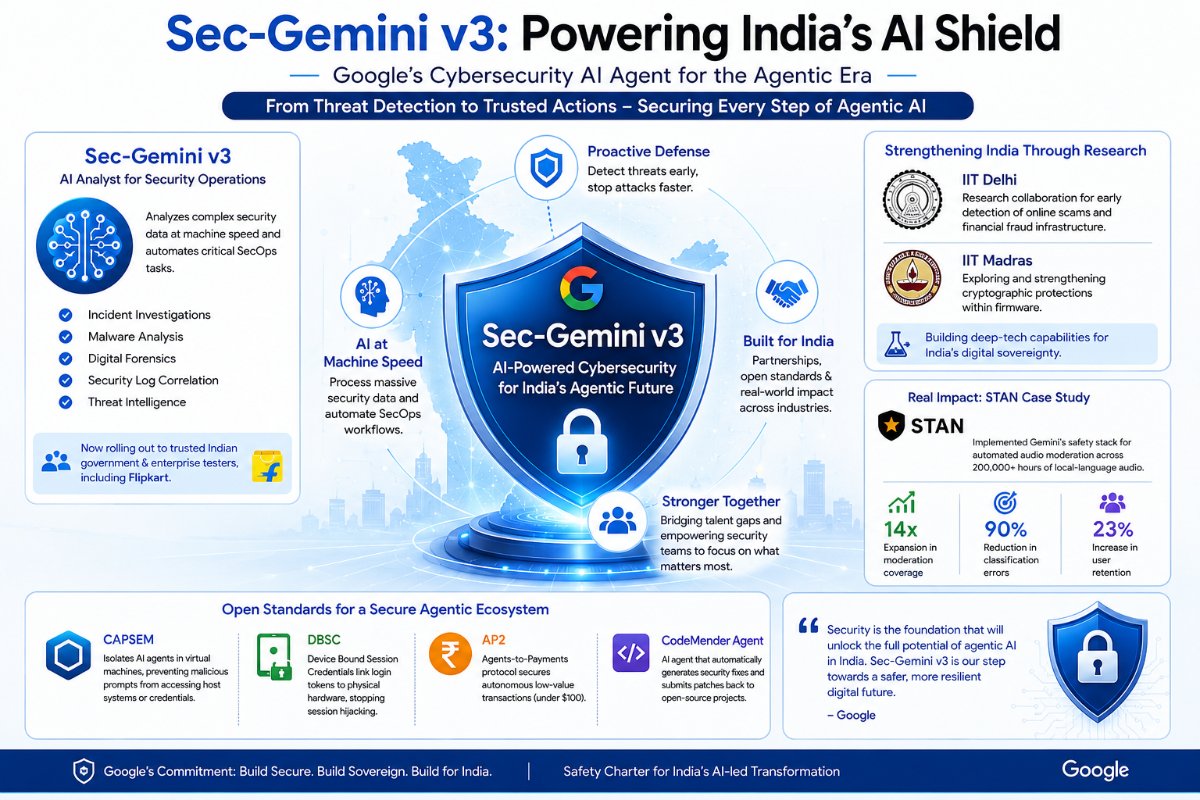
The company is partnering with IIT Delhi to develop techniques for identifying online scams and financial fraud infrastructure before attacks reach consumers. Given India's rapidly expanding digital payments ecosystem, proactive fraud detection has become a national cybersecurity priority.
Meanwhile, researchers at IIT Madras are collaborating with Google on strengthening cryptographic protections within firmware—the lowest layer of modern computing. Securing firmware helps ensure that AI systems begin operating from trusted hardware, making higher-level security controls significantly more reliable.
These partnerships indicate that Google views India not simply as a deployment market but as a contributor to future AI security research.
STAN Shows What AI Safety Looks Like in Production
Google also showcased an Indian deployment that demonstrates the business impact of AI safety.
Gaming and social platform STAN implemented Gemini's safety stack to moderate more than 200,000 hours of local-language audio across its platform.
The results extended beyond operational efficiency:
- 14× expansion in moderation coverage
- 90% reduction in classification errors
- 23% increase in user retention
Those numbers illustrate an important shift in enterprise thinking.
AI safety no longer serves only compliance teams. It directly improves user trust, platform quality, and customer retention, transforming security into a measurable business advantage.
Security Becomes Google's Competitive Advantage
For years, AI competition revolved around benchmark scores, parameter counts, and reasoning performance.
Google's latest India strategy suggests the next competitive frontier lies elsewhere.
As AI agents gain permission to investigate cyber incidents, interact with enterprise software, and conduct financial transactions, organizations will increasingly judge AI platforms by their ability to operate safely rather than simply intelligently.
Sec-Gemini v3 reflects that transition. It is less about showcasing another capable model and more about providing the operational trust enterprises need before autonomous AI becomes part of critical infrastructure.
That makes Google's India strategy notable. Instead of asking enterprises to trust AI first and secure it later, the company is attempting to make security the platform upon which the agentic future is built. (The Economic Times)