Sugarcane in Your Tank? Demystifying India's New E85 Petrol Launch
With the launch of E85 fuel across select Indian cities, confusion is mounting among motorists regarding compatibility. This comprehensive article clarifies why E85 is strictly for flex-fuel vehicles and breaks down the real-world impact on your engine and your wallet.
Sugarcane in Your Tank? Demystifying India's New E85 Petrol Launch
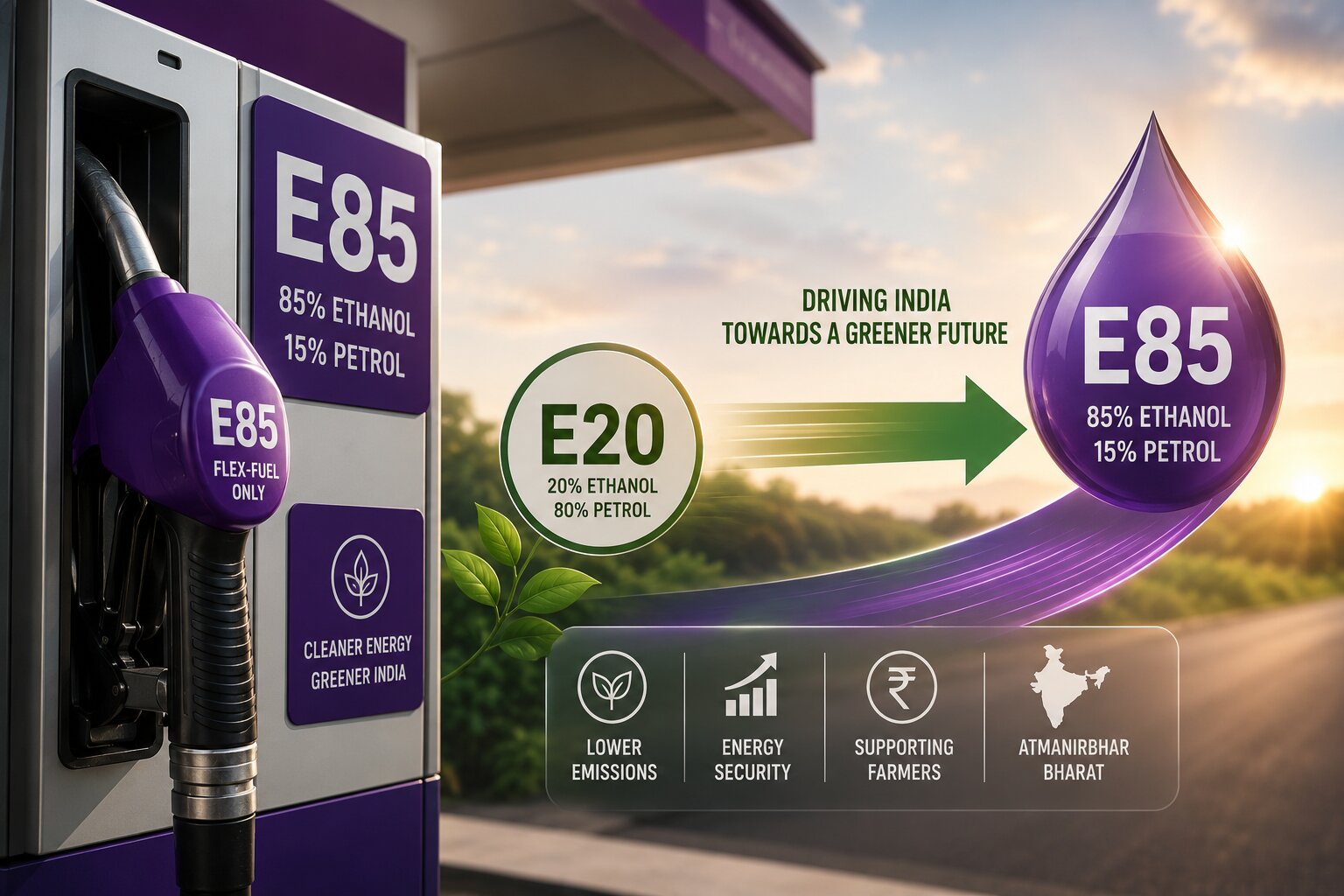
India has officially entered a new era of green mobility with the national launch of a high-ethanol fuel called E85. Formally introduced on World Environment Day by Union Petroleum Minister Hardeep Singh Puri, this new fuel variant has debuted at a retail price of ₹82.12 per liter in Delhi—making it nearly ₹20 cheaper than regular petrol.
While a steep discount sounds like a massive win for our wallets, it has sparked considerable confusion across the country. What exactly is E85? Can your current car or bike run on it? Where is it rolling out, and what does the direct math look like for an average Indian vehicle owner?
Let's clear up the facts using direct, straightforward comparisons.
1. What Exactly is E85 Petrol?
The "E" stands for Ethanol—a type of clear alcohol produced domestically right here in India, primarily fermented from sugarcane juice, damaged food grains, and agricultural waste. The number "85" represents the mixture ratio.
To understand how big of a jump this is, look at the timeline of how India's commercial fuel mix has evolved over the years:
- The Past (Pre-2014): Pure petrol mixed with almost zero alcohol (just 1.5% ethanol).
- The Present (Current National Standard): E20 Fuel. Every standard petrol pump across India currently mandates a mix of 20% ethanol and 80% petrol. Your current car or bike runs on this daily without you even noticing.
- The New Launch (E85): A heavy, highly specialized shift consisting of 85% Ethanol and only 15% Petrol.
2. Where Has the Rollout Started?
Because E85 requires entirely new storage and dispensing infrastructure, the government is introducing it through a structured, phased roadmap. It is not available everywhere instantly.
The rollout is breaking down across three distinct phases:
- Phase 1 (Immediate Pilot): The fuel has officially launched across 48 initial public sector outlets, starting at a flagship Indian Oil Corporation (IOCL) station on Pusa Road in New Delhi. Over the coming weeks, the pilot is expanding to 50–100 specific stations across major corridors including Delhi-NCR, Mumbai, Pune, Nagpur, and Bengaluru.
- Phase 2 (December 2026): Public sector oil companies aim to scale the network up to 500 operational E85 stations across major Tier-1 and Tier-2 urban hubs.
- Phase 3 (December 2027): The national target is to establish approximately 5,000 E85 green outlets spanning the entire country.
3. Can Your Current Vehicle Use E85?
The short answer is an absolute No.
Unless you are driving a specialized, newly launched vehicle explicitly built and badged as a Flex-Fuel Vehicle (FFV), you cannot use E85.
Ethanol behaves very differently than normal petrol. It naturally attracts moisture and can rapidly corrode standard rubber fuel hoses, plastic seals, and aluminum components in older fuel systems. Furthermore, because alcohol packs less chemical energy than petrol, an engine must pump significantly more fuel into the combustion chamber to generate the exact same power. If you fill a standard car or bike with E85, your engine will stall, and your fuel lines will degrade over time.
The Relief Clause: You do not need to worry about accidental fill-ups. The Ministry of Petroleum has clarified that standard E20 petrol remains India's mainstream fuel strategy and isn't going anywhere. At participating stations, E85 will be dispensed via highly visible, completely distinct purple fuel nozzles featuring clear, bold "E85 Flex-Fuel Only" warning labels. Your current vehicle remains completely safe on regular petrol.
4. What Makes a Vehicle Eligible? (The Structural Differences)
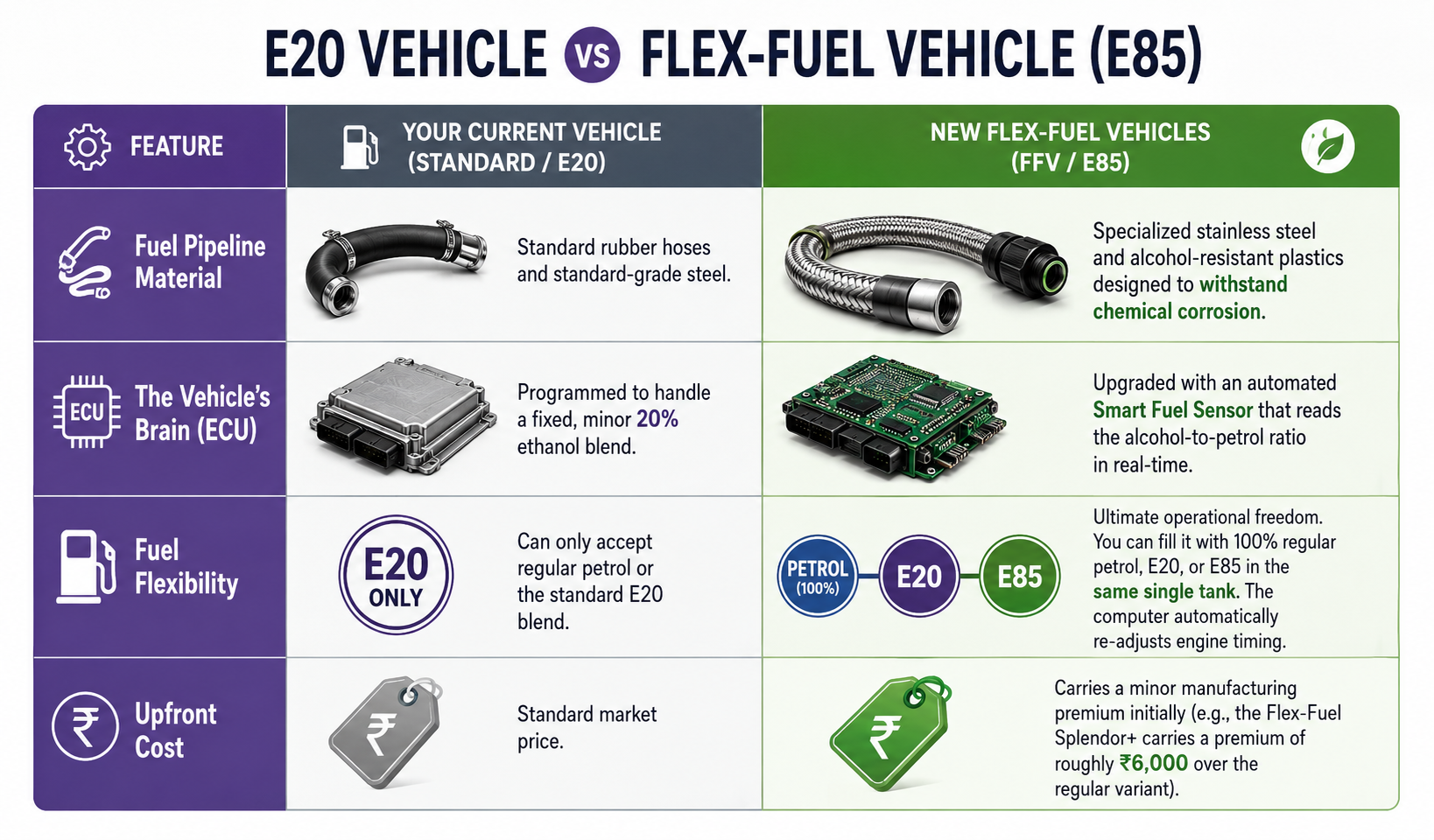
To safely handle high ethanol concentrations, manufacturers have engineered completely modified powertrains. Major brands have already started rolling out compatible models to dealerships, including Hero MotoCorp (with flex-fuel variants of the Splendor+ and HF Deluxe), Suzuki (with the Gixxer SF 250 FFV), and Maruti Suzuki (showcasing the production-spec WagonR Flex Fuel as India's first flex-fuel passenger car).
Here is the exact structural difference between what is sitting in your garage right now versus these new flex-fuel models:
5. Why is India Moving Toward E85?
The national push behind this milestone is a major win for the country’s self-reliance, anchored by significant economic records achieved by the Ministry of Petroleum:
- The Foreign Exchange Shield: India historically imports roughly 89% of its crude oil, resulting in a massive $120 billion annual import bill. By scaling up ethanol blending over the last decade, India has successfully substituted 302 lakh metric tonnes of imported oil—saving a massive ₹1.84 lakh crore in foreign exchange from leaving the country.
- Supporting Indian Farmers: Instead of sending trillions of rupees to oil-exporting countries, high-ethanol fuel channels that capital directly back home. The Ministry estimates that if just half of all new two-wheelers and passenger vehicles sold shift to flex-fuel technology, it will generate roughly ₹12,403 crore in extra income directly for Indian farmers and rural distilleries.
- Cleaning Our Cities: According to data from NITI Aayog, vehicles running cleanly on E85 reduce lifecycle greenhouse gas emissions by 61% and drop toxic particulate matter (the heavy black smoke) down to near-zero levels, drastically cleaning up urban air quality.
6. The Hidden Catch: Will It Actually Save You Money?
While filling a tank at ₹82.12 per liter sounds incredible compared to paying ₹100+ for normal petrol, auto enthusiasts are highlighting a critical operational trade-off: The Mileage Drop.
Because ethanol contains roughly 30% less energy density than pure petrol, your engine has to burn more liquid fuel to cover the exact same distance.
The Real-World Running Cost Breakdown
Let's do the hard math comparing a typical commuter hatchback running on regular petrol versus the new E85 fuel:
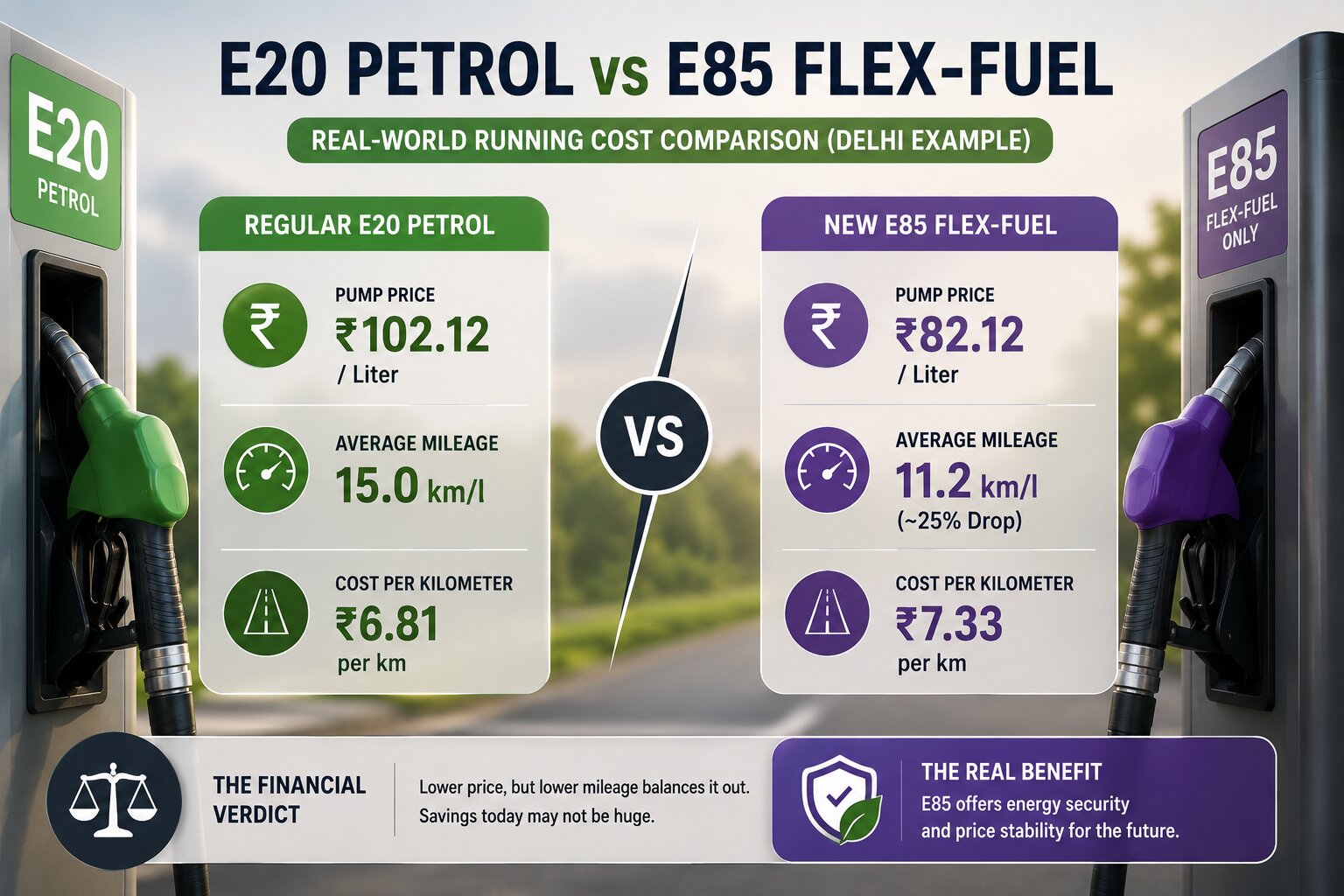
The Financial Verdict: Looking at the numbers, you aren't necessarily saving a massive fortune on your fuel bills on day one, because the lower mileage balances out the cheaper pump price.
The Real Benefit: The true financial value of an E85 vehicle is insurance against global market shocks. If international tensions flare up and regular petrol spikes past ₹120 or ₹130 per liter, E85 prices will remain insulated, domestic, and highly stable because sugarcane is grown entirely right here at home.
Bottom Line
The commercial launch of E85 isn't an immediate threat to your garage, nor is it a magical fix for your fuel bills. It is a highly practical alternative highway running right alongside Electric Vehicles (EVs) and regular petrol.
You do not need to rush out and sell your current vehicle. But if you are planning to purchase a new daily commuter motorcycle or a budget family car over the next year, keeping an eye out for an incoming Flex-Fuel variant is a fantastic, future-proof way to gain ultimate freedom at the fuel pump.