The ₹28,000 Crore Optical Illusion: How 'Dark Patterns' Secretly Dictate Your Spending
A new report quantifies a staggering ₹28,000 crore annual loss to deceptive e-commerce design, putting industry giants under the microscope. We decode the UI/UX traps and analyze the thin line between persuasive marketing and consumer exploitation.
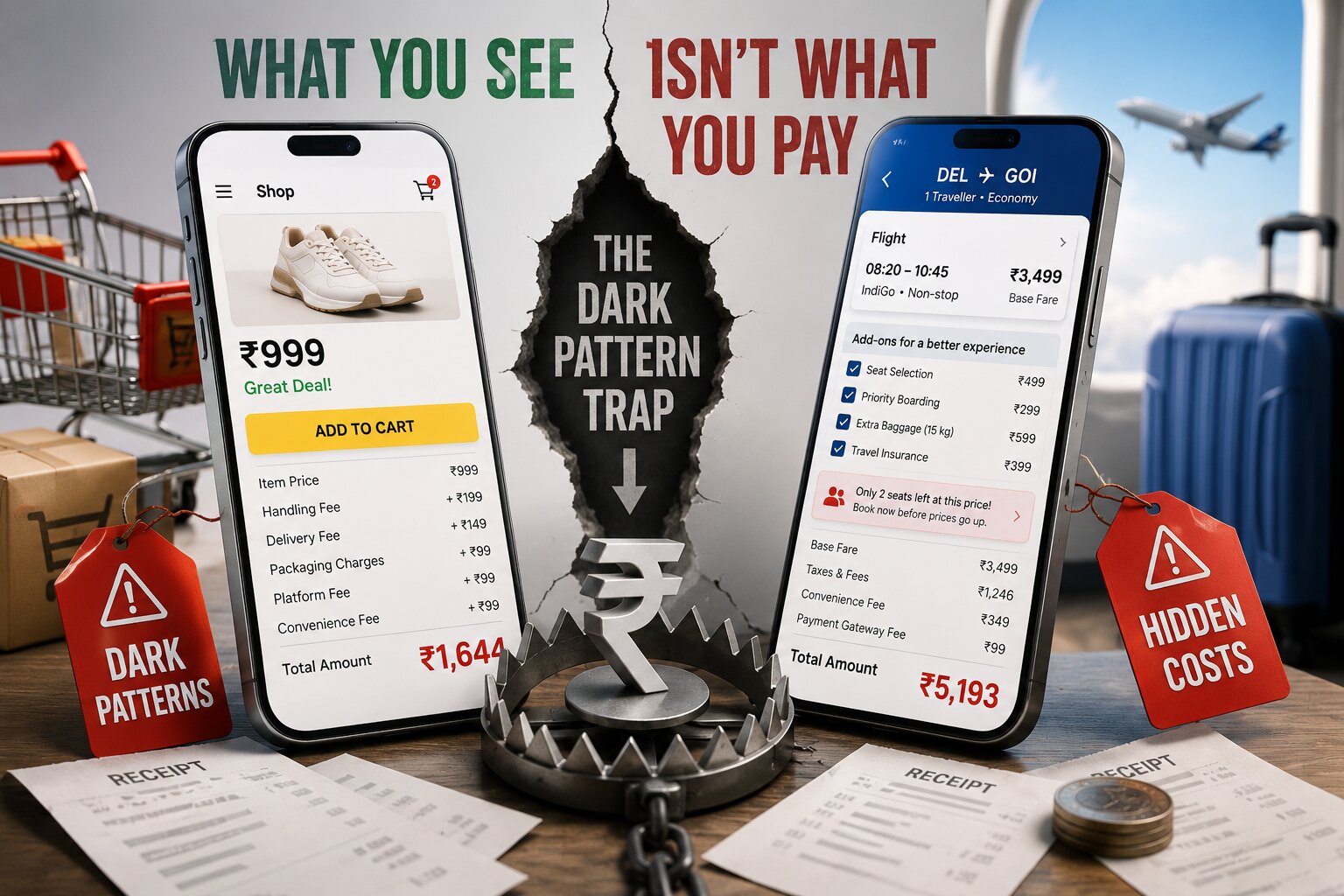
Photo by www.kaboompics.com on Pexels
The ₹28,000 Crore Optical Illusion: How 'Dark Patterns' Secretly Dictate Your Spending
For the average Indian consumer, ordering a late-night snack, booking a weekend flight, or restocking household goods has transformed into a digital minefield. A groundbreaking June 2026 report titled 'Dark Patterns in India's Online Marketplaces' by market research firm Datum Intelligence has shed light on the systematic manipulation embedded in our favorite applications. The study reveals a staggering annual economic leakage of ₹28,000 crore siphoned away from everyday shoppers.
This isn't a case of accidental bad UI; it is a calculated behavioral engineering effort to funnel users into higher-value checkouts. According to the data, 88% of India's 304 million online buyers lose approximately ₹78 to ₹87 every month to hidden charges, forced add-ons, and artificial countdowns. While a casual ₹80 loss might feel like pocket change during a single transaction, it aggregates into a massive macroeconomic tax on consumer convenience when scaled across a household's monthly expenses.
Using a specialized benchmarking system called the 'B-Index' (which evaluates platforms on the frequency, severity, and financial extraction of interface tricks), researchers analyzed major online platforms. The results are sobering: what tech companies loosely brand as "growth hacking" is officially a predatory UI/UX trap engineered to manipulate basic cognitive biases—specifically the fear of missing out (FOMO) and the sunk cost fallacy.
The Anatomy of a Trap: Where Your Money Gets Stuck
The Datum Intelligence study highlights a massive 92-point gap between the best and worst-performing consumer applications in India. To put it simply, some platforms are designed for transparency, while others are heavily optimized to trick your thumb before your brain can process the financial cost.
Under the Central Consumer Protection Authority’s (CCPA) 13-point restrictive framework, these manipulative tactics are strictly prohibited. Yet, the friction between short-term platform profitability and ethical compliance remains a massive hurdle. For everyday app users, understanding how these traps operate is the ultimate form of digital self-defense:
-
Drip Pricing & Hidden Charges: This is when an item is advertised at a stellar low price, but as you click through to the final checkout page, a sudden cascade of handling fees, delivery surges, and platform charges magically inflates the total cost. The survey found that a massive 63% of online payment users now experience this trap—up from 52 in previous tracking cycles.
-
Basket Sneaking: Adding micro-items, random insurance policies, or default "charity donations" into your cart without your explicit consent. A classic example occurred when tech platforms were forced to roll back pre-ticked ₹1 donation boxes after sharp regulatory crackdowns.
-
Confirmshaming: Utilizing emotional guilt to force a user into a purchase or subscription. It’s that annoying pop-up that forces you to choose between clicking a bright green button saying "Yes, upgrade my lifestyle" or a tiny gray button that says *"No, I prefer losing my benefits." *
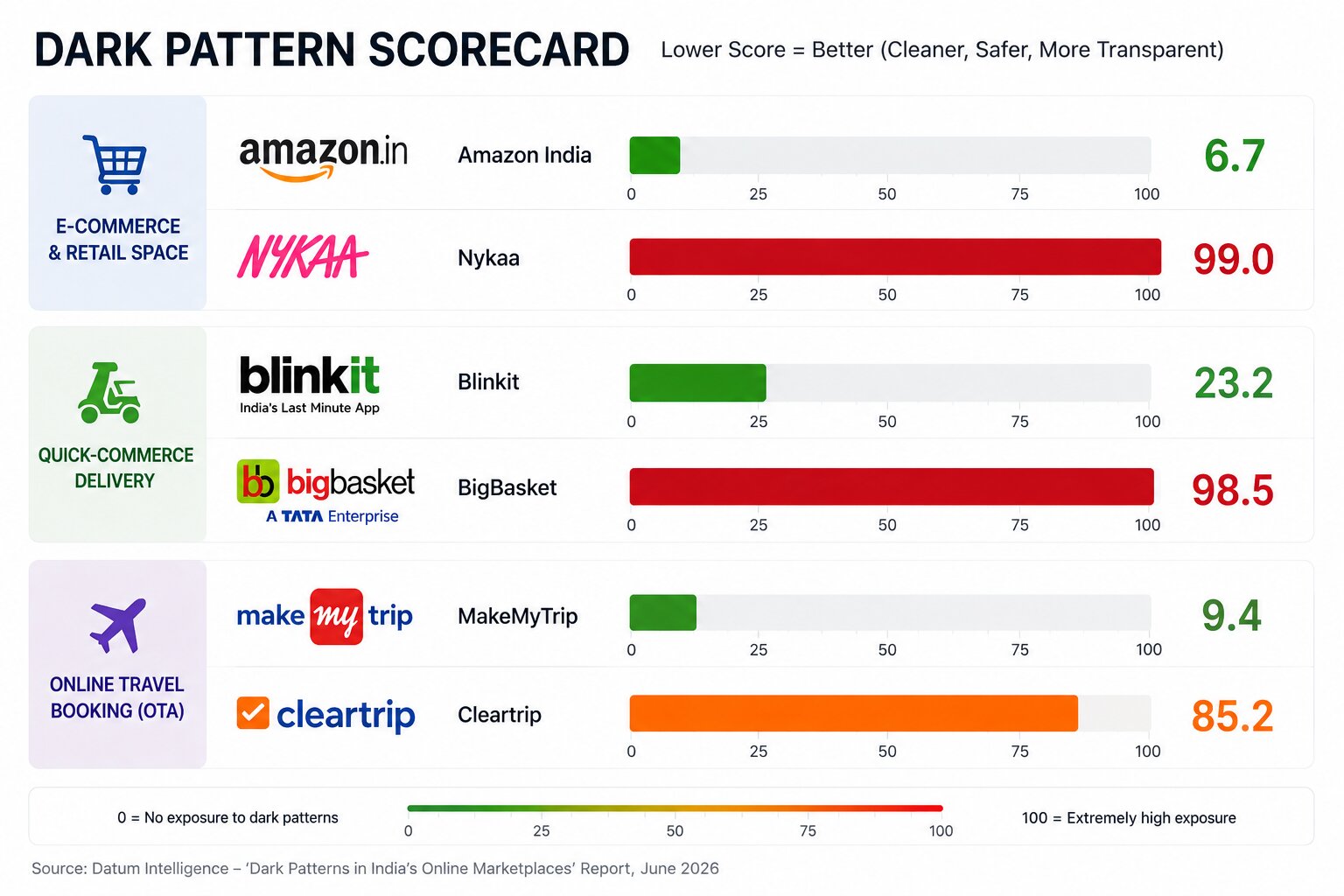
Live Comparison: The June 2026 B-Index Sector Breakdown
The report reveals sharp contrasts in user interface integrity across e-commerce, quick commerce, and online travel. A lower B-Index score indicates a cleaner, safer, and more transparent user experience:
💡 The Nightclub Entry Analogy:
Imagine walking up to a trending new nightclub that advertises a "Free Entry" sign at the gate.
You step inside the queue, but at the first door, the bouncer tells you that entry is only free if you buy a mandatory ₹500 drink coupon (Forced Action). You hand over the cash, but at the second door, another staff member informs you there is an additional ₹200 glass cleaning fee that wasn't listed outside (Drip Pricing).
Finally, when you get your bill, you notice they automatically added a ₹50 tip for the bartender without asking you (Basket Sneaking). You didn't spend more money because you wanted to; you spent it because the building was physically structured to exhaust your patience until you gave up and paid.
The Regulatory Enforcement Chasm
If these practices are illegal under the CCPA guidelines, why are they still showing up on your phone? The answer lies in a weak enforcement loop. While 26 major e-commerce platforms voluntarily submitted self-declaration letters confirming they cleared their interfaces of dark patterns, the practical reality on the ground tells a completely different story.
The report highlights a severe awareness paradox: while 81% of everyday Indian consumers can instantly identify a dark pattern when shown an example, 85% of them still admit to being actively misled by them. Knowing the trick does not slow down an interface flow that has been engineered against you.
Furthermore, the consumer grievance mechanism is largely broken. While more than half of surveyed users filed complaints directly with platforms after detecting a design trap, only a minor 23% walked away with a satisfactory resolution. With regulatory penalties capped at relatively minor amounts, large consumer applications often treat fines as a basic cost of doing business—dwarfed by the immense revenue generated from the traps themselves.
How to Protect Your Digital Wallet
Beating a system optimized by behavioral psychologists requires immediate, intentional friction. The next time you shop online, execute a quick three-step personal audit:
- The Fresh Refresh Test: If a countdown timer screams that an item will sell out in 2 minutes, refresh the page. If the timer magically resets back to 10 minutes, you are looking at a false urgency pattern.
- Uncheck the Defaults: Never rush through a checkout screen. Scroll to the absolute bottom of your order summary to verify that platform fees, handling commissions, or donation boxes haven't been pre-selected for you.
- Use the Direct Route: If an online travel app keeps hitting you with seat-selection markups and hidden baggage convenience charges, close the app and attempt to book directly through the airline or hotel portal. The report tracks that up to 41% of frustrated travel users are already switching back to direct booking lines to rescue their wallets.
The Bottom Line
The transition from predatory "Growth Hacking" to ethical, transparent design is a pivot that every major digital player must make to survive the coming regulatory crackdown. For consumers, the takeaway is clear: convenience should not come at the cost of your personal agency. If an application requires a hyper-vigilant eye and an internal defense manual just to check out without being fleeced, it doesn't deserve a spot on your home screen.