The $30 Billion Bridge: Why Google is Renting AI Compute From SpaceX Through 2029
Google’s $920 million monthly commitment to SpaceX’s compute infrastructure has ignited a firestorm of speculation. As the industry questions if this is a sign of xAI’s financial desperation or a pragmatic masterstroke in the AI arms race, we examine the numbers behind the shift.

Photo by Google DeepMind on Pexels
Bailout or Strategic Synergy? Decoding Google's $30 Billion Bet on SpaceX's AI Infrastructure
Google rarely rents its future from someone else.
For two decades, the company built its competitive advantage on owning nearly every layer of its technology stack—from custom silicon to hyperscale data centers. Yet buried inside SpaceX's June 2026 IPO filing sits one of the most surprising contracts in modern tech history: Google has agreed to pay SpaceX approximately $920 million per month for AI computing capacity.
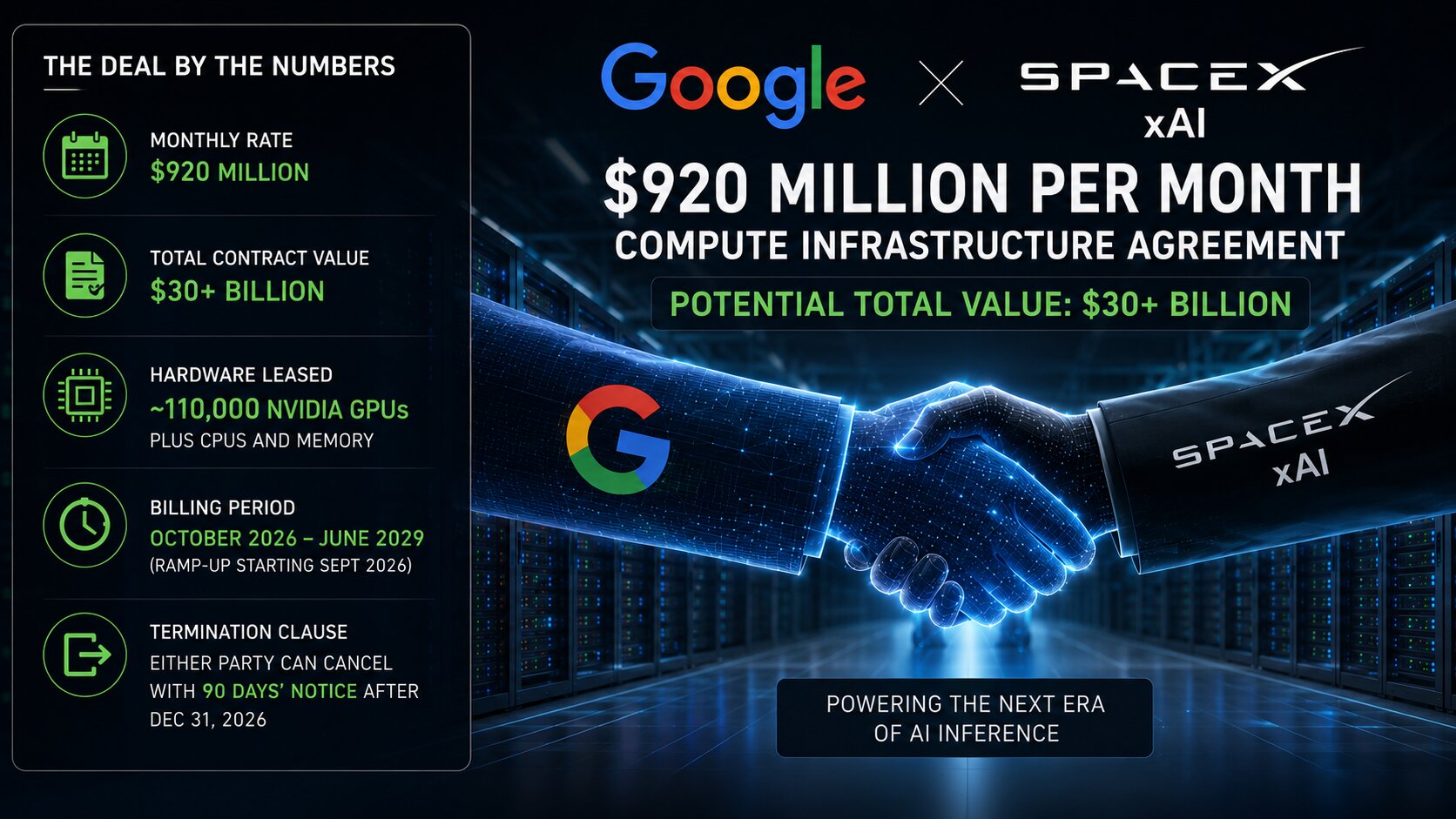
The agreement could exceed $30 billion if it runs through its full term. It gives Google access to roughly 110,000 Nvidia GPUs, making SpaceX—through its recently integrated xAI infrastructure—an unexpected pillar of Google's AI strategy.
The timing makes the deal impossible to ignore. Just days before SpaceX's June 12 Nasdaq debut, one of the world's largest technology companies effectively endorsed Elon Musk's infrastructure ambitions with a contract larger than the annual revenue of many Fortune 500 firms.
The Numbers Behind the Shock
The contract begins ramping up in September 2026 and enters full billing mode from October 2026 through June 2029.
The structure looks straightforward at first glance:
| Metric | Details |
|---|---|
| Monthly Payment | $920 million |
| Potential Contract Value | $30+ billion |
| Compute Capacity | Approximately 110,000 Nvidia GPUs |
| Primary Use Case | AI inference workloads |
| Termination Rights | 90-day cancellation after Dec. 31, 2026 |
The headline figure grabbed attention, but the cancellation clause tells the deeper story.
Either company can walk away after December 31, 2026 with just ninety days' notice. That flexibility transforms what appears to be a long-term commitment into something closer to a strategic hedge.
Google gains immediate access to scarce compute resources without locking itself into a decade-long dependency. SpaceX secures a massive customer capable of validating its AI infrastructure business ahead of public-market scrutiny.
Both sides preserve an exit route.
Why Google Suddenly Needs Outside Compute
The deal exposes a reality many industry observers suspected but few expected Google to admit.
Its internal infrastructure expansion has not kept pace with demand.
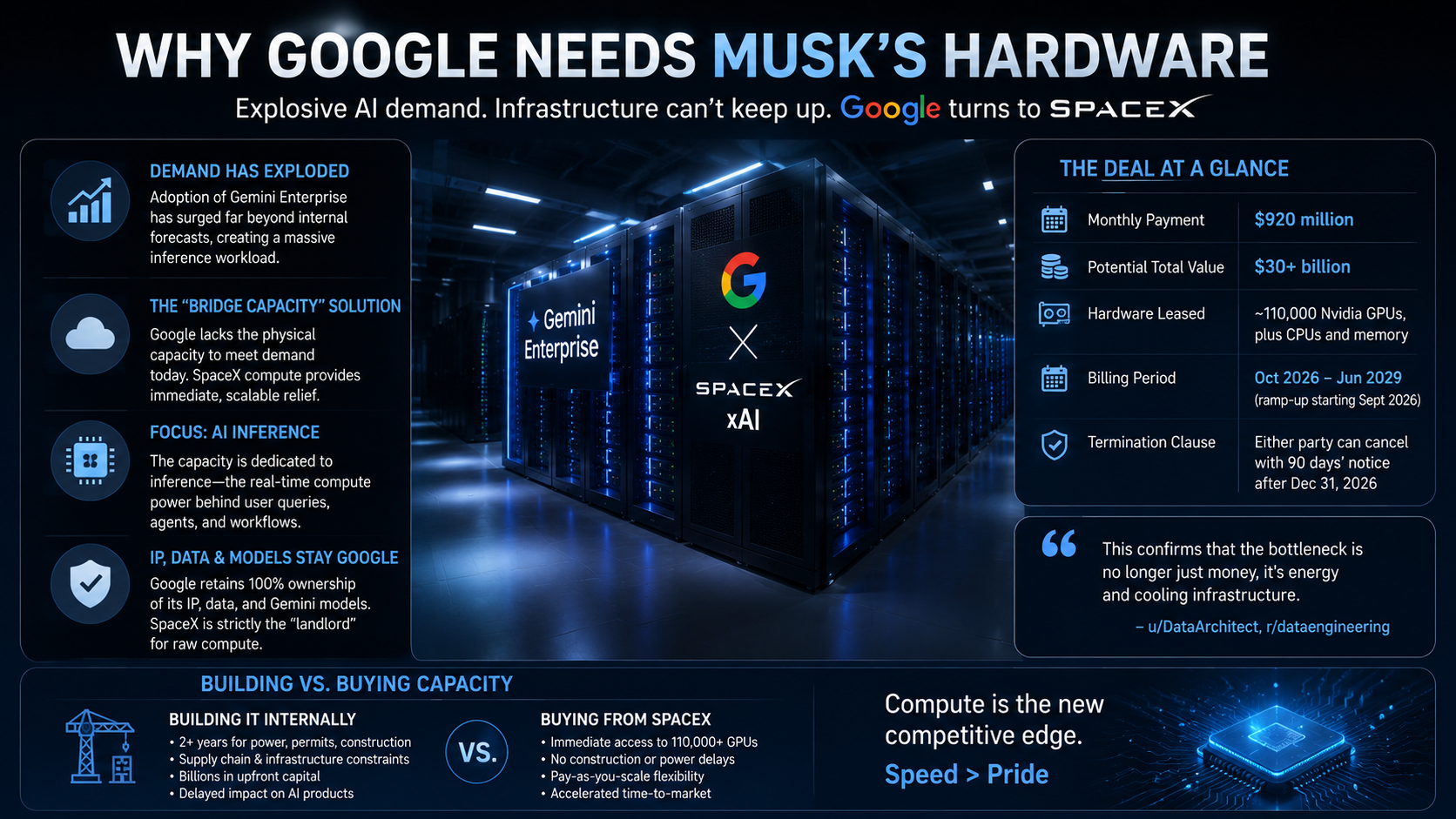
A Google Cloud representative reportedly acknowledged that adoption of Gemini Enterprise products significantly exceeded forecasts. The challenge isn't model quality. It's capacity.
Every AI query requires inference. Every enterprise agent, chatbot interaction, document search, and automated workflow consumes compute resources. As AI products move from experimentation into production, demand compounds rapidly.
Google traditionally solved scaling problems by building more infrastructure. This time, construction timelines became the bottleneck.
New hyperscale data centers require land acquisition, power agreements, cooling systems, networking equipment, regulatory approvals, and years of physical construction. Many regions now face electrical grid constraints that delay deployment even further.
Rather than waiting, Google appears willing to treat compute as a commodity.
The company retains ownership of its Gemini models, customer data, and intellectual property. SpaceX simply provides the horsepower.
That distinction matters.
Google isn't outsourcing AI development. It is outsourcing infrastructure capacity.
The xAI Factor Nobody Can Ignore
The GPUs powering this agreement reportedly come from facilities originally built for xAI, including infrastructure associated with the massive Colossus footprint in Memphis, Tennessee.
That creates an uncomfortable contradiction.
Google now relies on computing resources operated by an organization controlled by Elon Musk—a businessman actively building AI products that compete with Google's own ecosystem.
Critics immediately framed the arrangement as a bailout.
The skepticism stems from numbers disclosed in the IPO filing. SpaceX revealed that xAI generated approximately $3.2 billion in revenue while posting a $6.4 billion operating loss.
Against that backdrop, a contract worth nearly a billion dollars every month looks less like ordinary cloud leasing and more like a financial lifeline.
Reddit and industry forums quickly seized on the optics.
One commenter on r/technology noted how conveniently the contract's flexible expiration aligns with the IPO timeline. Others argued the agreement confirms that the AI bottleneck has shifted beyond capital and into power, cooling, and infrastructure availability.
Both observations carry weight.
The Financial Engineering Argument
Another layer makes the transaction even more intriguing.
Google isn't merely a customer.
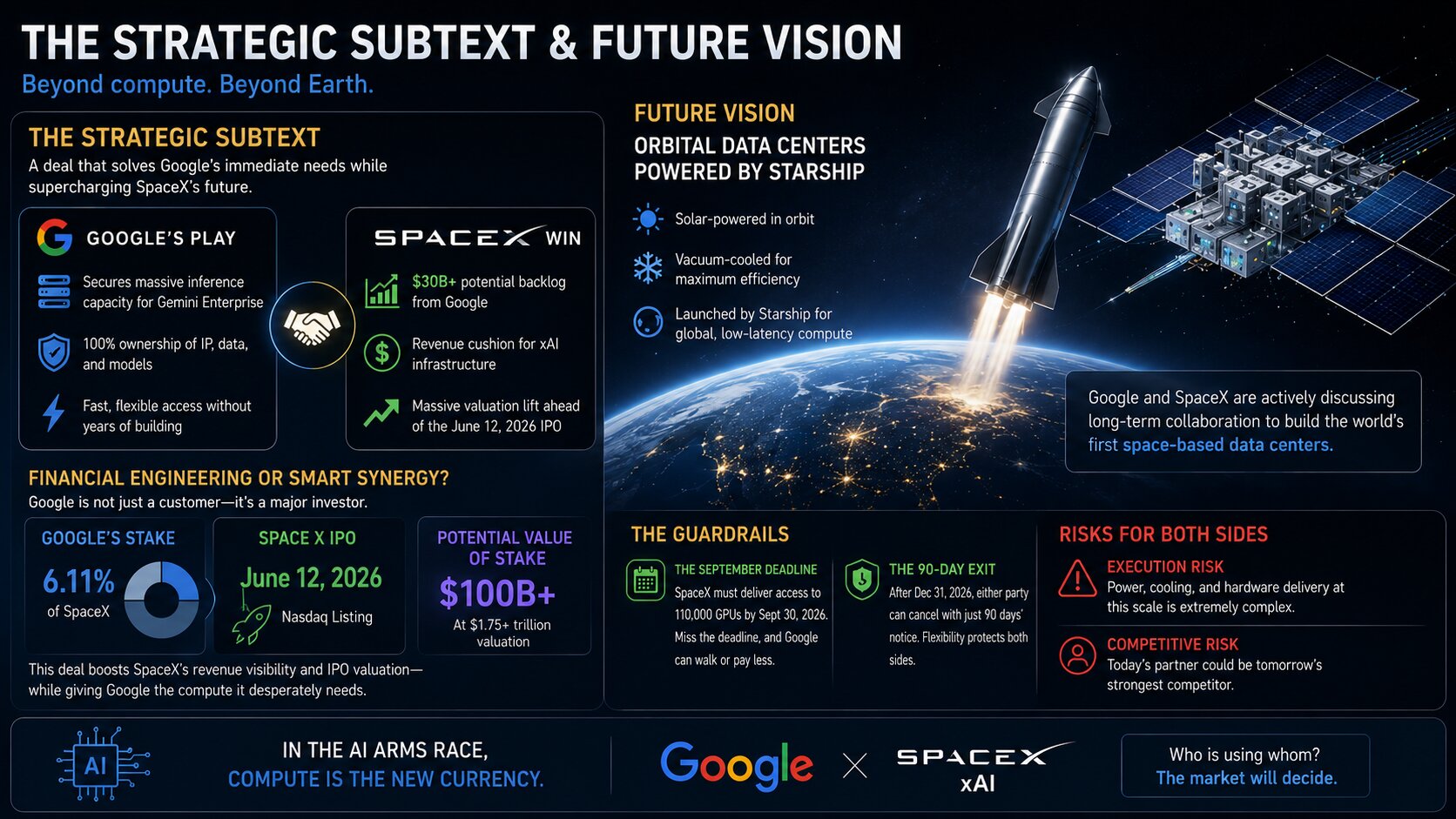
It also owns an estimated 6.11% stake in SpaceX, making it one of the company's most significant outside investors.
If SpaceX achieves its targeted valuation of roughly $1.75 trillion, Google's ownership stake could be worth well over $100 billion.
Viewed through that lens, the contract serves two purposes simultaneously.
First, it solves Google's near-term compute shortage.
Second, it strengthens the investment narrative behind a historic IPO.
Wall Street analysts have already highlighted this dynamic. Revenue visibility from Google and Anthropic—another reported customer paying roughly $1.25 billion per month for compute capacity—helps reposition SpaceX from a capital-intensive aerospace company into a high-margin AI infrastructure platform.
Investors assign very different multiples to those businesses.
The distinction could influence hundreds of billions in market value.
Safeguards Hidden in the Fine Print
Google did not write a blank check.
The contract reportedly includes strict performance requirements.
SpaceX must deliver access to the promised 110,000 GPUs by September 30, 2026. Failure to meet that deadline gives Google the right to reduce payments or exit entirely.
That provision shifts significant execution risk back onto SpaceX.
Building massive GPU clusters sounds simple on paper. In practice, operators must secure hardware, power generation, networking equipment, cooling infrastructure, and technical staffing at unprecedented scale.
Any delay could jeopardize a revenue stream worth nearly $1 billion every month.
Google's negotiators clearly anticipated that possibility.
Beyond Earth: The Orbital Data Center Vision
The most futuristic detail appears near the end of the filing.
Google and SpaceX reportedly continue discussions around orbital computing infrastructure.
The concept sounds like science fiction: solar-powered data centers operating in space, cooled by the vacuum environment and launched using Starship.
Today, such projects remain largely theoretical.
Yet the conversation reveals how both companies view the future. They are no longer competing solely for better AI models. They are competing for energy, cooling, and compute capacity.
In that race, infrastructure becomes strategy.
The central question isn't whether this agreement qualifies as a bailout or a partnership. It may be both.
Google needs immediate compute. SpaceX needs credible, recurring revenue ahead of its IPO. Each side gains something the other cannot easily create alone.
The result is one of the most consequential AI infrastructure deals ever signed—and a reminder that in the current AI arms race, access to GPUs may matter more than ownership of the algorithms running on them.