The 50k SIP Blueprint: Should You Index or Go Active?
With fresh salary increments and a new financial year underway, young professionals are rushing to deploy capital into mutual funds. We break down the 'Core-Satellite' strategy to help you balance low-cost passive index funds with high-conviction active management for long-term growth.

Photo by Markus Winkler on Pexels
The 50k SIP Blueprint: Should You Index or Go Active?
With the financial year in full swing and the post-hike salary credits hitting bank accounts, young professionals are recalibrating their financial futures. For many, the move from 'saving' to 'optimizing' hits a critical milestone: the 50,000 INR monthly SIP. It is the point where passive index tracking begins to clash with the desire for market-beating alpha, leaving many investors caught in the crossfire of the "Index vs. Active" debate.
The 50k SIP Reality Check: Understanding Asset Allocation
At a 50k monthly commitment, your portfolio is no longer just a collection of funds; it is a serious engine for compounding. A common pitfall for young investors is "SIP fatigue"—the tendency to spread capital across 8 to 10 different schemes, resulting in extreme over-diversification that mirrors the index while stripping away the potential for outperformance.
To move beyond this, we recommend the 'Core-Satellite' strategy. By allocating 60-70% of your capital into low-cost index funds, you build a foundation of stability that tracks the broader Nifty 50 or Next 50. The remaining 30-40% is your satellite, a high-conviction space dedicated to active mid-cap or sectoral funds that possess the agility to beat the benchmark.
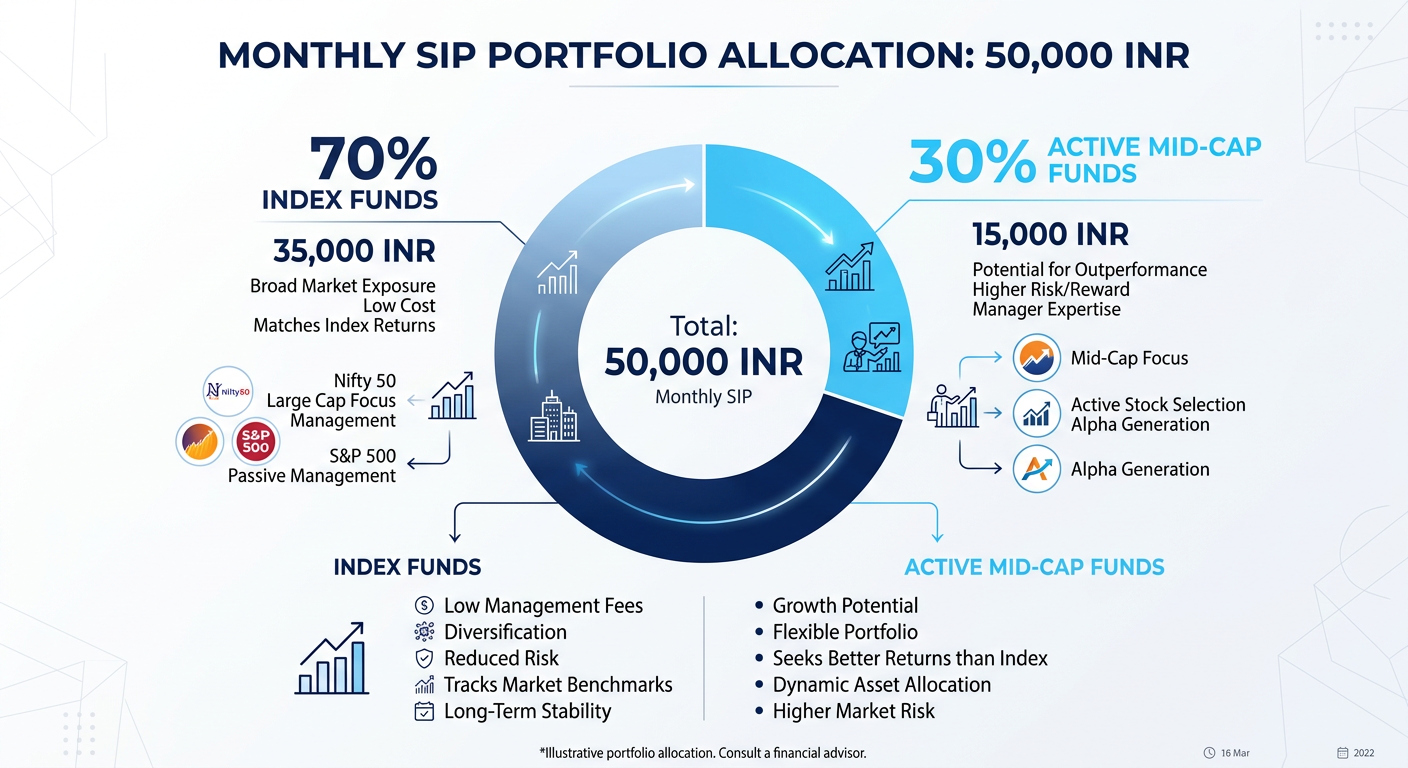
Index vs. Active: Debunking the Alpha Myth
While the passive movement is gaining momentum, active management in India remains a nuanced play. Mid-cap managers have historically delivered alpha, but investors must look past the headline returns. Once you factor in an expense ratio that is often 1% to 1.5% higher than index funds, the "excess return" begins to thin out significantly over a 10-year horizon.
Index funds offer a clear advantage in tax efficiency and transparency, but active funds provide the "psychological asset allocation" that keeps young investors engaged. If you are tempted by active management, ensure the fund manager has a proven record of navigating at least one full market cycle (e.g., 2020 volatility). If they haven't beaten the Nifty Midcap 150 index on a rolling 5-year basis, the "high conviction" label is likely just a marketing term for high fees.
When to Hire vs. DIY: The Hidden Costs of Self-Management
Self-management at a 50k monthly level is sustainable, but only if you have the temperament to ignore short-term "noise." As your corpus scales beyond 10-15 lakhs, the complexity of tax-loss harvesting—balancing capital gains against the new tax regime—becomes a technical burden.
This is where 'Behavioral Alpha' enters the equation. A fee-only advisor doesn't just pick funds; they provide the intervention required during market drawdowns, preventing emotional exits. If you find yourself checking your portfolio daily or frequently asking for advice on forums, you have hit the inflection point where a professional is no longer an expense, but an asset.
The Risk Corridor: Small-cap Exposure
Should your 50k blueprint include small-caps? The short answer is yes, but only as a volatility hedge, not a primary driver. We suggest capping small-cap exposure at 10-15% of your total monthly outflow. Small-caps offer high growth potential but come with liquidity risks that can be catastrophic for an early-career investor who might need to withdraw capital in a hurry.
As your SIP grows beyond 50k, rebalancing becomes mandatory. If your mid-cap satellite grows to represent 60% of your portfolio due to outperformance, trim it back to your target allocation and redistribute the gains into your index core.
Bottom Line
Don't let the quest for the "perfect" fund prevent you from starting. Whether you go 100% index or follow the 70/30 core-satellite blueprint, the most important metric for an investor under 30 is the consistency of the SIP inflow. Start simple, automate your investment, and revisit your allocation only once every six months. The market rewards those who stay in the game longer than those who play it the most aggressively.