The 99% Discrepancy: Deconstructing SEBI's 'Mind-Boggling' Claims Against Rajesh Exports
SEBI’s stunning interim order alleging a ₹15.15 lakh crore revenue inflation has sent shockwaves through the market, casting doubt on the financial integrity of one of India’s largest gold refiners. We break down the forensic findings versus the company's defense as institutional investors like LIC face mounting scrutiny.
The 99% Discrepancy: Deconstructing SEBI's 'Mind-Boggling' Claims Against Rajesh Exports
In the high-stakes world of Indian corporate finance, few numbers have ever triggered as much visceral panic as ₹15.15 lakh crore. This figure—an amount roughly equivalent to the GDP of a mid-sized economy—sits at the heart of an interim order by the Securities and Exchange Board of India (SEBI) against gold refinery giant Rajesh Exports. As share prices hit lower circuits and retail investors scramble for answers, the gap between the company’s bullish defense and the regulator's forensic findings has opened a massive crater in the firm's credibility.
The Anatomy of a ₹15 Lakh Crore Allegation
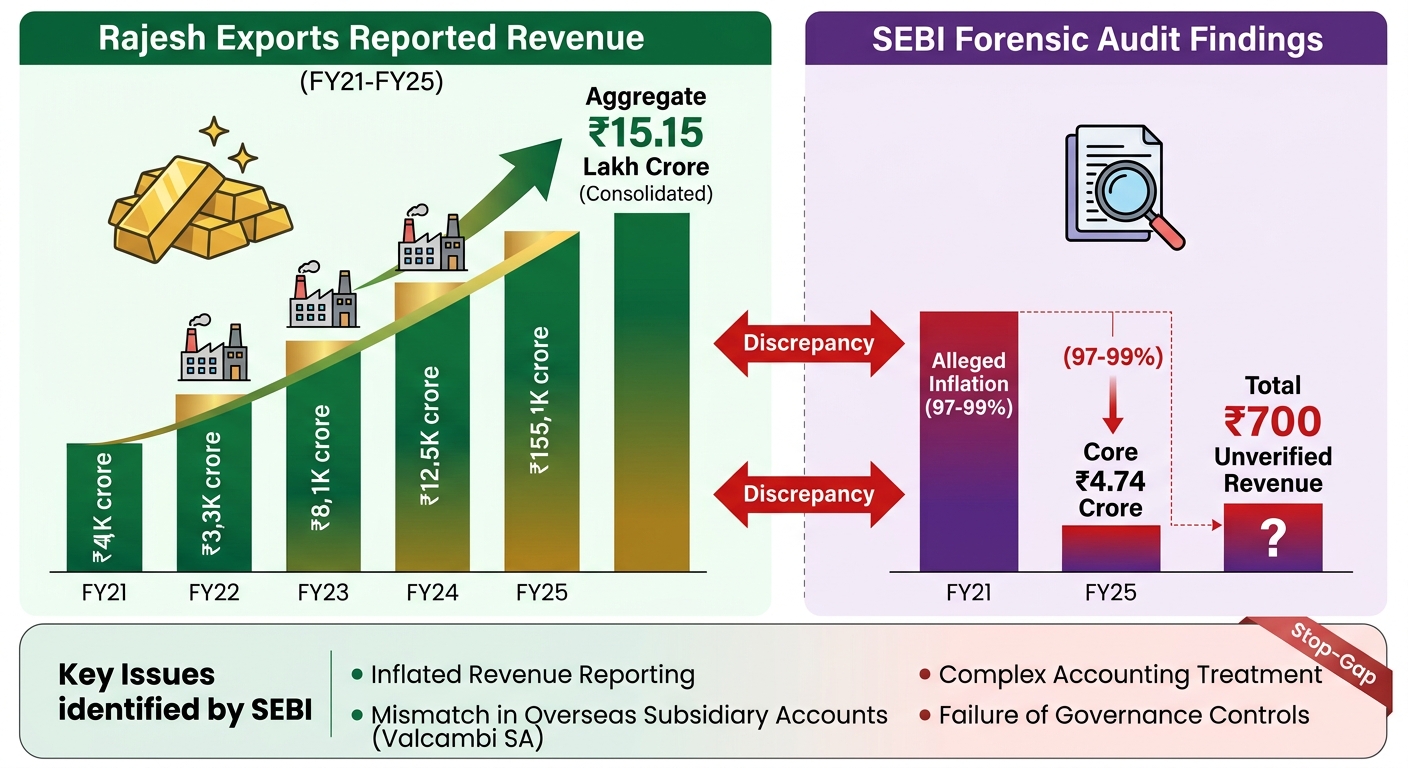
SEBI’s interim order paints a picture of systemic financial distortion. According to the regulator, Rajesh Exports allegedly inflated its consolidated revenues by a staggering 97-99% over the FY21-FY25 period. While the headline number of ₹15.15 lakh crore sounds cataclysmic, market analysts are quick to note that this is a 5-year aggregate figure, not a single-year revenue gap.
Rajesh Exports, however, maintains that this is a case of a "communication gap" rather than malfeasance. The company argues that the discrepancy arises from a fundamental misunderstanding of its business model—specifically, how it accounts for "processing fees" versus "gross trade value." They contend that their disclosures are accurate and that the regulator is misinterpreting the scale of their physical gold operations.
The Valcambi Factor: Layers of Complexity
Central to this dispute is Valcambi SA, the Swiss gold refinery acquired by Rajesh Exports in a deal that was once hailed as a crowning achievement for Indian global expansion. SEBI’s forensic audit highlights a troubling mismatch between the consolidated accounts presented in India and the actual audited financials of overseas subsidiaries.
For retail investors, Valcambi represents the ultimate "blind spot." Complex, multi-jurisdictional structures often mask the movement of capital and goods. SEBI suspects that the revenue layering may be inflated by these international reporting standards, creating an illusion of scale that isn't supported by hard cash flows. If the "operating entity" is merely a shell for booking turnover, the entire consolidated revenue structure could be essentially hollow.
Institutional Blind Spots and the LIC Exposure
The crisis has turned political. With the Life Insurance Corporation of India (LIC) holding a 10.8% equity stake in the firm, questions regarding due diligence have reached the floor of Parliament. Critics are now questioning why a state-backed institutional giant failed to detect potential financial irregularities that a forensic probe seemingly uncovered with relative ease.
Governance Failures and Regulatory Next Steps
Where were the independent directors? The board’s role in verifying these massive revenue streams is now under the microscope. An interim order is not a final judgment—it is a preventative "stop-gap" to protect the integrity of the market. However, for a company heavily reliant on debt, the inability to trade freely or provide "clean" disclosures could trigger a liquidity crunch that a formal "guilty" verdict might not even be required to initiate.
This case is poised to reshape accounting standards for Indian gold refineries. The regulators are clearly signaling an end to the era of "trust-me" accounting, where multi-billion dollar firms could mask internal operations behind complex overseas corporate structures.
Bottom Line
Whether this is a genuine accounting misunderstanding or a coordinated effort to mask the true health of the company, the Rajesh Exports saga is a masterclass in the dangers of institutional "blind spots." Until the company can reconcile its books with the regulator’s forensic audit, the ₹15.15 lakh crore figure will remain a heavy shadow over its future.