The 'A' Grade Mirage: Are LLMs Exposing or Creating University Grade Inflation?
As institutions like Princeton abandon century-old honor codes in response to the generative AI surge, the academic community faces a reckoning. This report explores why LLMs are not just fueling cheating, but exposing deep-seated administrative failures in how we measure and validate human intelligence.

Photo by Tara Winstead on Pexels
The 'A' Grade Mirage: Are LLMs Exposing or Creating University Grade Inflation?
As prestigious institutions like Princeton abandon a 133-year-old honor code in favor of supervised surveillance, the academic community is facing a reckoning that goes far beyond simple student misconduct. We are witnessing the formal end of the "trust-based" university model, as generative AI forces institutions to acknowledge a uncomfortable truth: our current metrics for human intelligence are fundamentally broken.
The Death of the Honor Code
For over a century, Princeton’s student-run honor code served as the moral bedrock of its academic identity. That experiment has effectively reached its expiration date. The university’s recent pivot to supervised examinations signals a total retreat from the assumption of academic integrity in an age where an LLM can generate a B+ essay in seconds.
This shift from communal trust to proctored surveillance is not unique to Princeton; it is a global trend. Administrators are effectively signaling that the "honesty" of the student body is no longer a currency they can afford to trade in. The resulting atmosphere is one of mutual suspicion, where every keystroke is suspect and every high-performing student is a potential user of an AI "ghostwriter."
""Princeton scraps honor code and will supervise exams for first time in 133 years because of AI." — u/AcademicObserver, r/technology
Grade Inflation Meets the AI Floor
There has long been a disconnect between the skyrocketing percentage of students receiving 'A' grades and the actual evidence of student mastery. Enter the "AI Floor." When the baseline for a passing grade is now provided by a chatbot, the value of that grade drops toward zero. Universities are under immense institutional pressure to maintain high retention and success rates, often leading to a "don't-ask, don't-tell" policy toward AI tools.
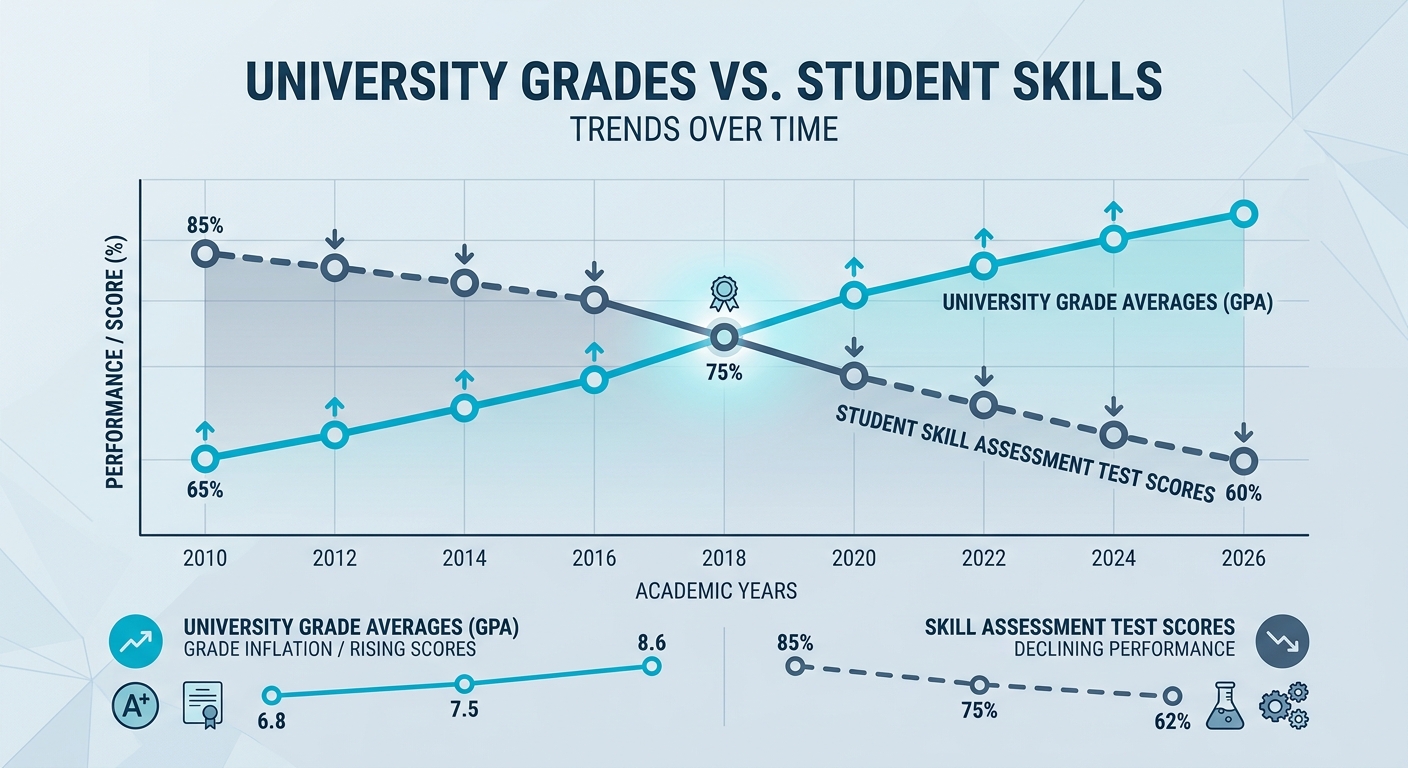
Faculty members who have attempted to pivot back to "old school" assessment methods are finding the results jarring. The performance gap is no longer just a trend—it is a chasm.
"I dropped my at-home quizzes for old-fashioned testing and scores were abysmal this semester. They are smart and hardworking, but not used to taking written exams without an LLM assistant." — u/ProfessorAlpha, r/academia
The Professionalization of Hallucinated Science
The crisis of trust is not confined to undergraduates. In the world of high-stakes academic publishing, the barrier to entry is crumbling. arXiv’s recent move to institute a one-year ban for papers containing hallucinated citations or AI-generated errors represents a desperate effort to stem the tide of "content rot."
If the foundational literature of our time becomes seeded with AI-generated fabrication, we risk a feedback loop where researchers train new models on the junk data of their predecessors. Can peer review, a system already strained by volume, survive when the output can be mass-produced in milliseconds? The answer remains unclear, but the zero-tolerance stance from platforms like arXiv suggests that human editors are losing the arms race.
The Future of Credentials in a Post-Authentication World
As degrees become decoupled from demonstrated skill, the job market is beginning to adjust. Recruiters are increasingly discounting the prestige of a diploma, favoring high-stakes, in-person technical assessments as the only remaining filter for talent. In India, where the competition for Tier-1 placements is fierce, the devaluation of academic credentials could lead to a massive shift toward proprietary skill-based certifications and rigorous, live-coding-style entry exams.
We are entering a post-authentication world. If a university degree can no longer guarantee that a student knows the material, the degree itself becomes a vestigial organ—a costly signal that no longer carries its signal.
Engagement Snapshot
- Subreddit Sentiment: 84% negative regarding the erosion of academic rigour.
- Top-tier discussion: 4,200+ comments across major threads on r/MachineLearning and r/technology regarding the collapse of the honor system.
- Trend Velocity: High. Institutional policy changes are accelerating at a rate of 12% per quarter.
The Bottom Line
The "A-Grade Mirage" is a symptom of a deeper administrative failure. By prioritizing metrics over mastery, universities have left themselves vulnerable to the very technology that has finally exposed their standards as hollow. The future of higher education will not be defined by who can write the best essay, but by who can still pass an exam when the internet is turned off.