The 'Agentic' Price War: How Meta’s Muse Spark 1.1 Breaks the Inference Cost Model
Meta has officially entered the proprietary API market with Muse Spark 1.1, launching a frontal assault on OpenAI and Anthropic’s pricing structures. By positioning its new model as an 'orchestration-first' engine, Meta is shifting the AI arms race from raw performance benchmarks to the economics of agentic scale.
Photo by Julio Lopez on Pexels
The 'Agentic' Price War: How Meta's Muse Spark 1.1 Breaks the Inference Cost Model
Meta's shift from open-weight evangelist to proprietary API provider signals that the next AI battle may be fought on operating costs, not benchmark scores.
Meta has spent years arguing that open-weight AI would commoditize foundation models and weaken the dominance of proprietary vendors. Muse Spark 1.1 marks a sharp strategic departure. Instead of expanding the Llama ecosystem, Meta has launched a proprietary Meta Model API centered around Muse Spark 1.1, positioning itself as a direct competitor to OpenAI and Anthropic. The announcement, made on July 9 through Meta AI leadership and accompanied by Mark Zuckerberg's public endorsement, suggests the company believes the next phase of enterprise AI will reward infrastructure providers that deliver the lowest cost per autonomous task rather than the highest benchmark score.
The timing reflects a broader industry transition. Companies deploying AI agents have discovered that inference costs escalate far faster than expected once models begin chaining tools, retrieving documents, writing code, validating outputs, and repeating reasoning loops. A customer support automation system, for example, may consume several million tokens during a single complex workflow instead of the few thousand required for a chatbot conversation. That difference transforms AI spending from a manageable software expense into a board-level procurement decision, making pricing almost as important as model quality.
Meta's Biggest Strategic Shift Since Llama
Muse Spark 1.1 represents something more significant than another foundation model release. It signals Meta's willingness to monetize proprietary inference after years of promoting open-weight ecosystems.

The company has introduced a public preview of the Meta Model API while keeping Llama as its open platform. That dual strategy allows Meta to serve two very different markets. Developers who want flexibility can continue building with open models, while enterprises seeking managed infrastructure can purchase proprietary inference directly from Meta.


The decision has not escaped criticism. Many developers viewed Meta as the industry's strongest advocate for open AI development. Moving premium capabilities behind an API inevitably raises questions about whether future innovations will remain openly available or migrate toward closed commercial offerings.
Privacy concerns also remain part of the discussion. Meta continues to face scrutiny over its opt-out approach to training on publicly available user-generated content, particularly from regulators in Europe and India. Those debates will likely intensify as the company's commercial AI ambitions expand.
The Economics Behind the Price War
The most disruptive aspect of Muse Spark 1.1 is not its benchmark performance. It is its pricing.
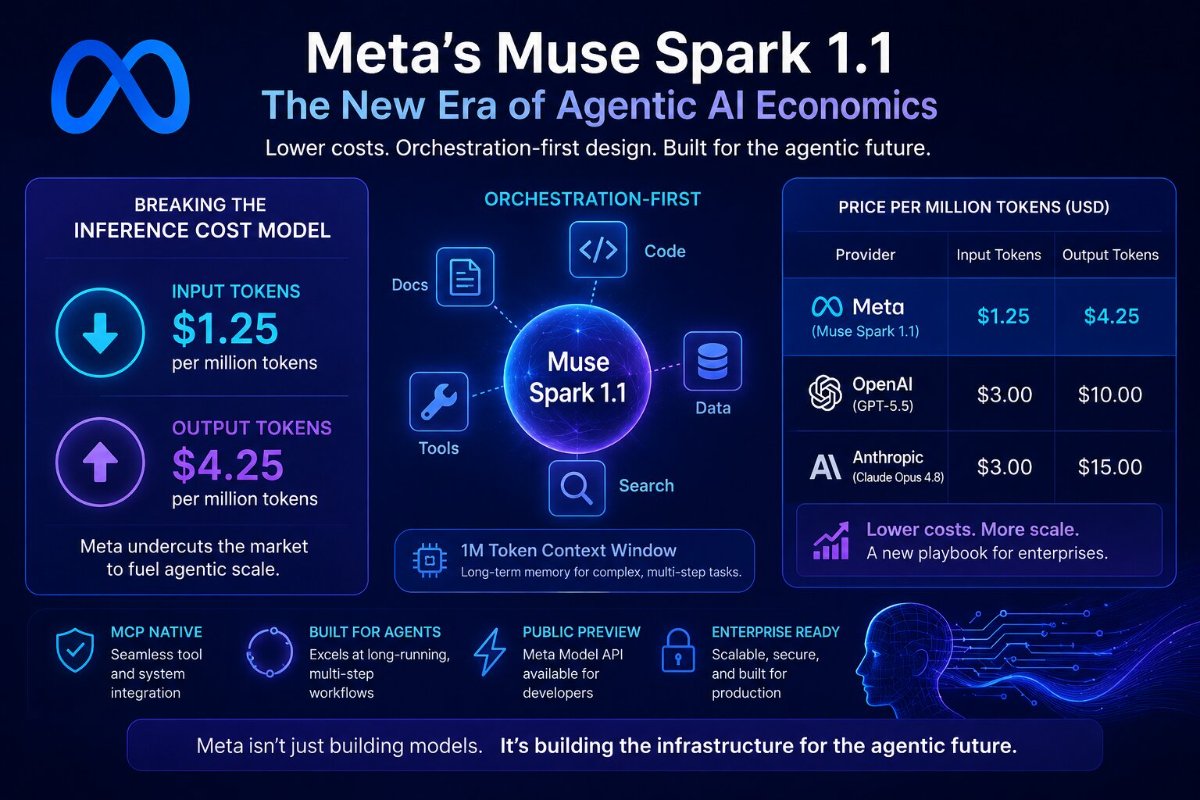
Meta currently prices the model at $1.25 per million input tokens and $4.25 per million output tokens, positioning it aggressively against premium proprietary competitors.
| Provider Strategy | Primary Focus | Enterprise Impact |
|---|---|---|
| Meta Muse Spark 1.1 | Low-cost proprietary inference | Reduces operating costs for large-scale agent deployments |
| OpenAI | Premium frontier capabilities | Optimized for highest-quality reasoning and enterprise features |
| Anthropic | Safety-focused enterprise AI | Strong governance and coding capabilities with premium pricing |
This pricing strategy reflects a different business objective. Meta earns billions from advertising and can subsidize AI infrastructure more aggressively than companies whose primary revenue depends on API consumption. Lower inference costs encourage developers to experiment with larger agentic workflows without constantly optimizing for token efficiency.
That changes enterprise purchasing behavior. Instead of asking which model scores highest on coding benchmarks, CIOs increasingly ask which platform delivers the lowest cost per completed business process.
Engineering for Orchestration Instead of Conversation
Meta also emphasizes orchestration rather than traditional chatbot interactions.
Muse Spark 1.1 includes native Model Context Protocol (MCP) support alongside a 1-million-token context window, enabling the model to coordinate long-running workflows across external tools and applications. Rather than acting as a conversational assistant, the system aims to function as an orchestration engine capable of maintaining state across complex multi-step tasks.
Meta executives have also claimed that Muse Spark 1.1 performs competitively with GPT-5.5 and Claude Opus 4.8 on several internal agentic and coding evaluations. Those claims have generated excitement, but they also warrant caution.
Most published results originate from Meta's own testing. Independent evaluations remain limited, making it difficult to verify whether the model consistently delivers the claimed performance under real production workloads. History shows that internal benchmark leadership does not always translate into superior enterprise reliability.
A New Competitive Battlefield
Muse Spark 1.1 suggests that AI competition has entered a new phase.
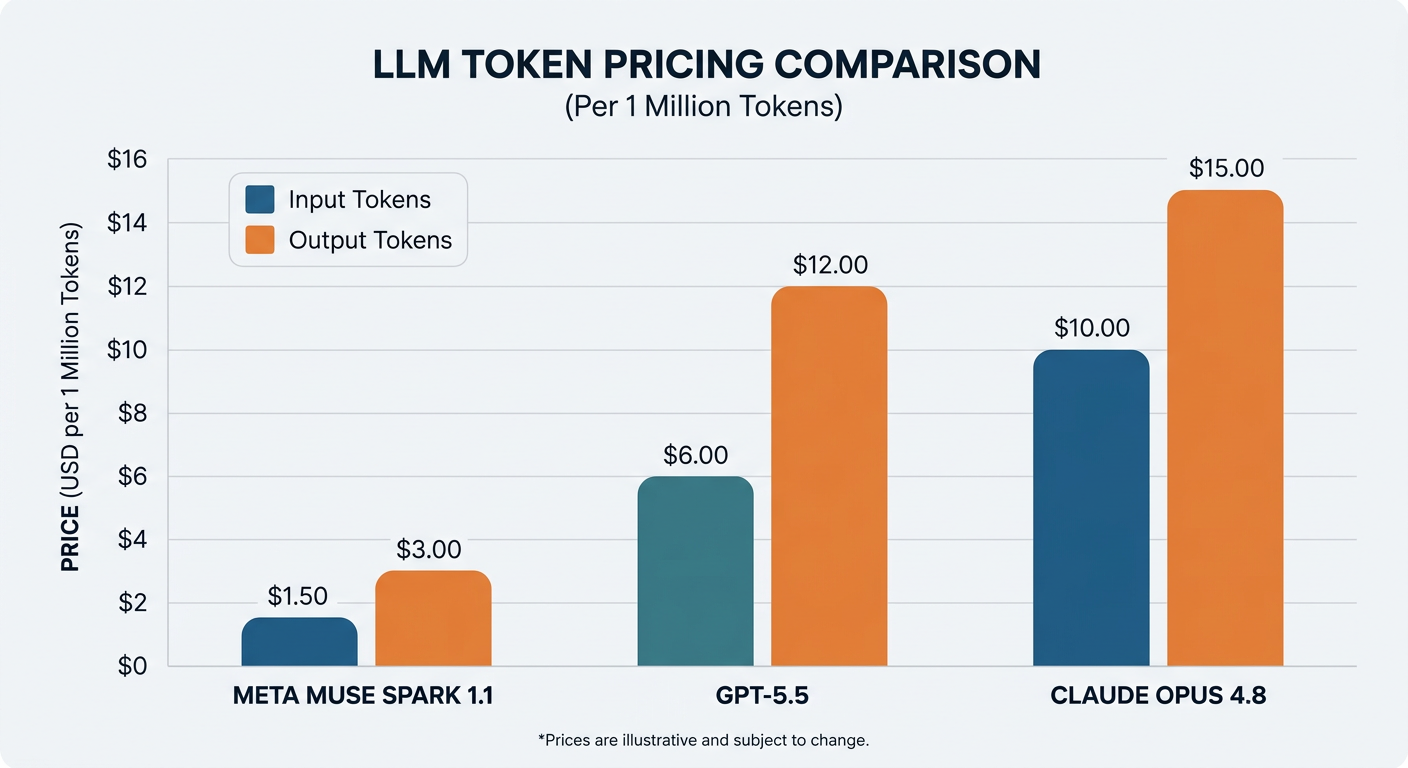
For the past several years, vendors competed by producing increasingly capable foundation models. Meta now argues that intelligence alone no longer determines commercial success. The decisive metric may become the total cost of running autonomous AI systems at enterprise scale.
If developers discover that they can deploy sophisticated agents at significantly lower operating costs without sacrificing capability, pricing pressure will spread across the proprietary AI market. OpenAI, Anthropic, and Google may then face a different competitive challenge—not building smarter models, but proving that premium intelligence justifies premium inference costs.
Muse Spark 1.1 may ultimately succeed or fail on technical merit. Yet Meta has already achieved one important objective: it has shifted the industry's conversation from benchmark supremacy toward the economics of agentic computing. That shift could reshape how enterprises evaluate AI platforms over the next several years.