The "Bargain" Trap: Why Buying More of a Crashing Stock Destroys Wealth
When an item goes on sale at a grocery store, buying more of it is a great way to save money. But applying this same logic to the stock market is one of the easiest ways to accidently drain your savings. Here is a simple, non-technical breakdown of why buying more of a losing investment backfires, and how a strategy called "pyramiding" uses the power of momentum to build lasting wealth.

Photo by Andy Barbour on Pexels
The "Bargain" Trap: Why Buying More of a Crashing Stock Destroys Wealth
Imagine you buy shares of a well-known company at ₹500. A few weeks later, you open your trading app and notice the price has slid down to ₹400. Your screen is flashing red, showing a clear loss.
Instantly, a natural shopping instinct kicks in: “Hey, it’s the exact same company, but now it’s on a 20% discount! If I buy more shares right now at ₹400, I will lower my average buying price to ₹450. That way, when the stock goes back up, I’ll recover my money much faster.”
In the financial world, this habit is called "averaging down" (or more dramatically, catching a falling knife). While it feels like smart bargain-hunting, it is actually one of the most common psychological traps that ends up wiping out the portfolios of regular investors. Here is why this grocery-store logic fails in the market, and what you should be doing instead.
The Core Trap: Why a Stock "On Sale" Is Often a Warning Sign
The reason we love discounts at the supermarket is because a bar of soap or a packet of biscuits doesn't change its internal value just because the store lowered the price.
But a stock is not a consumer product. A stock represents a tiny, living slice of a real business. When a stock's price collapses continuously while the rest of the market is doing fine, it is almost never a random "holiday discount." It means the big, professional institutions—who manage thousands of crores and hire teams of experts to audit companies—have discovered something deeply wrong with the business and are quietly selling off their shares.
When you buy more of a crashing stock, you are effectively breaking the golden rule of business: you are throwing extra money at your worst-performing asset.
Historically, companies that suffer massive price drops rarely bounce right back. Instead, they often enter a long, slow decline. By doubling down on a losing investment, you trap your hard-earned savings in a sinking ship, missing out on great companies that are actually growing and making money every day.
Quick Overview: Fixing the Mistake vs. Funding Success
To understand why successful long-term investors refuse to buy more of a crashing stock, look at how the two different mindsets handle their cash:
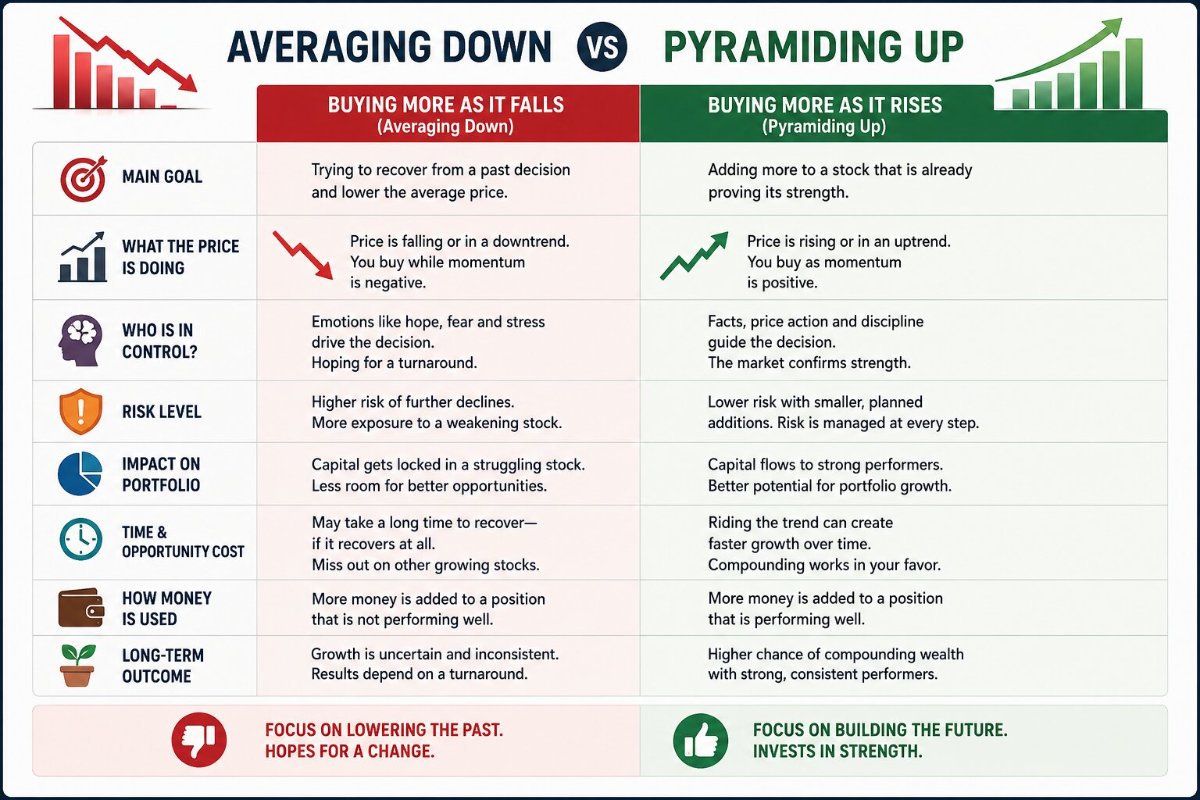
The Pyramid Secret: How Buying Winners Generates Massive Compounding
If buying a crashing stock is a wealth killer, how do the world's most successful investors build lasting fortunes? They use a simple, geometric system called Pyramid Buying (Averaging Up).
Instead of dumping 100% of your savings into a stock on day one, you treat your first purchase as a small "experiment." You only allow yourself to buy more shares if the stock rewards you by going up in price.

This simple pyramid structure creates a massive compounding effect for your wealth due to three straightforward reasons:
-
You Only Feed Winners: Because you are strictly banned from adding money to a stock that is dropping, you mathematically ensure that your largest amounts of cash are automatically invested in your absolute best-performing companies.
-
The Magic of Compounding Interest: Compounding works best when you leave your money in an asset that is moving upward. By pyramiding into a rising stock, your early, lower-priced shares start generating massive "paper profits." These profits act as a safety cushion, allowing your total portfolio value to grow exponentially without exposing your original bank balance to high risks.
-
Built-in Protection: If a stock you buy starts crashing immediately, your pyramid rules ensure you only own your small, initial "Step 1" baseline. You never end up holding a massive amount of shares in a failing company, keeping your overall losses incredibly small and easy to manage.
The Bottom Line
True financial peace of mind doesn't come from tracking down cheap stocks on a deep discount, nor does a temporary price drop mean a company is structurally flawed markets frequently overreact to short-term hurdles. The real challenge is that continuously adding your hard-earned cash to a rapidly falling stock locks up your capital in a stagnant asset, completely stalling your growth engine.
Real wealth creation relies entirely on the math of healthy compounding. Compounding needs momentum; it multiplies beautifully when your money is left to grow in stable or appreciating assets. By protecting your cash reserves, keeping your initial experimental losses small, and using a disciplined pyramid structure to invest only as a stock establishes a clear upward stability, you ensure your savings are always feeding your true compounders rather than trying to rescue a losing position.