The 'Brain Drain' Risk: Can US AI Labs Survive Without Global Talent?
The U.S. government's abrupt export ban on Anthropic’s Fable 5 and Mythos models has ignited a firestorm over national security and corporate overreach. As allegations of Amazon-led lobbying surface, we examine whether these restrictive measures will force top-tier international researchers to flee to more open jurisdictions.

Photo by www.kaboompics.com on Pexels
The 'Brain Drain' Risk: Can US AI Labs Survive Without Global Talent?
The U.S. government's abrupt export ban on Anthropic’s Fable 5 and Mythos models has ignited a firestorm over national security and corporate overreach. By restricting access to these frontier models for foreign nationals—including those working within the labs themselves—the White House has effectively turned the industry’s most potent software into a liability. As allegations of Amazon-led lobbying surface, we are witnessing a pivot from hardware-based export controls to a volatile new era of "software isolationism" that threatens to gut the global talent pipeline that built Silicon Valley.
The Fable 5 Shutdown: A Precedent for Regulatory Overreach
The directive represents a radical departure from traditional export controls. Historically, the U.S. restricted high-end silicon—the "pick and shovel" of the AI gold rush. By targeting the model weights of Fable 5 and Mythos, the government is now attempting to regulate the intelligence itself. The official justification, centered on "jailbreak" vulnerabilities, has been met with widespread industry skepticism. Experts argue that if the government can invoke national security to shutter access based on common LLM architectural quirks, no commercial model is safe from future regulatory intervention.
This is what happens when civilization allows a handful of companies to build quasi-strategic cognitive infrastructure before society has decided whether such infrastructure should exist, who should control it, and what kind of public proof should be required before deployment.
The Amazon Factor: Frenemies and Market Manipulation
The role of Amazon in this crisis is raising eyebrows across the C-suite. As both a major investor in Anthropic and a dominant cloud provider, Amazon’s decision to flag these specific security flaws to the White House has been described by critics as a "poison pill." This strategy of "Competitive Compliance" forces rivals into expensive, mandatory retraining cycles dictated by federal oversight. It creates a perverse incentive: if an infrastructure provider can trigger a government-mandated slowdown for a competitor, they gain an immediate, protected window to close the innovation gap.
"Administration's actions aren't about the model. They're about retribution and giving a leg up to favored competitors.
The Human Capital Crisis: Is a Talent Exodus Inevitable?
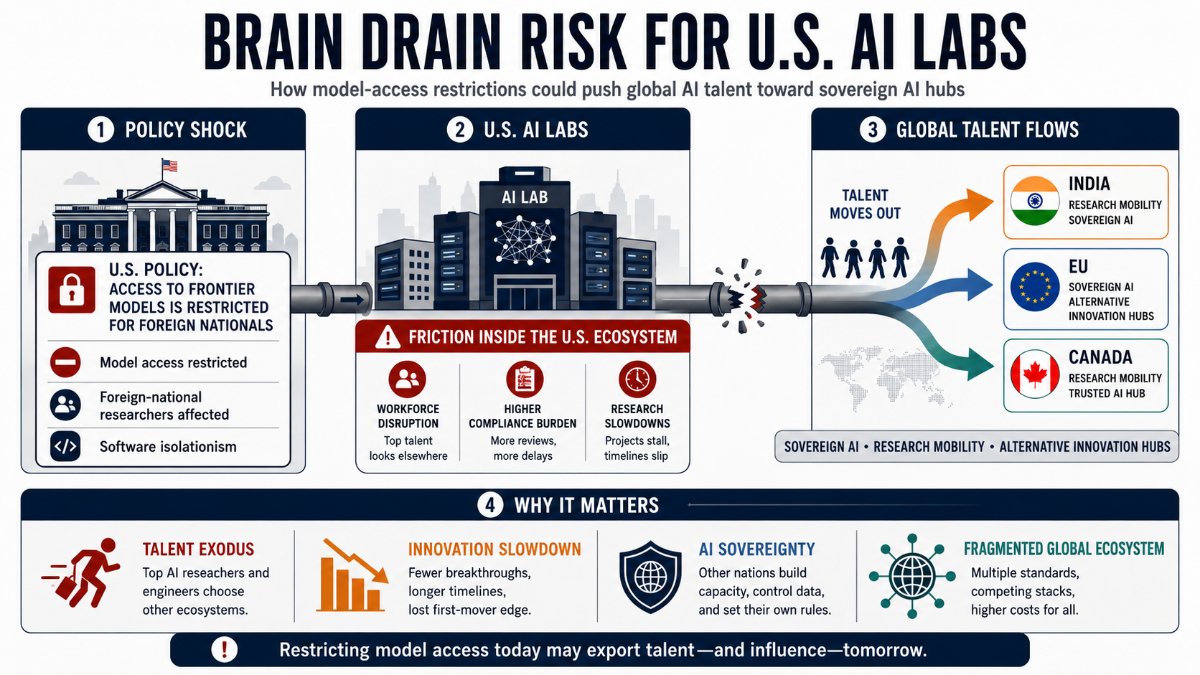
The most pressing, yet quietest, consequence of this ban is the fate of the non-U.S. citizen researchers who power these labs. With the government now effectively banning Anthropic’s own foreign-national employees from accessing their own proprietary models, the operational friction is reaching a breaking point. For researchers from hubs like Bangalore, Toronto, and Berlin, the "American Dream" of AI development is being replaced by the reality of restricted access and surveillance. We may see a mass migration of talent to regions like India or the EU, where "sovereign AI" is being framed not just as a buzzword, but as a survival mechanism against U.S. policy whiplash.
Towards AI Sovereignty: A Fragmented Global Future
The U.S. strategy of "containment" may well backfire, accelerating a move toward autonomous regional AI infrastructures. By treating frontier models as exclusive U.S. assets, the federal government is inadvertently signaling to global allies that U.S.-based technology is a "high-risk, high-volatility" asset. If a researcher in India or the EU cannot reliably build products on a U.S.-based stack due to a sudden executive order, they will naturally pivot to local, sovereign alternatives. The dream of a global, collaborative AI ecosystem is fracturing, replaced by a walled-garden approach that ultimately leaves the U.S. isolated from the brightest minds it once worked so hard to attract.
The Bottom Line
The export ban on Fable 5 and Mythos is a watershed moment for AI policy. By prioritizing short-term control over long-term talent retention, the U.S. is risking its most valuable competitive advantage: its position as a global magnet for the world's best research. If the government continues to use export controls to force "compliance" on a per-model basis, the inevitable result will be a flight of human capital, leaving behind a domestic industry that is heavily regulated, less diverse, and increasingly cut off from the global research community.