The 'Dopamine' Paradox: Why Gen Z is Choosing Fake Apps Over Real Tech
Gen Z is increasingly turning to 'dopamine apps'—low-stakes simulations of reality—to cope with financial and social anxiety. However, this blurred line between intentional fiction and malicious deception is creating a dangerous vulnerability to a new wave of sophisticated digital scams.

Photo by Markus Winkler on Pexels
The 'Dopamine' Paradox: Why Gen Z is Choosing Fake Apps Over Real Tech
Gen Z is increasingly turning to 'dopamine apps'—low-stakes simulations of reality—to cope with financial and social anxiety. However, this blurred line between intentional fiction and malicious deception is creating a dangerous vulnerability to a new wave of sophisticated digital scams, with Indian users increasingly caught in the crossfire.
The Rise of the Digital 'Simulacra'
In the high-pressure ecosystem of modern digital life, reality has become something to be curated or escaped. From South Korea to Bengaluru, a surge of "dopamine sites"—apps that simulate the experience of ordering food, taking a smoke break, or tracking a fictitious salary—are gaining traction. These apps offer a controlled, low-stakes environment that lacks the "perfectionist" pressure inherent in Instagram or LinkedIn.
For a generation battling unprecedented financial anxiety, these simulations act as psychological relief valves. They provide the satisfaction of utility without the risk of real-world consequences. However, this retreat into "safe" digital spaces has inadvertently lowered the collective skepticism of digital natives. When users spend their hours in curated, pleasant simulations, the jarring "uncanny valley" of a phishing link or a fraudulent app becomes harder to distinguish from the intentionally "fake" reality they have grown to prefer.
The Dark Side of the Simulation: From Fun to Phishing
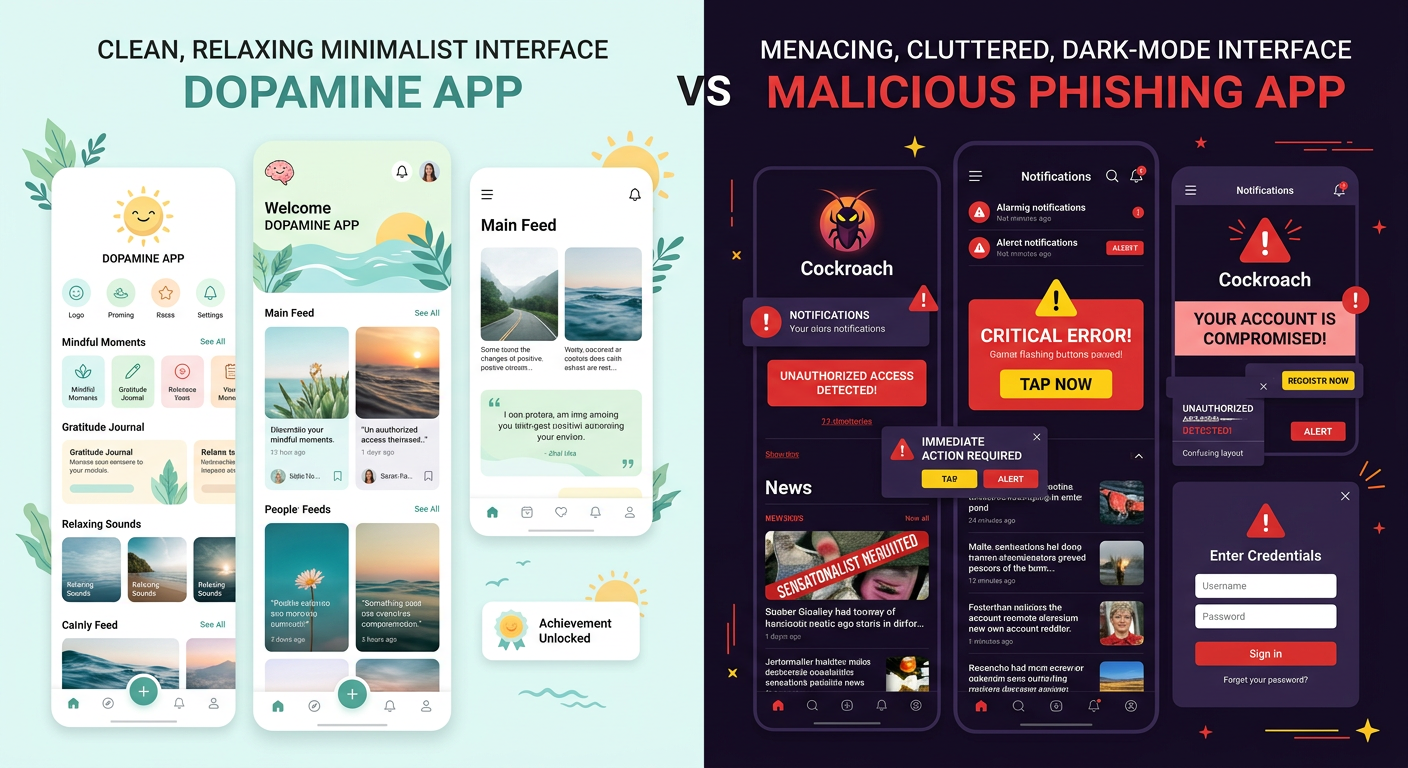
Malicious actors have become experts at exploiting this preference for "resilience-themed" content. In India, the 'Cockroach Janta Party' (CJP) movement has been weaponized as a Trojan horse. By leveraging the branding of a group centered on survival and resilience, attackers create a psychological safety net that makes users lower their defenses against suspicious installation prompts.
Deep-dive analysis reveals that these applications are not just simple phishing portals. Many now embed the CallLogs.smali module. Unlike basic credential-scraping tools, this module allows for persistent device surveillance, effectively turning a user’s smartphone into a window for long-term domestic espionage. By masquerading as political mobilization tools, these apps convince users to grant intrusive permissions that they would otherwise deny to a standard utility app.
Systemic Failure: Responsibility in an Age of Automation
There is a fierce debate brewing: Does the burden of security lie with the user, or have platforms essentially abandoned their duty to police the digital commons? Currently, we rely heavily on manual reporting—a "whack-a-mole" strategy that is fundamentally ill-equipped to combat the sheer scale of automated botnets.
Experts argue that the current surveillance-based business model of major platforms inherently fuels the prevalence of malicious ads. When the goal is maximizing time-on-app and ad-click volume, the barrier to entry for a "fake" app—even one embedded with malicious modules—remains dangerously low.
"There are currently many coins on on-chain DEXes that are impersonating Xeffy’s $Xef. From now on, only contract officially posted on Xeffy’s Twitter are legitimate. All other contracts are scams and impersonating/fake contract." — @Xeffy_io, X
Navigating the New Threat Landscape
As the line between real and fake continues to blur, users must adopt a "Zero Trust" mindset. A non-technical yet essential rule is to avoid apps or services that utilize suspicious domain patterns, such as the frequent use of .info or .site extensions for services that should ideally be hosted on secure, primary domains.
""HATI HATI penipu , scammer apps PREM. QRIS A.n fluffy tangsel. Ini dari yg ditipu tiket cgv." — @bibilypoco, X
For those who have already fallen victim to these scams, the legal reality is stark. In many cases of decentralized finance or app-based fraud, the lack of centralized oversight makes recovery almost impossible.
The Bottom Line
We are living in an era where "fake" is the default setting of the internet. While dopamine-simulating apps provide a necessary reprieve from modern burnout, they are training a generation to accept the non-verifiable as truth. To protect against this evolving threat, we must shift the conversation from individual "digital literacy" to institutional accountability. Until platforms prioritize the integrity of their ecosystems over the scale of their engagement, the burden of security remains, unfairly, on those least equipped to handle it.