The 'ESOP Trap': Why Indian Startup Packages Fail in Global Compensation Comparisons
As senior tech professionals weigh the risks of relocation, a critical analysis of inflated ESOP valuations is exposing a widening gap between paper wealth and real-world liquidity. We dive into the 'phantom wealth' phenomenon and why global markets remain skeptical of Indian startup compensation models.

Photo by Rafael Minguet Delgado on Pexels
The 'ESOP Trap': Why Indian Startup Packages Fail in Global Compensation Comparisons
For the Indian tech veteran, the promise of a "total compensation package" from a high-growth domestic startup often feels like a passport to wealth. Yet, as global markets recalibrate and the funding winter persists, a hard truth is emerging: when held up against international offers, Indian unlisted equity is increasingly viewed as 'phantom wealth.' As senior tech professionals weigh the risks of relocation, a critical analysis of inflated ESOP valuations is exposing a widening gap between paper wealth and real-world liquidity.
The Illusion of Equity: Why ESOPs Are Often Misvalued
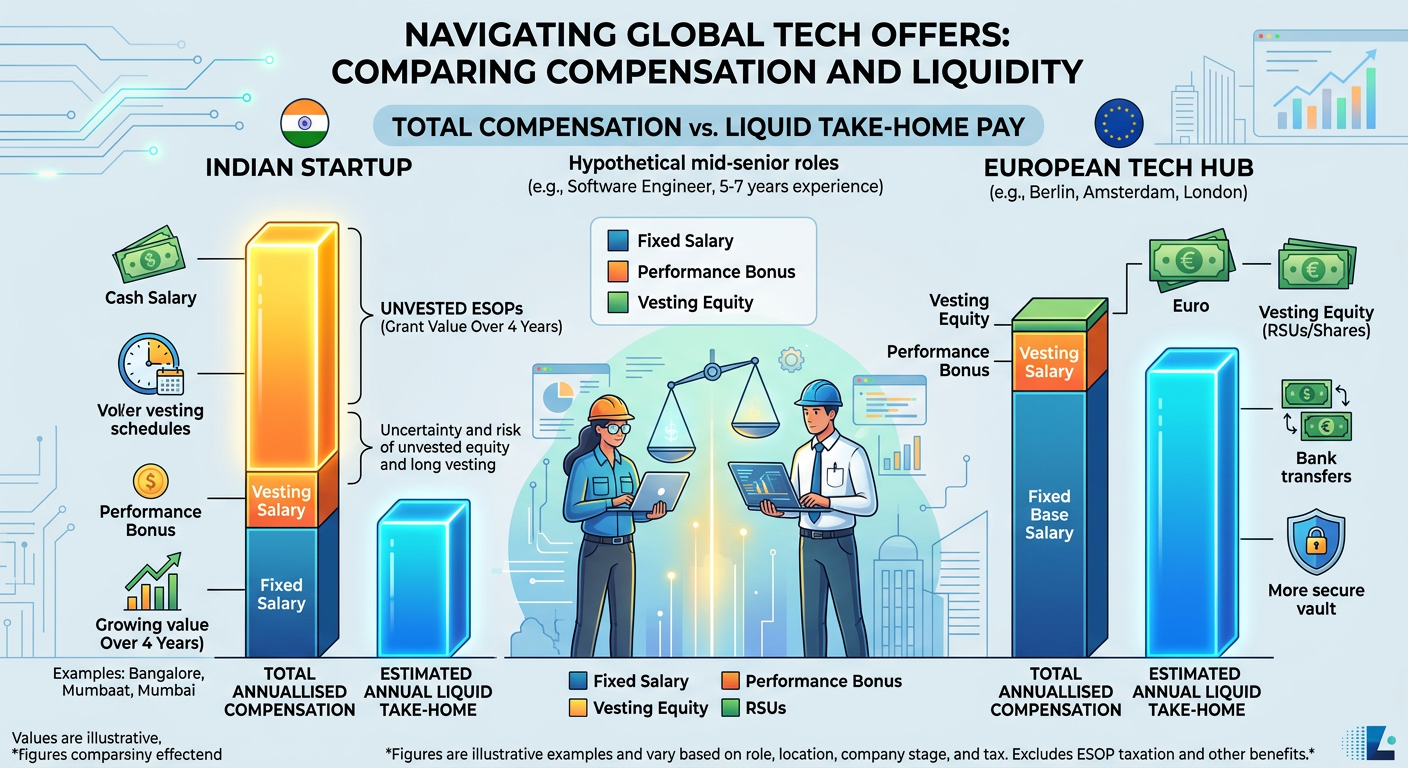
In the Indian startup ecosystem, it has become standard practice to pad CTC (Cost to Company) figures with generous allocations of ESOPs or Restricted Stock Units (RSUs). While these represent theoretical ownership, they are a poor substitute for cash. Unlike the mature secondary markets of Silicon Valley, where employees can frequently liquidate portions of their holdings, the Indian ecosystem suffers from a distinct lack of secondary sale culture. For many senior developers, this equity remains locked in an unlisted entity with no clear path to an IPO or acquisition.
Global recruiters, particularly in the US and EU, are increasingly skeptical of these figures. When a candidate presents a package where 40% to 50% of the total value is tied up in unlisted stock, international firms discount that equity significantly—often to zero. The volatility of the current market means that a 'down-round' can evaporate these paper fortunes overnight, leaving employees with nothing but a lower base salary than what they might have secured in a cash-heavy multinational role.
"I spent five years counting my ESOPs as 'wealth' for my house down payment, only to realize that without a secondary market or a liquidity event, they are just lines of code in a cap table. My new offer in Germany is 20% lower on paper, but 100% liquid cash. I'll take the liquidity any day." — @DevExpat_blr, X
The Great Migration Calculus: Europe vs. Dubai vs. India
The decision to move is no longer just about the absolute salary number; it is a complex calculation of net savings, tax impact, and legal stability. Dubai offers the allure of zero income tax, which can lead to 30% to 40% higher net savings compared to India. However, this comes at the cost of long-term residency pathways and a lack of labor protections inherent in European jurisdictions.
Conversely, Europe presents a 'protection gap.' While European labor laws are robust, the reality for a migrant worker is often a bureaucratic hurdle that limits legal recourse. Professionals must also contend with the 'career reset' phenomenon—where an Engineering Manager in Bengaluru might be down-leveled to a Senior Engineer in Berlin due to differences in product scale and legacy stack requirements. The perceived 'stability' of a high-paying Indian startup, once seen as a safe harbor, has been eroded by a cycle of aggressive layoffs, forcing talent to reconsider if the risk-reward ratio of Indian startups still justifies staying put.
Negotiation Strategies for the Global Market
To bridge the gap between Indian packages and global expectations, professionals must pivot from valuing 'potential' to demanding 'liquidity.' The primary goal should be shifting the compensation mix toward base salary dominance. If an offer remains ESOP-heavy, candidates should negotiate for "liquidity windows" or periodic buybacks written into their contracts.
For those targeting remote-first international roles, geography is becoming secondary to tax residency. It is now more common to negotiate for compensation in USD or EUR to hedge against currency depreciation. When relocation is non-negotiable, focus on the 'Net Savings' metric rather than the 'Gross Salary.' A $100,000 salary in a high-tax European city may provide a lower quality of life than a $70,000 job in a low-cost, low-tax environment. Don't be afraid to demand a relocation bonus that covers the 'sunk cost' of unvested options left behind in India.
The Bottom Line
The 'ESOP trap' is a realization that wealth is only as real as its accessibility. As the Indian tech sector matures, the industry must move toward more transparent, liquid compensation models. Until then, senior professionals should treat unlisted equity as a "bonus" rather than a pillar of their financial planning. Whether you stay or move, the math must always start with liquid cash—everything else is just a valuation on paper.