The Hidden Costs of 'Digital Gold': Why EGRs Are Not Just Another ETF
The National Stock Exchange's launch of Electronic Gold Receipts promises a revolution in gold trading, but retail investors should look past the hype. Beneath the surface lie vaulting fees, logistical hurdles, and GST implications that differentiate EGRs from standard gold ETFs.

Photo by Pixabay on Pexels
The Hidden Costs of 'Digital Gold': Why EGRs Are Not Just Another ETF
On May 4, 2026, the National Stock Exchange (NSE) officially unveiled Electronic Gold Receipts (EGRs), promising to bridge the gap between India's age-old obsession with physical bullion and the modern necessity for digital liquidity. While the headlines tout this as the "future of gold investing," retail investors are finding that the transition from paper-based ETFs to exchange-traded receipts is not merely a change in ticker symbols. Beneath the regulatory promise of SEBI-backed transparency lies a complex ecosystem of vaulting fees, delivery logistics, and specific GST triggers that demand a closer look.
The EGR Launch: Market Formalization or Another Retail Hurdle?
The NSE’s entry into the EGR space is designed to standardize the chaotic, fragmented gold market in India. By bringing gold onto the exchange, the aim is to ensure price uniformity and institutional-grade purity checks. However, the initial rollout has been met with a mix of optimism and skepticism, primarily due to the current state of broker integration.
While the infrastructure is live, most major brokerage platforms are still in the early stages of enabling full, frictionless access to the EGR order book. Retail investors are currently finding that while the "buy" button is there, the ecosystem is not yet as liquid or intuitive as trading Nifty 50 stocks.
"NSE just launched Electronic Gold Receipts (EGR) - Is this the future of gold investing in India?"
— u/investor_in_demand, r/IndianStockMarket"Gold isn’t gold as long as I can’t touch it."
— u/skeptic_gold_bull, r/NSEbets
The Hidden Costs: Beyond the Trading Screen
It is tempting to view EGRs as just another ETF, but the financial architecture is fundamentally different. Unlike Gold ETFs, which are managed funds with an expense ratio, EGRs are essentially claims on physical gold stored in registered vaults. This introduces the "Cost of Carry."
Investors must account for vaulting and storage fees charged by clearing corporations. While these are often marginal for short-term traders, they accumulate for long-term holders. Furthermore, the 0% GST charge on trading is a convenience for speculators, but the moment you exercise your right to convert those receipts into physical bullion, you hit a fiscal wall. Delivery isn't just about moving metal; it involves logistics, insurance, and GST implications that significantly alter the net cost of the asset compared to buying from a local jeweler.
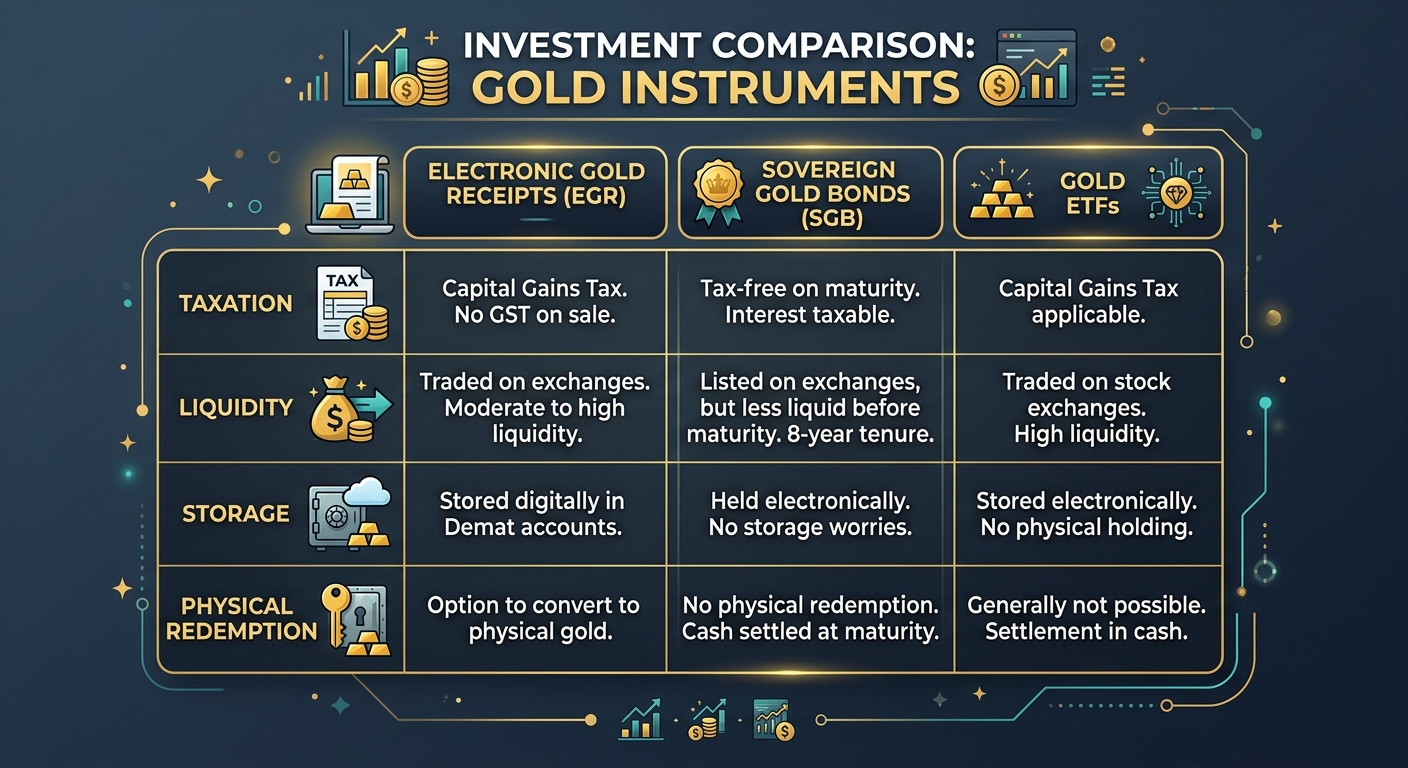
Comparative Analysis: EGRs vs. ETFs vs. SGBs
When we stack EGRs against Sovereign Gold Bonds (SGBs) and traditional ETFs, the differences become stark. SGBs offered an interest payout, which EGRs lack. ETFs offer liquidity without the physical redemption headache. EGRs, however, occupy a middle ground—providing the capability of physical ownership without the storage risk.
Taxation is a major lever here. EGRs benefit from a 12-month Long-Term Capital Gains (LTCG) threshold, which is more favorable than physical gold held for shorter durations. Yet, the liquidity concerns remain; the secondary market for EGRs is still finding its legs, and spread costs can sometimes eat into the gains compared to highly liquid ETFs.
The Verdict: Is It Ready for Your Portfolio?
Before you jump into the EGR fray, ask yourself one question: Do you actually want the physical gold, or are you looking for a price-tracking investment?
If you want a pure-play investment vehicle, traditional Gold ETFs remain more efficient due to lower operational friction. If you are an investor who intends to hold gold for the long term and eventually convert it to bullion for personal use or gifting, EGRs offer a modernized, transparent path that eliminates the purity concerns of traditional retail buying.
The Bottom Line: Ensure your broker has a streamlined interface for EGRs before diving in. Do not ignore the vaulting costs—calculate them as part of your total return. For most retail portfolios, EGRs are a powerful tool, but they are a scalpel, not a sledgehammer; use them specifically for the bridge between digital tracking and physical acquisition.
Engagement Snapshot
- Primary Discussion Hubs: r/IndianStockMarket, r/NSEbets
- Sentiment: Cautiously optimistic; primary concerns remain broker support and the practical cost of physical conversion.
- Key Takeaway: The market is formalizing, but liquidity and logistical "hidden costs" are the new variables to watch.