The 'Hold or Fold' Dilemma: Decoding Multibagger Profit-Booking in a Choppy Market
As Nifty volatility sends retail investors into a tailspin, the pressure to protect gains from recent market run-ups has reached a fever pitch. This guide breaks down the tactical framework for deciding whether to trim your winners or hold through the current sectoral rotation.

Photo by AlphaTradeZone on Pexels
The 'Hold or Fold' Dilemma: Decoding Multibagger Profit-Booking in a Choppy Market
As the Nifty 50 swings between record highs and sudden profit-taking bouts, the mood on Dalal Street has shifted from unbridled optimism to cautious calculation. Retail investors, many of whom rode the post-pandemic rally to triple-digit returns, are now facing the classic psychological trap: the fear of giving back gains versus the fear of missing out on the next leg of a bull run.
INLINE_IMAGE: chart_showing_nifty_volatility_trends.jpg
The Psychology of the 'Partial Exit'
Market veterans often cite the 'house money' effect as the biggest hurdle for individual investors. When a stock climbs 150% or more, it becomes an emotional anchor in the portfolio. Holding onto a 'multibagger' is easy when the tide is rising, but when sectoral rotation sets in, the lack of a defined exit strategy often leads to capital erosion.
"I trimmed 30% of my position in an IT midcap after it hit a 200% gain over two years. It felt painful at the time, but now that the sector is correcting, that cash is my dry powder for the dip. It's not about being wrong; it's about being prepared."
— u/AlphaInvestor99, r/IndianStreetBets
The Tactical Framework: When to Trim
Institutional desks don't fall in love with tickers; they look at risk-adjusted returns. To manage your winners, consider the 'Rebalancing Threshold.' If a single stock grows to represent more than 15% of your total portfolio, your risk profile is no longer what you intended. Trimming back to a 10% weight allows you to lock in gains without abandoning the growth story.
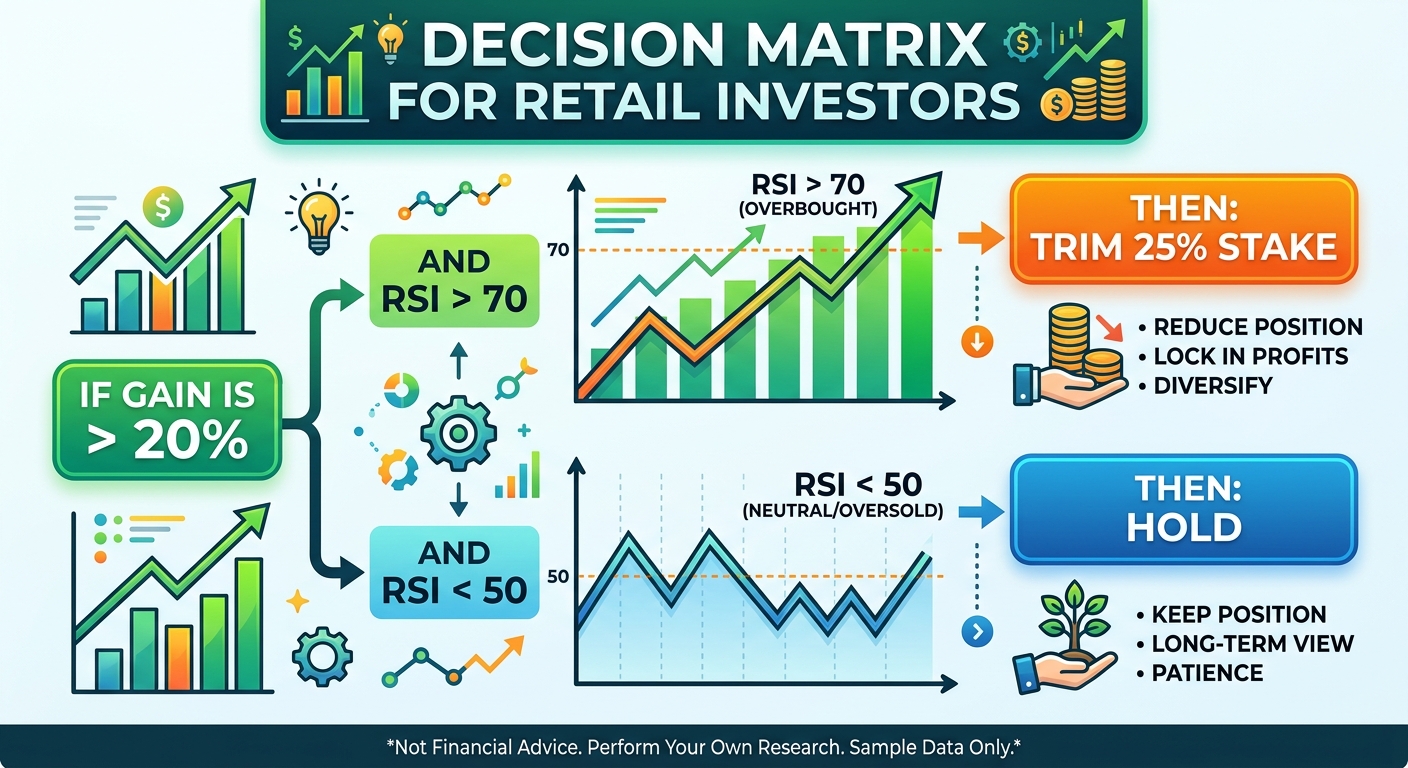
The Math of Profit-Booking: Two Approaches
To strip the emotion out of the decision, we look at two distinct mathematical models for harvesting gains.
Example 1: The 'Cost-Basis Liquidation'
Suppose you invested ₹1,00,000 in a stock that has grown to ₹3,00,000. Your profit is ₹2,00,000. By selling just one-third of your position (worth ₹1,00,000), you take out your entire initial capital. You are now playing with 'house money'—the remaining ₹2,00,000 in the market carries zero risk to your principal investment. This provides immense psychological relief during volatile phases.
Example 2: The 'Trailing Percentage Reduction'
Consider a portfolio stock that hits an all-time high. You decide to use a 20% trailing stop-loss rule. If the stock falls 20% from its peak price, you sell. If the stock is at ₹500, you place an order at ₹400. If it rises to ₹600, your exit trigger moves to ₹480. This math ensures you keep 80% of the ride while effectively capping your downside risk, allowing the winners to run as far as they can.
INLINE_IMAGE: mathematical_decision_matrix.jpg
"The problem isn't the stock; it's the lack of a plan. If you didn't have a price target when you bought it, you shouldn't be surprised when you panic-sell at the first red candle."
— u/ValueSeeker_Ind, r/IndiaInvestments
The Bottom Line
The goal of investing isn't just to see green numbers on a screen; it is to realize value. Whether you choose to bank your principal or trail your stop-losses, the key is to formalize the exit before the market makes the choice for you. In a choppy environment, the most successful investors are those who view profit-taking not as a defeat, but as a strategic reallocation of capital.