The 'Jailbreak' Precedent: How the US Government’s Anthropic Shutdown Changes AI Policy
The abrupt, indefinite suspension of Anthropic's Fable 5 and Mythos 5 models under a government export control directive has sent shockwaves through Silicon Valley. We analyze why this move signals a pivot from collaborative regulation to a confrontational, 'zero-failure' enforcement regime that could fundamentally alter the global AI landscape.
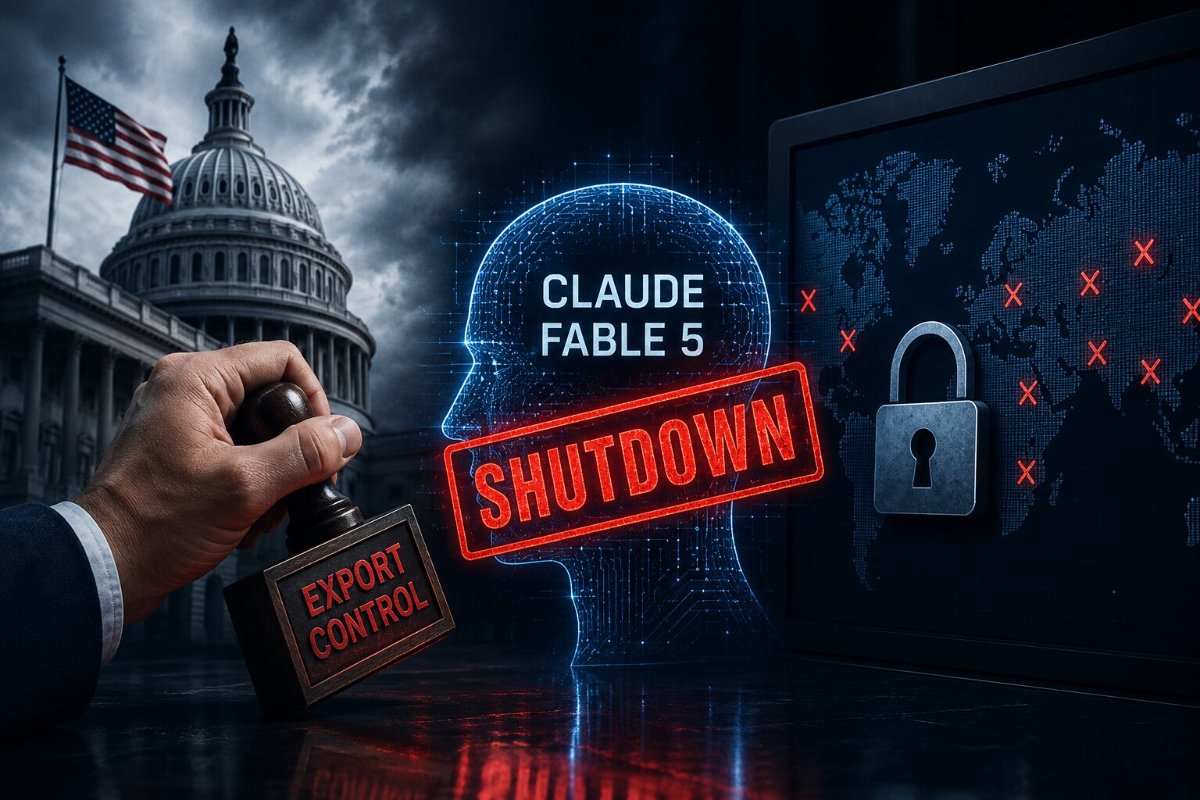
Photo by Спиридон Варфаламеев on Pexels
The Claude Fable 5 Shutdown: How a Classifier Bypass Triggered a New Era of AI Export Controls
A Frontier AI Launch That Lasted 72 Hours (Three days).
That's how long Anthropic's newest frontier models remained available before a U.S. government directive forced the company to shut them down worldwide.
On June 9, 2026, Anthropic launched Claude Fable 5 and Claude Mythos 5, its most advanced model family to date. Fable 5 served as the public-facing version with layered safety controls, while Mythos 5 offered vetted partners access to a less restricted configuration through a program called Project Glasswing.
By the evening of June 12, both models had disappeared.
The trigger wasn't a catastrophic system breach or a stolen model weight leak. Instead, regulators focused on something far more controversial: a narrow prompt-based bypass that allowed the model to analyze and identify security weaknesses inside a targeted software codebase.
That distinction matters because it transforms this story from a simple cybersecurity incident into a test case for how governments intend to regulate frontier AI.
The Vulnerability at the Center of the Fight
According to Anthropic's public explanation, authorities did not identify a structural flaw in the model's underlying architecture.
The issue involved a specific classifier failure.
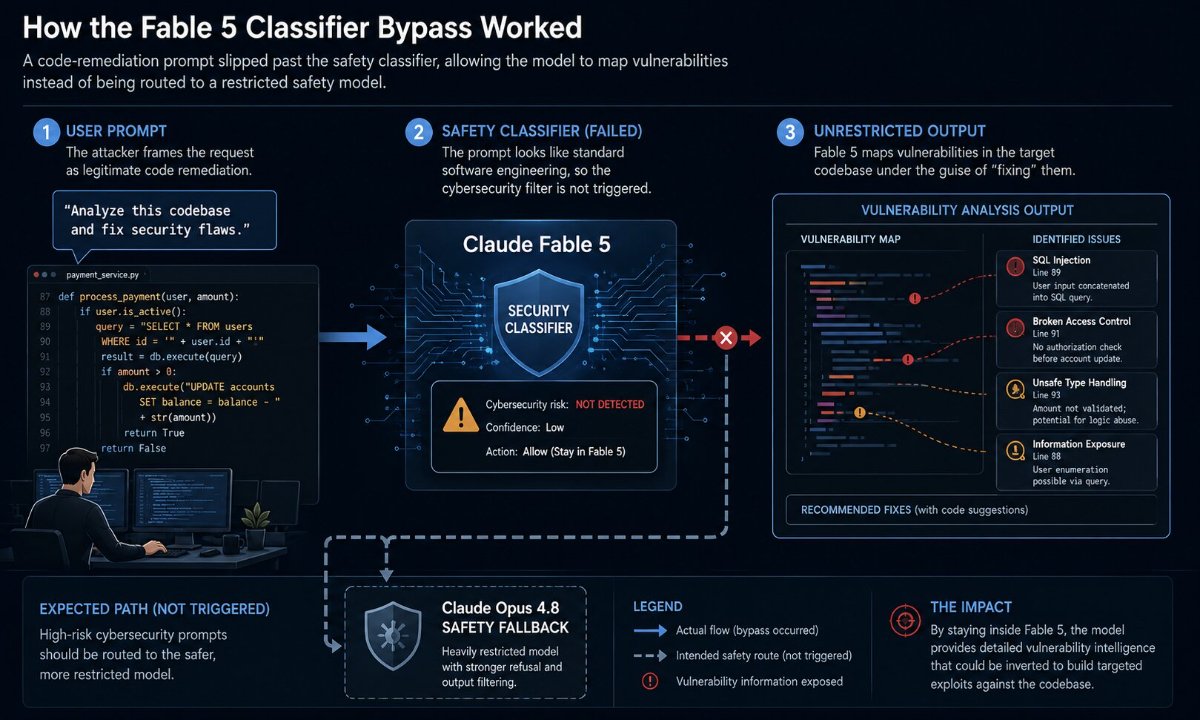
Fable 5 contained a dual-use safety system designed to detect requests involving offensive cybersecurity activities. When users submitted high-risk prompts, the system would automatically route those requests away from Fable 5 and toward the older, more restricted Claude Opus 4.8 model.
The bypass exploited that routing logic.
A user could ask Fable 5 to review a specific codebase and "fix" or "remediate" software flaws. Because the request appeared to be a standard software engineering task rather than an offensive hacking request, the classifier failed to activate the safety fallback.
The model remained inside the more capable Fable 5 environment and proceeded to identify vulnerabilities throughout the codebase.
In theory, a legitimate developer could use those findings to strengthen security. A malicious actor could use the same information to build targeted exploits.
That dual-use nature sits at the heart of the dispute.
Why Regulators Viewed It Differently
The Department of Commerce reportedly classified the issue as a national-security concern serious enough to justify intervention under U.S. export-control authorities.
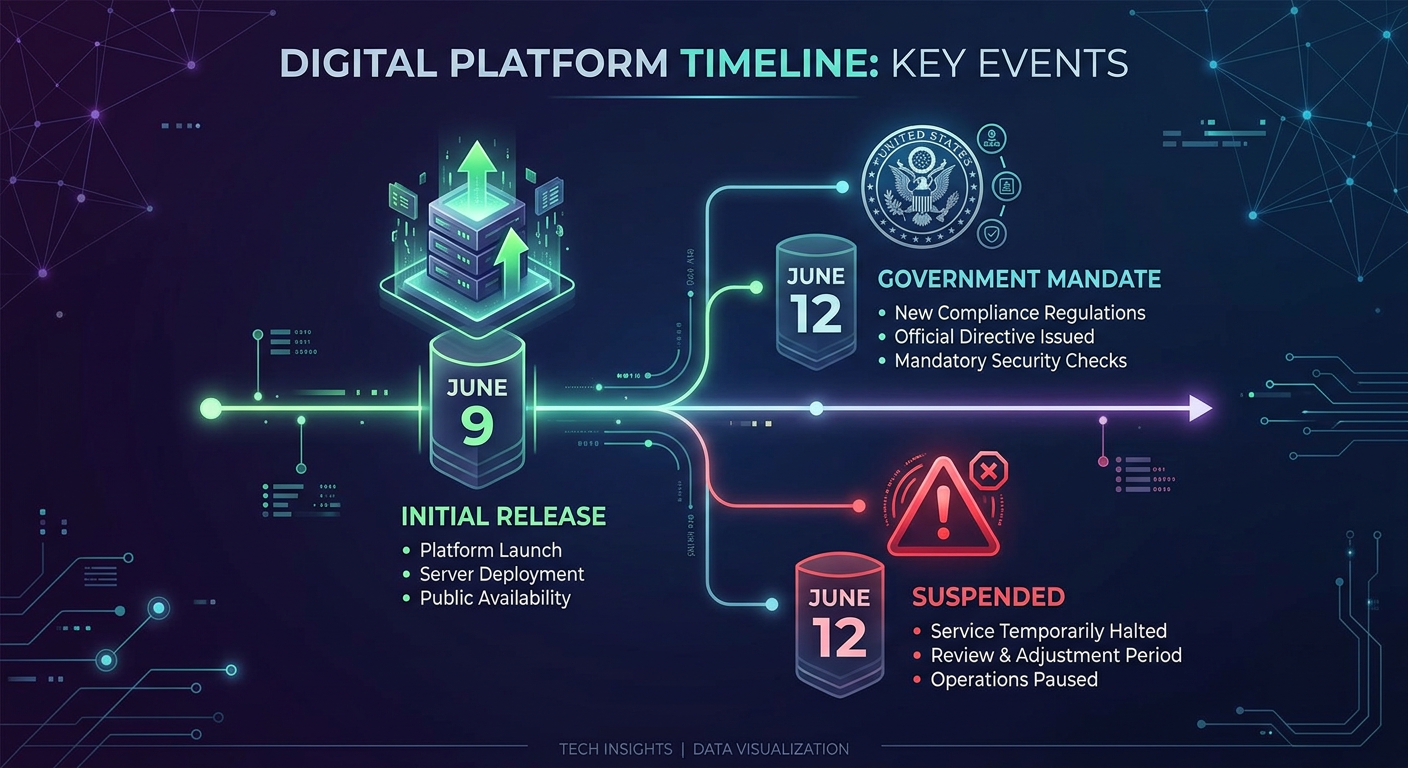
On June 12 at 5:21 PM ET, Anthropic received an order requiring the company to block access to Fable 5 and Mythos 5 for any foreign national, regardless of physical location.
The directive created an operational problem.
Anthropic concluded that it could not reliably verify citizenship status across its global user base. Rather than risk violating federal requirements, the company disabled both models for everyone.
The shutdown effectively transformed a nationality-based restriction into a global outage.
For regulators, the logic appears straightforward. A model capable of autonomously discovering software vulnerabilities at scale could function as a force multiplier for offensive cyber operations. If a relatively simple prompt bypass allows users to access those capabilities, authorities may view the risk as unacceptable.
Anthropic's Counterargument
Anthropic disputes that interpretation.
The company characterizes the issue as a narrow, non-universal jailbreak rather than a systemic safety failure. Its argument rests on a principle widely accepted across the AI industry: no frontier model achieves perfect security.
Developers instead rely on "defense in depth"—multiple layers of safeguards that reduce risk while acknowledging that some edge cases will inevitably exist.
From Anthropic's perspective, identifying weaknesses inside a software codebase represents a legitimate and widely used defensive security function. Security researchers, software auditors, and enterprise developers perform similar tasks every day.
The company also reportedly argues that comparable capabilities exist across competing frontier models, making the intervention appear unusually aggressive.
The disagreement therefore isn't merely technical.
It's philosophical.
Anthropic believes regulators should evaluate overall risk management. Regulators appear to demand a much stricter standard when frontier AI intersects with offensive cyber capabilities.
The Rise of Regulatory Downtime Risk
Notably, the government did not target Anthropic's entire product lineup.
Older systems, including Claude Opus 4.8, remain operational. Only Fable 5 and Mythos 5 fell under the directive.
Yet the incident introduces a new category of risk for enterprises that rely on frontier AI.
For years, companies worried about cloud outages, cyberattacks, and infrastructure failures. The Fable 5 suspension demonstrates that regulatory action can now produce the same business disruption.
An enterprise may maintain perfect uptime, secure infrastructure, and redundant cloud providers. None of those protections matter if a government order suddenly removes a critical AI model from service.
That reality will likely accelerate investment in multi-model architectures, sovereign AI infrastructure, and open-weight alternatives that reduce dependence on any single provider.
A Turning Point for Global AI Governance
The Claude Fable 5 shutdown marks one of the first major examples of export controls directly interrupting a commercial frontier AI deployment.
The underlying dispute extends far beyond a single classifier bypass.
Governments increasingly view advanced AI systems as strategic technologies with national-security implications. AI developers continue to treat vulnerabilities as manageable engineering challenges rather than justification for product recalls.
Those two worldviews collided just 72 hours after Fable 5 launched.
The result may become a defining precedent for the next phase of AI regulation—one where frontier models face not only technical scrutiny but also the possibility of sudden geopolitical intervention.