The 'Jobs Apocalypse': Why Tech Giants Are Trading Employees for Computation
As Silicon Valley accelerates its quest for autonomous intelligence, a brewing ideological war is pitting Sam Altman’s vision of infinite abundance against Naomi Klein’s warning of a resource-draining, labor-erasing 'empire.' We examine the real-world costs of this high-stakes pivot.

Photo by Marek Piwnicki on Pexels
The 'Jobs Apocalypse': Why Tech Giants Are Trading Employees for Computation
As Silicon Valley accelerates its quest for autonomous intelligence, a brewing ideological war is pitting Sam Altman’s vision of infinite abundance against Naomi Klein’s warning of a resource-draining, labor-erasing 'empire.' We examine the real-world costs of this high-stakes pivot.
The Clash of Narratives: Abundance vs. Extraction
For years, Silicon Valley has sold us a dream: a post-scarcity future where AI automates the mundane, leaving humans to pursue creativity and leisure. OpenAI CEO Sam Altman frequently frames this as a moral imperative—a tool to liberate humanity from drudgery. But this narrative is facing an increasingly aggressive counter-offensive, led by author and activist Naomi Klein.
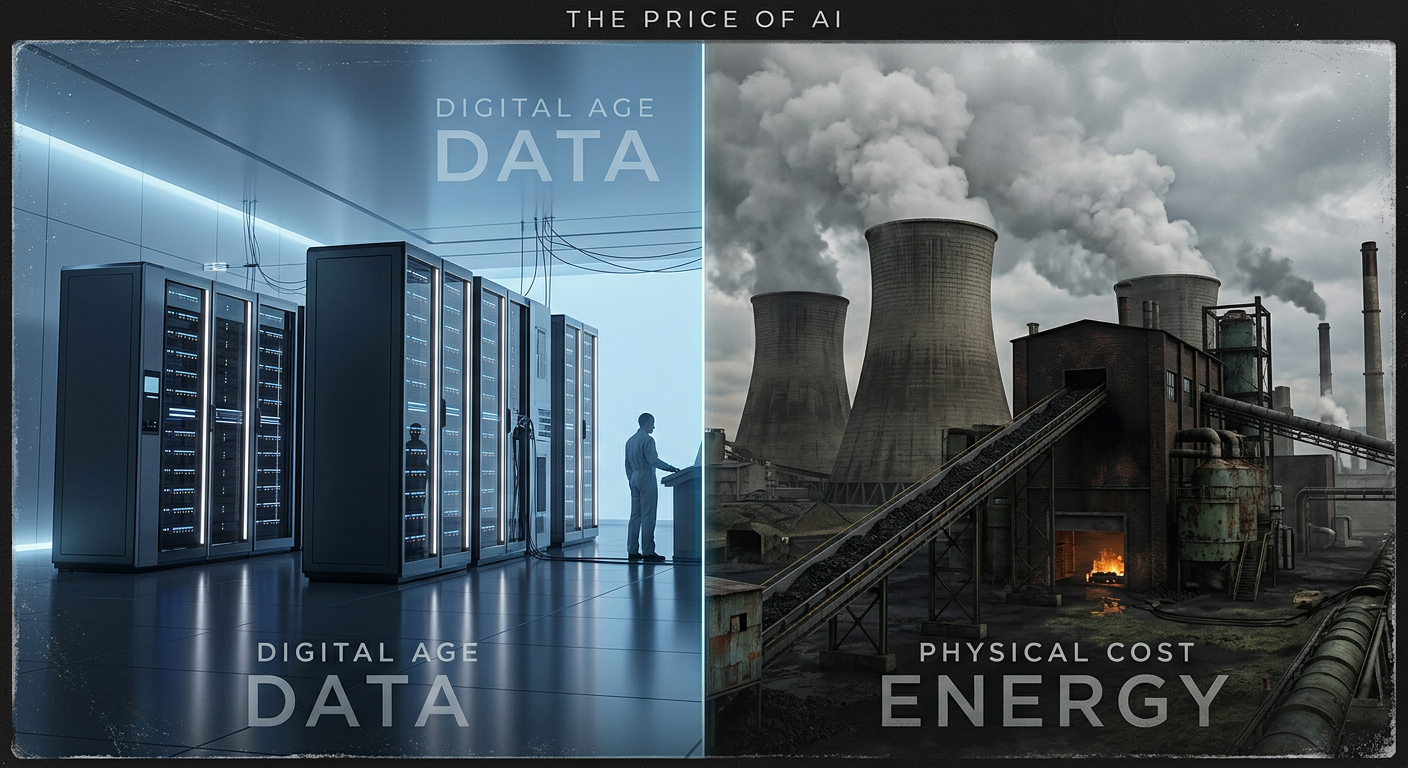
Klein characterizes this shift not as a humanitarian mission, but as an 'AI as Empire' project. She argues that the industry's polished, ethereal branding—all blue light and minimalist interfaces—is a calculated mask for a brutal industrial reality. Under the hood, the 'liberation' of labor actually entails the mass replacement of human roles with energy-intensive, compute-heavy extraction. While Altman speaks of abundance, Klein points to the physical reality: open-pit mines for rare earth minerals and gargantuan, carbon-heavy server farms.
"Who do you agree with?
Sam Altman, CEO of OpenAI: We are deploying responsibly developed AI to liberate humanity from menial labor and usher in an era of unparalleled creativity and abundance.
Naomi Klein, Author & Social Activist: You ingested the entire written output of human civilization witho" — @ShiningScience, X
The Economic Paradox: When Compute Costs Outpace Payroll Savings
There is a deepening suspicion that the 'jobs apocalypse' isn't just a byproduct of innovation, but a deliberate business model. Yet, the fiscal logic is starting to fray. In many sectors, the cost of training and running LLMs is currently dwarfing the potential payroll savings achieved by layoffs.
We are witnessing the emergence of a 'vampiric infrastructure.' Companies are trading predictable, human-centric costs for unpredictable, exponential energy and water overheads. In India’s burgeoning tech corridors, where data center growth is exploding, local grids are struggling to keep pace with the power demands of AI clusters. The question remains: if the productivity gains are currently speculative and the compute costs are astronomical, are tech giants simply burning capital to consolidate power at the expense of both the environment and the workforce?
The Climate Conflict: A New Frontier of Resistance
The friction between AI expansion and climate goals has shifted from theoretical debate to the front lines of local governance. Following the recent roundtable featuring Bernie Sanders, Ro Khanna, and Naomi Klein, the discourse has hardened. Critics point to an 'AI-Climate' paradox: the industry claims to be a tool for environmental optimization, yet its physical expansion is driving a resurgence in fossil fuel reliance to power thirsty data centers.
In various regions, we are seeing the birth of a new, bipartisan coalition—farmers, labor advocates, and environmentalists uniting to challenge the siting of massive data centers. This isn't just about jobs; it's about water rights, grid stability, and the long-term impact on local ecosystems that are being sacrificed to satisfy the insatiable hunger of large language models.
"Seeing this Naomi Klein response being shared widely.
She criticizes Sam Altman and other Silicon Valley executives for using "utopian" rhetoric to mask the aggressive, planet-draining expansion of AI. She targets Altman's claims that AI will "liberate humanity" https://t.co/gE7ZENe1wT" — @GautamGhosh, X
Unanswered Questions: Transparency and Regulation
Is the industry's rhetoric a genuine ideological belief, or merely a smoke screen for profit-driven displacement? We have yet to see meaningful transparency regarding the actual energy and water consumption of individual model training runs. Without regulatory mandates, the true carbon footprint of the 'AI revolution' will remain a corporate secret.
Regulators in India and abroad are beginning to grapple with this, but the industry moves significantly faster than legislative cycles. As we stand at this crossroads, the fundamental question remains: is the climate impact of AI inherently incompatible with our current environmental goals, or can we force transparency onto a sector that has historically thrived on opacity?
Bottom Line
The 'jobs apocalypse' is not merely an economic trend; it is a shift in the fundamental relationship between capital, labor, and the planet. Whether the promises of AI abundance hold water remains to be seen, but the tangible costs—measured in energy, jobs lost, and community friction—are already mounting. Silicon Valley may be trading employees for computation, but it is doing so at a price that our environment and social fabric may not be able to afford.