The 'Master's Degree' Tax: Is it Necessary to Survive the AI Era in Hardware?
As NVIDIA's AI-driven RTL generation reshapes silicon design, Indian ECE students face a paralyzing question: Is the industry gatekeeping entry-level roles behind M.Tech degrees, or is the 'semiconductor boom' simply failing to reach the classroom? We investigate the reality of the hardware job market.

Photo by Mikhail Nilov on Pexels
The 'Master's Degree' Tax: Is it Necessary to Survive the AI Era in Hardware?
As the Indian government pushes a vision of becoming a global semiconductor powerhouse, a quiet crisis is brewing in the lecture halls of the country’s engineering colleges. While headlines tout the 'semiconductor boom,' Electronics and Communication Engineering (ECE) students are reporting a jarring disconnect: a job market that feels increasingly gated by a 'Master's Degree tax,' even for entry-level roles. With AI tools like NVIDIA’s Horizon threatening to automate traditional RTL (Register Transfer Level) design tasks, many students are left wondering if their B.Tech degrees are becoming obsolete before they even graduate.
The Disconnect: Hype vs. Reality
Walk into any tier-2 or tier-3 college placement cell, and you will encounter a palpable sense of anxiety. The national narrative promises a surge in hardware manufacturing, yet students are finding that the doors to top-tier chip design firms remain stubbornly locked to anyone without an IIT or NIT pedigree, or a Master’s degree in VLSI.
This gap is widening as companies optimize for efficiency. If an entry-level engineer can be augmented or partially replaced by AI-driven automated design flows, firms are naturally gravitating toward candidates who already possess the deep theoretical grounding typically associated with post-graduate research. For the average ECE graduate, the 'semiconductor boom' feels like a distant event happening in a parallel universe.
The industry keeps talking about a talent shortage, yet my batch of 120 ECE students is mostly pivoting to IT services because the 'core' VLSI roles require a Master's degree from a top-tier institute. Is the boom only for the elite? — @SiliconSkeptical, X
The 'Master's Degree Tax' Myth
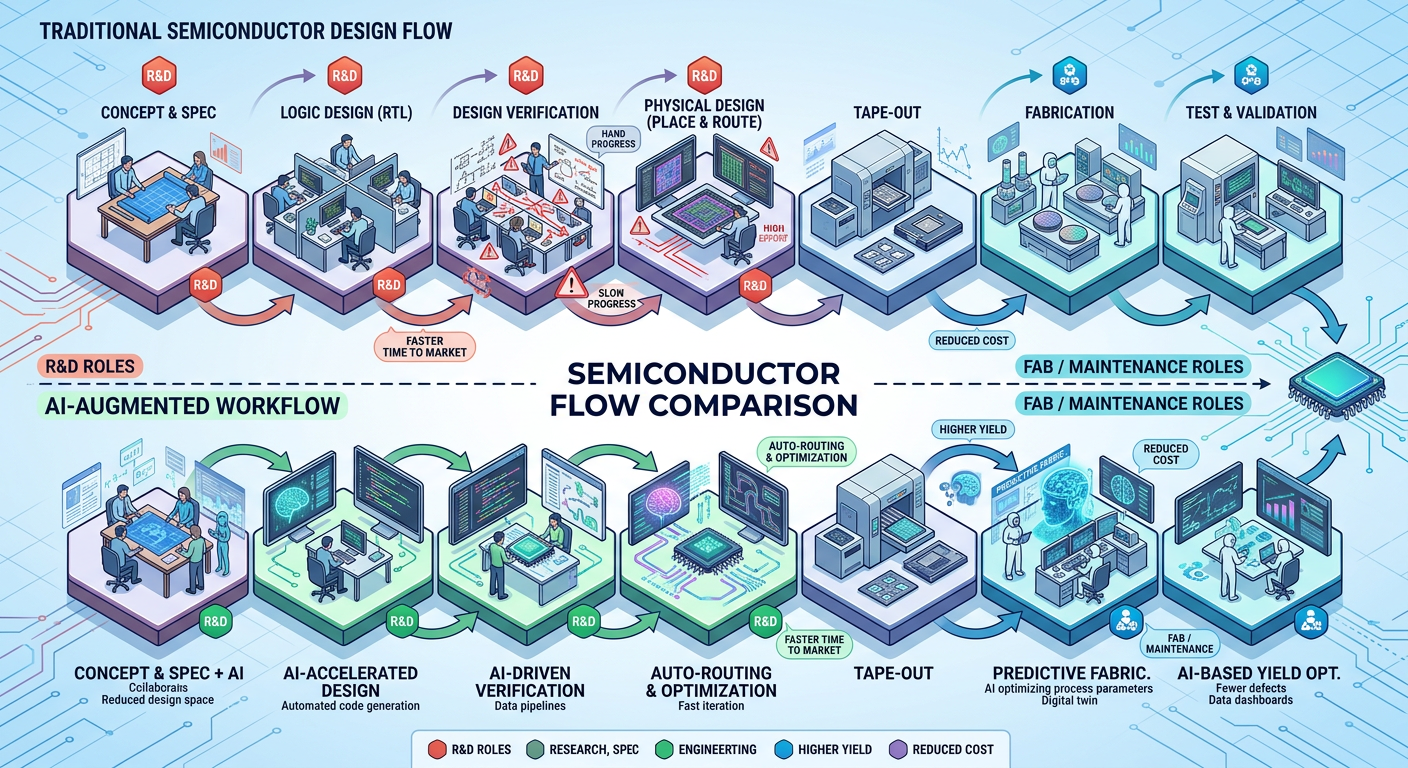
Is the M.Tech truly a mandatory gatekeeper, or is it a signaling mechanism for a saturated job market? Data suggests a nuance here: the 'Master's Degree Tax' is largely a feature of R&D and advanced Chip Design roles. In contrast, the burgeoning sectors of Fab operations, ATMP (Assembly, Testing, Marking, and Packaging), and maintenance are crying out for skilled, hands-on B.Tech graduates. The bottleneck isn't always degree-based; it is often a mismatch between academia’s theoretical focus and the industry’s demand for immediate tool proficiency.
The AI-Automation Paradox
NVIDIA's Horizon and similar AI-driven design automation tools have sparked fear that junior roles—specifically RTL coding—will vanish. However, the reality is more nuanced. While AI excels at generating standard digital logic, it struggles with the 'physical dependency' found in RF (Radio Frequency) and photonics. These fields require precise, non-automated test-bench validation that AI currently cannot handle at scale.
Furthermore, the lack of standardized, digitized training data for analog and RF design means these niches are, for now, immune to the kind of mass automation hitting digital VLSI. The 'AI-gap' creates a paradoxical opportunity: while simple digital design might see 30% to 40% efficiency gains via AI, specialized hardware-software co-design remains a domain that requires human expertise to bridge the gap between simulation and physical silicon.
Survival Strategies for the Non-Elite Graduate
If you are not from an elite college, how do you bypass the 'Master's Degree Tax'? The strategy must shift from theory to tool-readiness. The industry is currently facing a shortage of engineers who are proficient in Cadence, Synopsys, and Mentor Graphics workflows on day one.
- Focus on Tool Proficiency: Don't wait for your college curriculum to catch up. Certifications and hands-on experience with industry-standard EDA (Electronic Design Automation) tools are often more valuable to a hiring manager than a generic M.Tech degree.
- Target Emerging Sectors: Look beyond the big-name chip design houses. The expansion of Fab and ATMP facilities in India is creating a massive demand for hardware-software co-designers and systems engineers.
- Hardware-Software Co-design: Positions that sit at the intersection of firmware, embedded systems, and hardware architecture are less susceptible to pure automation and carry higher bargaining power.
Bottom Line
The 'semiconductor boom' is real, but it is not a rising tide that lifts every boat automatically. The 'Master's Degree Tax' is not a systemic conspiracy, but a symptom of a market that values specific, tool-ready skills over generalist degrees. By focusing on specialized niches like RF, photonics, and hardware-software integration—and by mastering the tools that AI cannot yet replace—the non-elite graduate can navigate the current transition without needing to chase an advanced degree to prove their worth.