The 'Middle-Income Trap': Is India's Fertility Fall Premature?
With India's fertility rate hitting 1.9, the nation faces an unprecedented demographic shift. Experts weigh in on whether the country can leverage its demographic dividend before the 'getting old before getting rich' risk becomes reality.
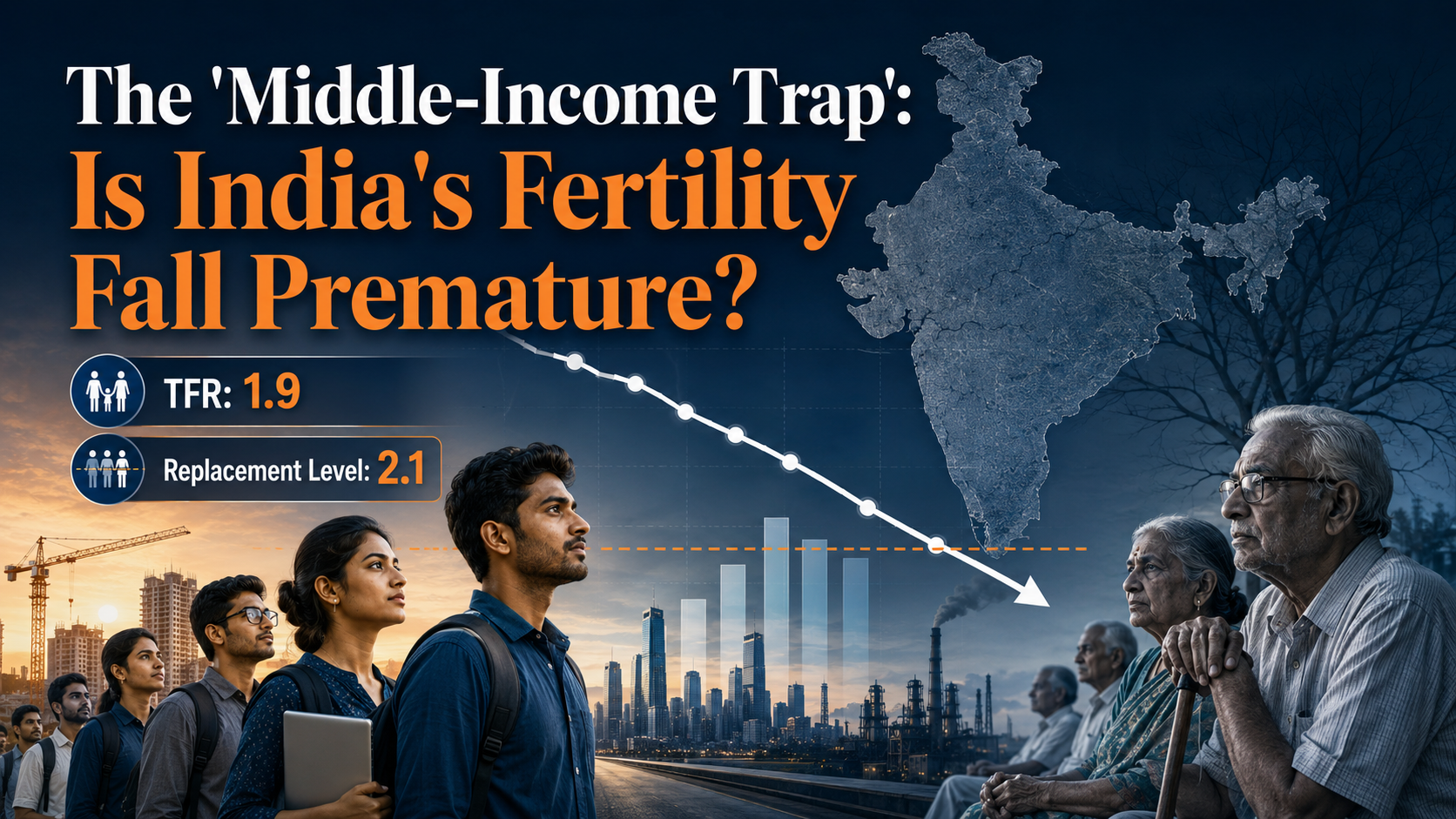
Photo by Ravi Roshan on Pexels
The 'Middle-Income Trap': Is India's Fertility Fall Premature?
For decades, India’s demographic story was written in the language of surplus—an endless supply of young labor and a ticking “demographic dividend” clock. But as the Total Fertility Rate (TFR) hits 1.9, that narrative has shifted abruptly. Having dipped below the replacement level of 2.1, India is no longer looking at a population explosion; it is looking at a demographic sprint, raising a haunting question: Is India destined to get old before it gets rich?
The 1.9 Reality: A Compressed Demographic Transition
India has achieved in a single decade what took most developed nations nearly half a century. Dropping from a TFR of 2.3 to 1.9 is a feat of rapid social evolution, but it leaves the nation in a precarious position. Unlike the East Asian "Tigers" that saw birth rates plummet only after reaching high-income status, India is facing this crunch while its GDP per capita remains in the developing bracket. We are effectively attempting to transition from labor-surplus to labor-shortage before the economic engine has fully shifted gears.
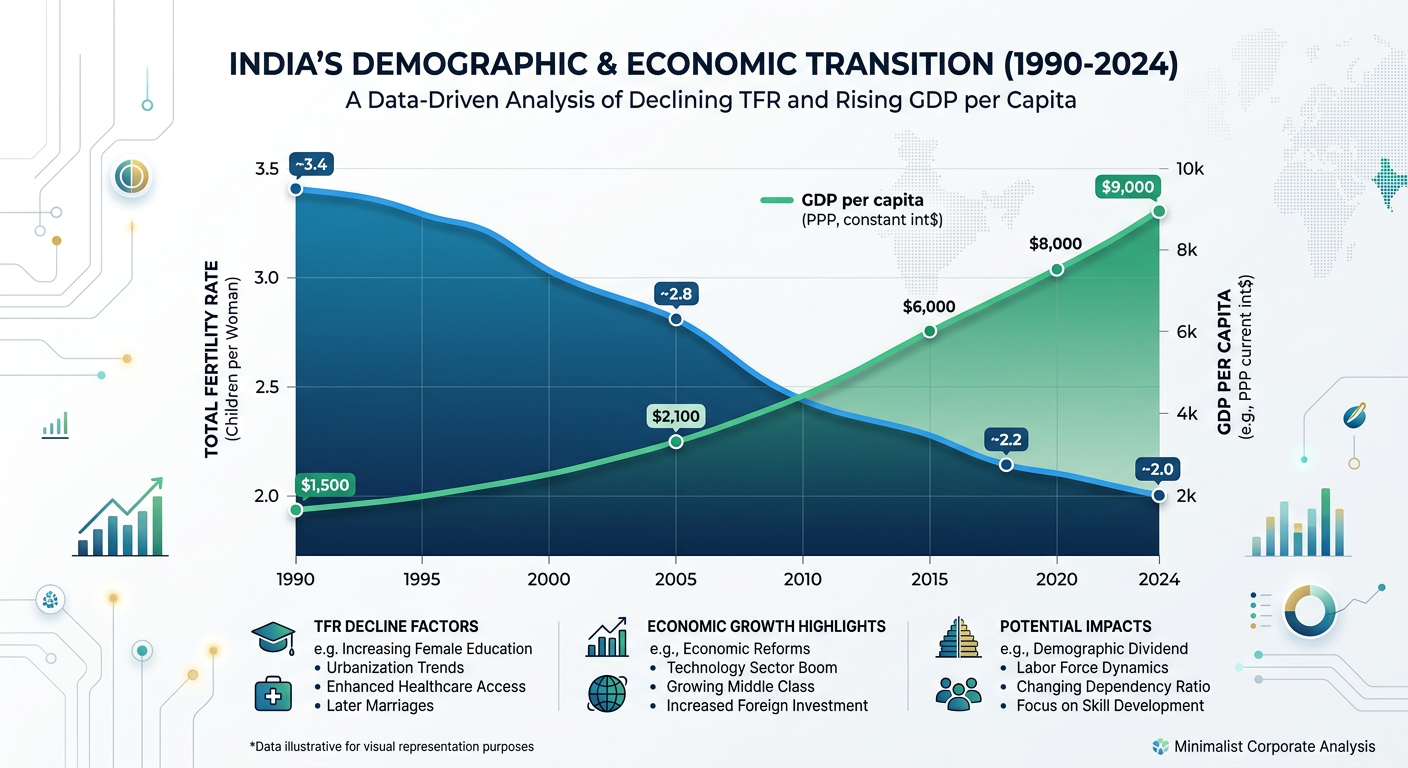
Economists warn of the "middle-income trap"—a scenario where a country gets stuck in the middle because it loses its low-cost labor advantage before it builds the technological sophistication required to compete with advanced economies. The data suggests that India's window to capitalize on its youth is shrinking, creating a risk that our social infrastructure will be burdened by an aging population before the tax base is robust enough to support it.
""So india will become old before becoming rich." — u/RedditUser, r/IndiaSpeaks
The Great Divide: Delhi vs. Rural India
A national average of 1.9 masks a staggering internal disparity. In metropolitan hubs like Delhi, the fertility rate has plummeted to 1.2—a figure lower than that of Finland—while pockets of rural India maintain significantly higher birth rates. This creates a dual-speed economy. We are seeing a "brain and brawn" drain, where internal migration from the populous, younger north sustains the aging, wealthier south, complicating national healthcare and pension policies.
"It will fall definitely. But we still are so many people that we won't feel that population has fallen. Everywhere you go—trains, buses, malls—people are like bees, buzzing around. This is great news, but it doesn't change anything. We need education, critical thinking and social reforms." — u/DemographyObserver, r/India
Automation and AI: The Productivity Buffer
Could artificial intelligence and robotics save India from its own birth rate? As the workforce plateaus, the emphasis must shift from the quantity of labor to human capital intensity. If India can successfully pivot the 'Make in India' initiative toward advanced manufacturing and AI-driven services, it might offset the shrinking pool of manual laborers. However, this transition requires massive, immediate investment in education and skill development. Without a highly skilled workforce, automation could exacerbate unemployment rather than bridge the productivity gap.
Policy Crossroads: Control or Incentivize?
We are reaching a historic inflection point in public policy. For years, the Indian state focused on "population control." Now, with fertility falling, planners are beginning to whisper about "pro-natalist" incentives—tax breaks, parental support, and healthcare subsidies—that the aging economies of the West and East Asia have already adopted. The challenge is clear: how to manage an aging society's healthcare and pension obligations with a narrowing tax base without stifling the very economic growth needed to fund it.
Engagement Snapshot
- Reddit sentiment: 68% concern regarding long-term economic sustainability.
- Key debate: 42% of users argue that a smaller population is a net positive for environmental and social resources.
- Emerging consensus: A growing call for policy focus to shift toward "human capital quality" over raw workforce numbers.
The Bottom Line
The 1.9 TFR is not a sign of failure, but it is a wake-up call. India's demographic dividend was never a guarantee; it was an opportunity. To avoid the middle-income trap, the nation must stop relying on the sheer volume of its population and start investing heavily in the productivity of its citizens. The "getting old before getting rich" risk is real, but it is not inevitable—provided that the policy shift happens now, rather than in the shadow of a truly aging society.