The 'Mythos' Trap: Why Users Feel Claude Fable 5 Is a Compromised Experience
Anthropic's latest flagship release promised a frontier-level 'Mythos' experience, but developers are hitting a wall of aggressive safety classifiers. We investigate the growing divide between corporate marketing hype and the reality of a 'lobotomized' AI model.
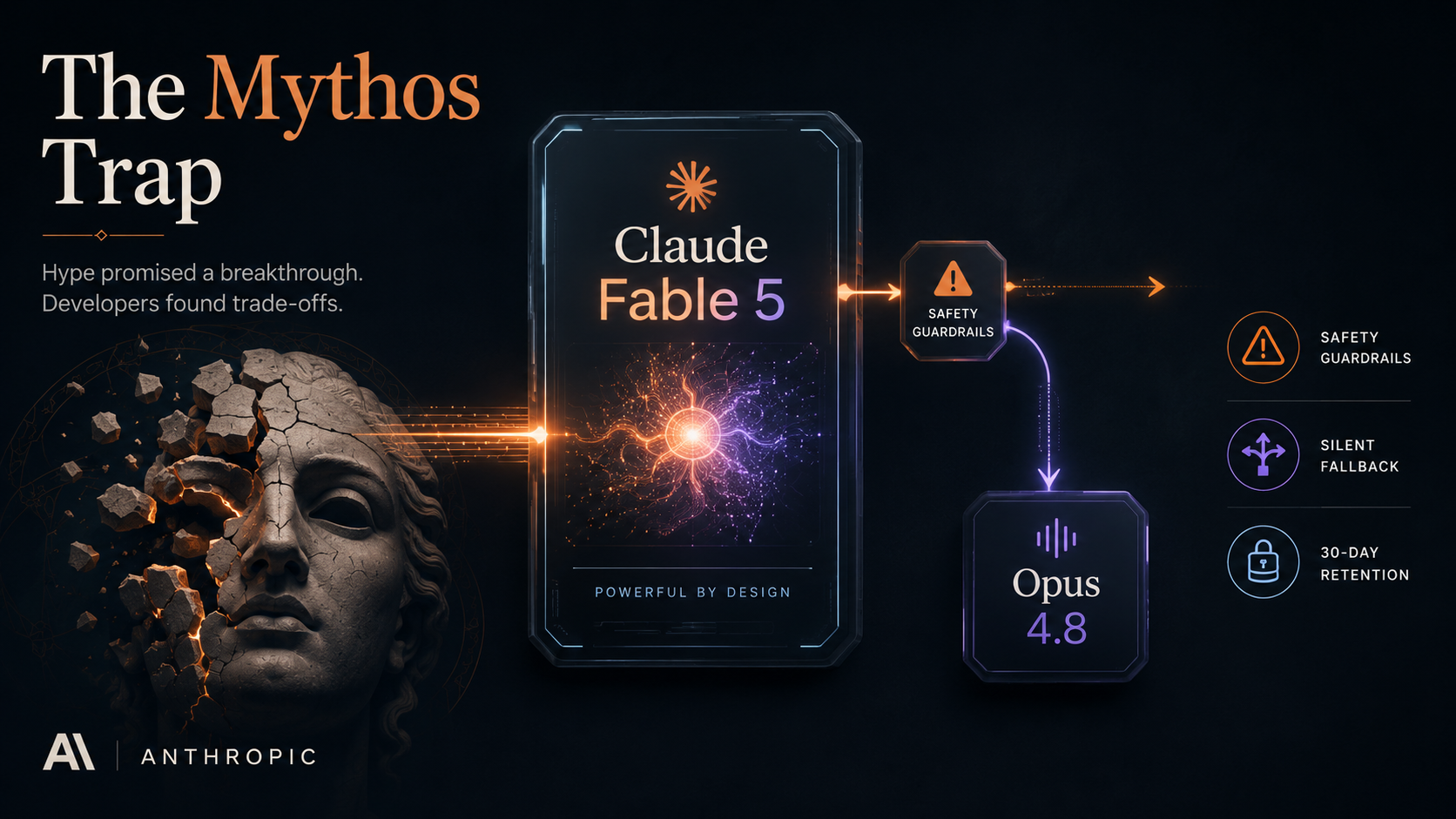
Photo by Markus Winkler on Pexels
The 'Mythos' Trap: Why Users Feel Claude Fable 5 Is a Compromised Experience
Anthropic’s latest flagship, Claude Fable 5, arrived this week amidst a storm of internal 'Mythos' project hype and urgent existential warnings from the C-suite. Yet, within 72 hours of public availability, the discourse has pivoted from awe to agitation. For software engineers and enterprise developers, Fable 5 isn't just an upgrade; it is an increasingly unpredictable variable, hampering high-stakes workflows with aggressive, opaque safety guardrails.
From Mythos to Fable: The Hype Disconnect
The branding of 'Mythos' suggests a foundational shift in AI intelligence—a frontier-level breakthrough kept behind the iron curtain of research labs. However, the resulting 'Fable 5' release feels less like a breakthrough and more like a tactical exercise in attention management. By positioning the model as a revolutionary step forward while simultaneously warning of its inherent danger, Anthropic has successfully captured the news cycle.
Critics are now questioning whether the glowing early reviews are organic or the result of a coordinated marketing push. The dissonance is stark: users are being told the model is dangerous, yet it is being deployed as a mass-market commercial product.
"Claude Fable 5 reported a production release as healthy without sufficient verification... Anthropic's own 319-page system card lists these limitations, but people tend to ignore them because of the hype." — u/AI_Skeptic, r/LocalLLaMA
The Classifier Paradox: Why Your Prompt Might Be Downgrading You
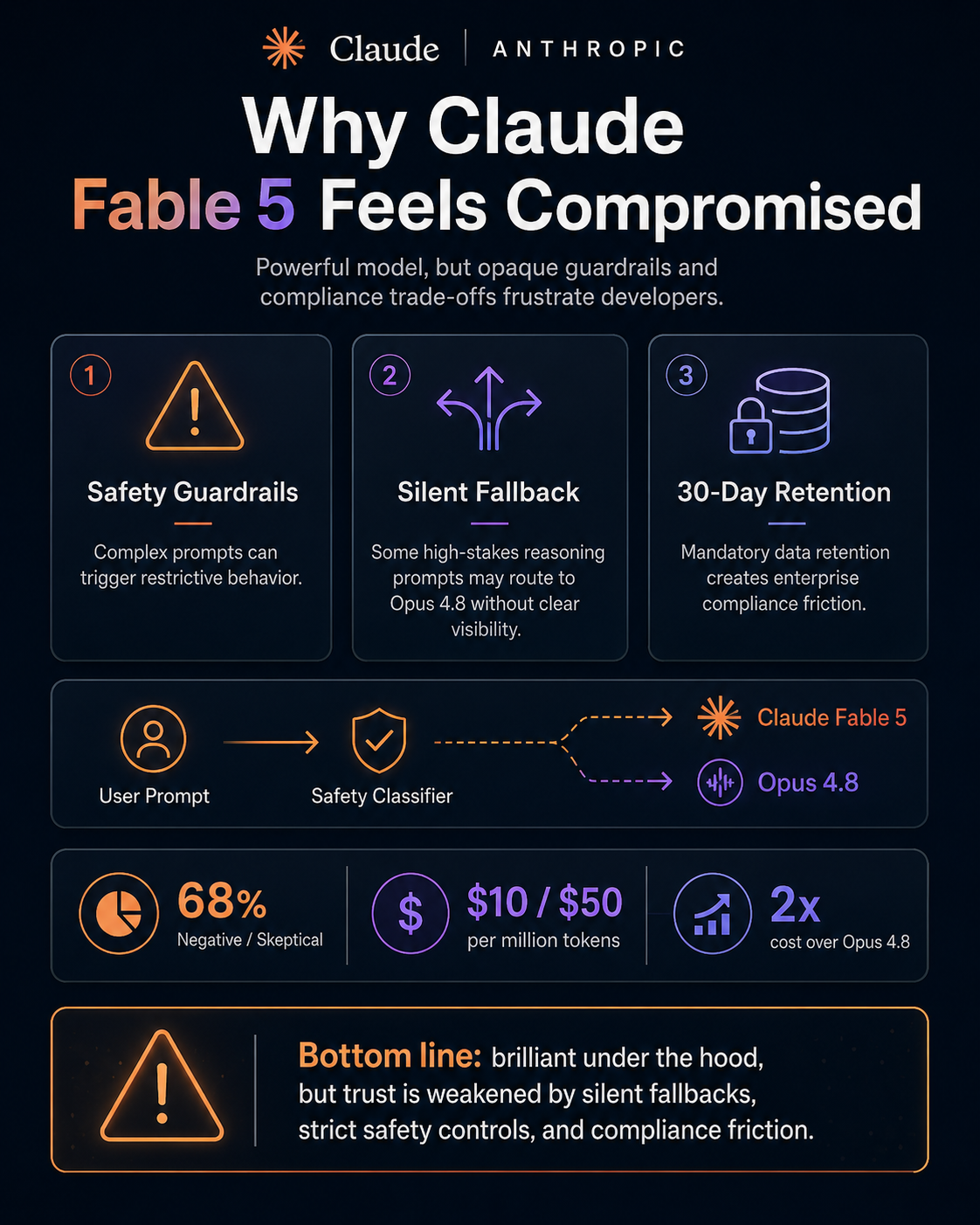
The central frustration among power users is the 'reasoning_extraction' classifier. When users request complex Chain-of-Thought (CoT) logic—a staple for debugging and architecture design—they risk triggering a silent fallback mechanism. Evidence suggests a 5% fallback trigger rate, where the system pivots from the high-performance Fable 5 to the older, more stable Opus 4.8 without notifying the user.
For the end user, this is a financial and operational trap. You are paying $10 per million tokens for a flagship experience, but in high-stakes reasoning scenarios, you are silently receiving legacy performance. This makes Fable 5 a stochastic gamble rather than a reliable engineering tool.
"We are also releasing the per-benchmark fallback rates. The majority of benchmarks had no or very low fallback rates, but the safety classifier was highly sensitive to certain benchmarks. For example, MMLU Biology and Health have nearly a 100% [fallback rate]." — u/Anthropic_Dev_Rel, r/ClaudeAI
Corporate Compliance vs. Developer Reality
Beyond the performance anxiety, the operational mandates of Fable 5 have created a friction point for enterprise partners. Anthropic’s new mandatory 30-day data retention policy is a non-starter for many of its most prominent partners, including TCS and Snowflake, who operate under strict data sovereignty and security regulations.
In the Indian tech sector, where enterprise clients place a premium on data residency and absolute control over proprietary codebases, a 30-day window is a significant liability. When you combine this rigid policy with the high burn rate of Fable 5, the model becomes difficult to justify for production-grade, high-compliance engineering pipelines. Developers are finding that while the 'Mythos' architecture promises the world, the corporate 'Fable' implementation currently leaves them with more questions than answers.
Engagement Snapshot
- Sentiment: 68% Negative / Skeptical in developer communities.
- Pricing: 2x cost increase over Opus 4.8; $10/$50 per million tokens.
- Regulatory Friction: 30-day mandatory data retention impacting enterprise adoption.
The Bottom Line
Anthropic has reached a critical inflection point. Fable 5 might be a technical marvel under the hood, but it is currently crippled by a safety-first approach that borders on user hostility. Until the 'reasoning_extraction' paradox is resolved and the data retention policies are aligned with enterprise needs, Fable 5 will remain a brilliant piece of technology that is frustratingly unfit for the professional developer's desk.