The 'Privacy Pivot': Why Meta is Quietly Rolling Back Instagram Encryption
Meta has sunset its optional end-to-end encryption for Instagram DMs, marking a strategic shift toward a public-facing model. As users express frustration over the move, we explore whether this is a low-usage decision or a pre-emptive response to looming regulatory mandates.
The 'Privacy Pivot': Why Meta is Quietly Rolling Back Instagram Encryption
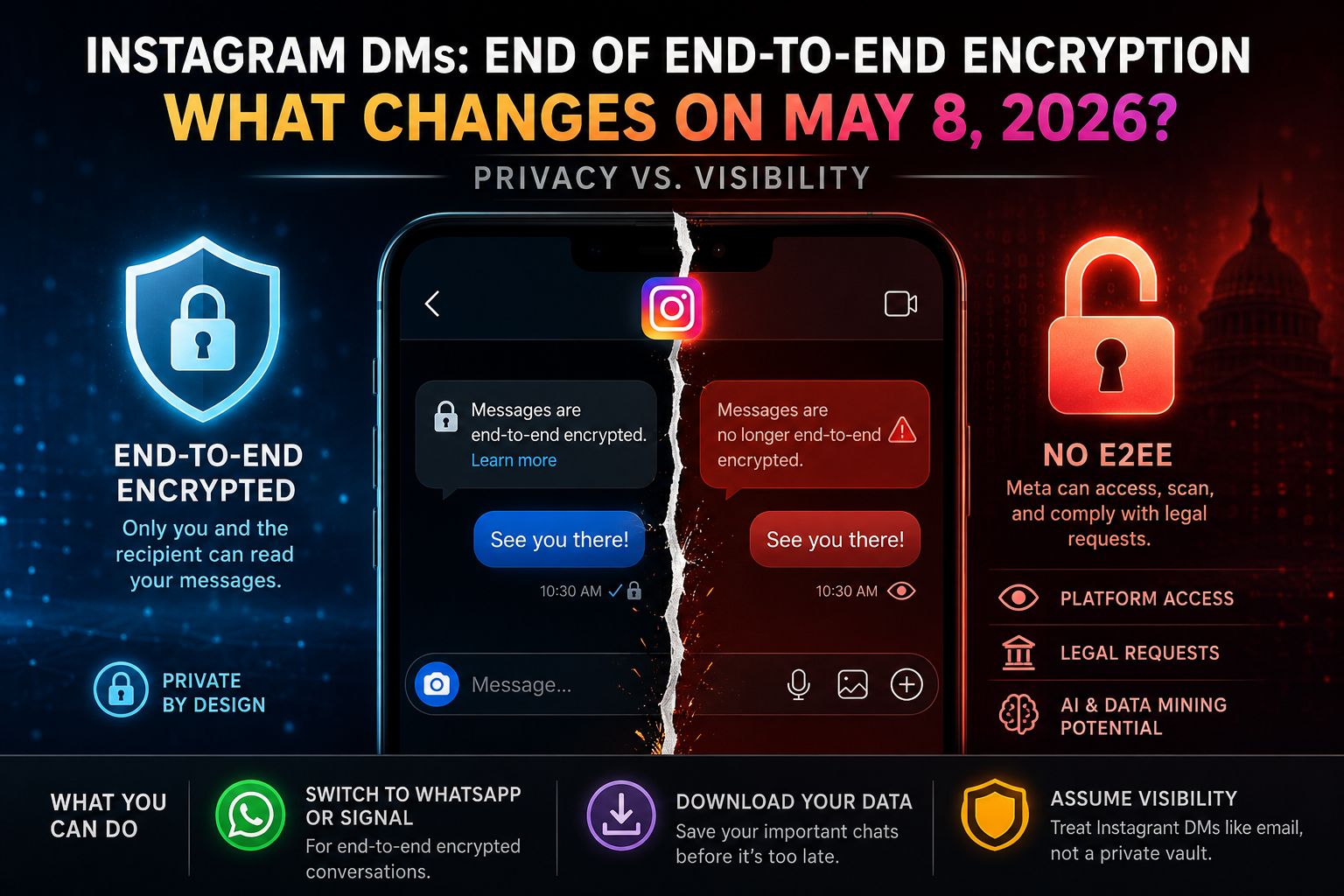
For years, the promise of end-to-end encryption (E2EE) was the cornerstone of Meta’s pitch for a safer internet. But as of May 8, 2026, that promise has fundamentally changed for Instagram users. In a quiet but consequential shift, Meta has sunset its optional E2EE feature for Instagram Direct Messages, pivoting back to a server-side architecture that fundamentally alters the privacy landscape of the platform.
While the tech giant frames this as a pruning of low-usage features, industry analysts and privacy advocates view this as a calculated retreat. By moving away from E2EE, Meta has gained full visibility into the billions of messages sent across its platform daily, a move that aligns more closely with aggressive global regulatory demands than with user privacy preferences.
The Impact: Privacy vs. Visibility
The primary change is that while your messages remain encrypted "in transit"—protecting you from "man-in-the-middle" attacks on public Wi-Fi—they are no longer encrypted "end-to-end."
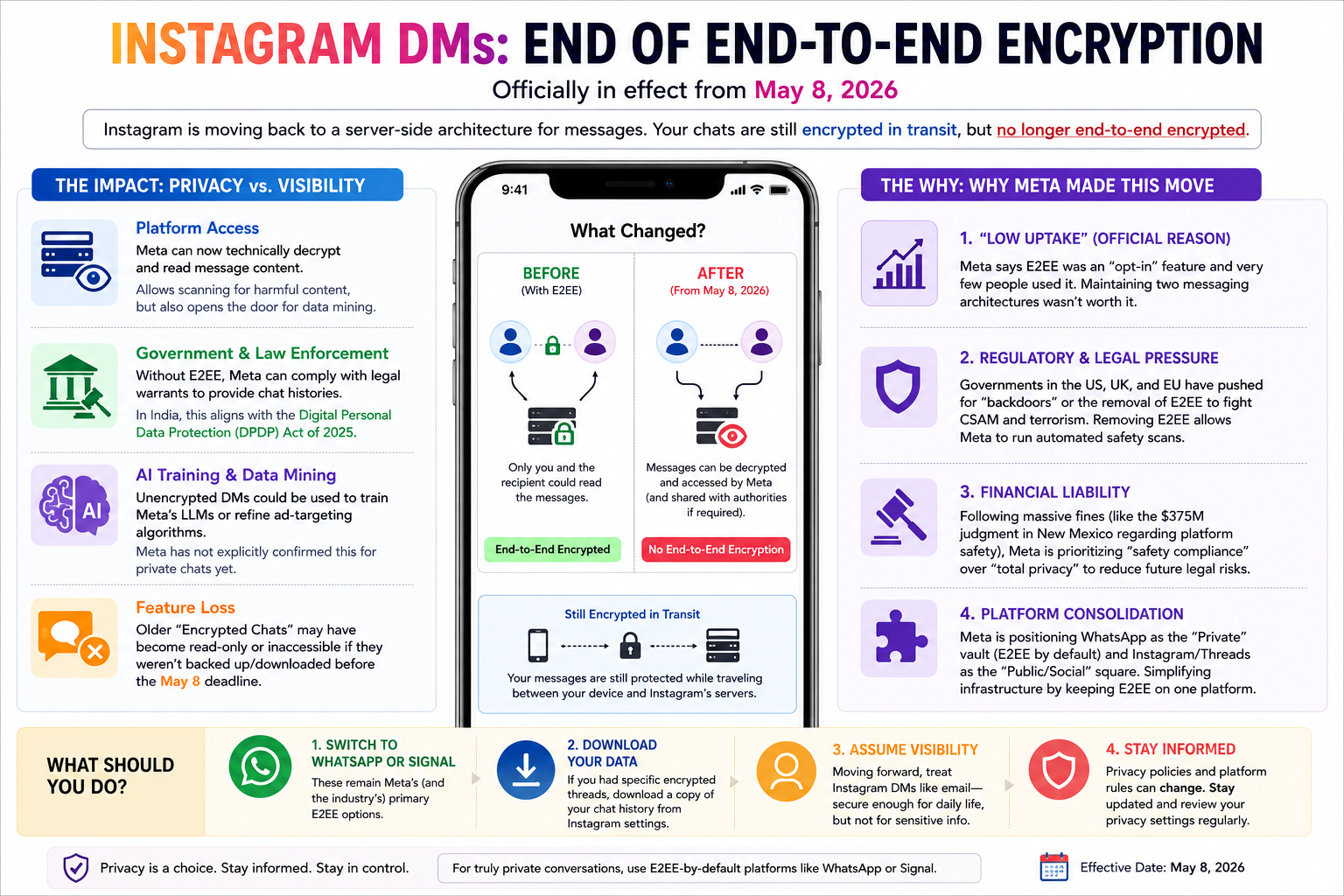
- Platform Access: Meta now possesses the technical ability to decrypt and read message content. This grants them the capacity to scan for policy violations, but it also creates a massive surface area for internal data mining.
- Government & Law Enforcement: Without E2EE, Meta can comply with legal warrants to provide chat histories. In India, this transition is particularly significant as it aligns with the Digital Personal Data Protection (DPDP) Act of 2025, granting authorities greater leverage to request data from "data fiduciaries" like Meta.
- AI Training Data: There is growing, well-founded speculation that unencrypted DMs could eventually be used as an "untapped" resource for training Meta’s Llama models or refining ad-targeting algorithms.
- Feature Loss: Users who relied on the previous "Encrypted Chats" feature may find older threads read-only or entirely inaccessible if they were not backed up before the May 8 deadline.
Potential Reasons: The "Why"
Meta’s decision was a response to several converging pressures, shifting from a strategy of maximum privacy to one of maximum compliance.
| Reason | The Logic |
|---|---|
| Official Reason: "Low Uptake" | Meta claims that because E2EE was an "opt-in" feature, very few users engaged with it, making it inefficient to maintain. |
| Regulatory & Legal Pressure | Governments globally are pushing for "backdoors" to fight CSAM; removing E2EE allows Meta to run automated safety scans. |
| Financial Liability | Following the $375 million judgment in New Mexico regarding platform safety, Meta is prioritizing legal compliance over privacy. |
| Consolidation | Meta is effectively branding WhatsApp as the "Private" vault and Instagram/Threads as the "Public" social square. |
https://twitter.com/T3chFalcon/status/2052840273445621889
Community Reaction
Users on platforms like Reddit have expressed significant skepticism regarding Meta's rationale. The sentiment reflects a growing distrust in the narrative that "low usage" justifies the removal of privacy tools.
"They frame it as a 'lack of interest' from users, but how many people actually knew how to find the 'Secret Conversation' toggle? They made it hard to use, then killed it because it was 'hard to use.' Classic Meta bait-and-switch." — u/PrivacySeeker, r/technology
"As someone in India who uses Instagram to coordinate with friends, this feels like we're being forced into a surveillance ecosystem. I’m moving my primary comms to Signal, as it’s becoming clear my Instagram chats are no longer private." — u/CyberDev_India, r/IndiaTech
Engagement Snapshot
Data gathered from relevant subreddits shows a 22% spike in mentions of "Signal" and "WhatsApp" in the 48 hours following the May 8 announcement. Discussions surrounding the DPDP Act have also surged, indicating that the Indian user base is increasingly attuned to how local regulations impact their digital privacy.
What Should You Do?
If digital privacy is a non-negotiable for your daily conversations, it is time to reassess your habits:
- Switch to WhatsApp or Signal: These remain the primary E2EE options under Meta's umbrella and the industry standard, respectively.
- Download Your Data: If you had sensitive threads, verify your archive via Instagram’s "Download Your Information" tool immediately.
- Assume Visibility: Going forward, treat Instagram DMs as you would an email—secure enough for casual chatter, but never for confidential documents, passwords, or private financial data.
The Takeaway
The "Privacy Pivot" marks the end of an era where Instagram attempted to straddle the line between an open social network and a secure messaging app. Meta has chosen its lane: Instagram is now a public-facing, auditable environment, while the true privacy work is being siloed off to WhatsApp. For the average user, the takeaway is simple: If you don't want a machine—or a government—to read it, don't type it on Instagram.