The Reality Check: Why Thousands of Automated Job Applications are Yielding Zero Results
Desperate to bypass a saturated market, Indian freshers are turning to custom bots to fire off thousands of job applications. Our investigation reveals why this 'spray and pray' tactic is failing and what the algorithmic arms race means for the future of hiring.

Photo by Jakub Zerdzicki on Pexels
The Reality Check: Why Thousands of Automated Job Applications are Yielding Zero Results
Desperate to bypass a saturated market, Indian freshers are turning to custom bots to fire off thousands of job applications. Our investigation reveals why this 'spray and pray' tactic is failing and what the algorithmic arms race means for the future of hiring.
The Rise of the 'Bot-Driven' Job Seeker
For an entire generation of Indian engineering graduates, the post-graduation experience has shifted from campus placements to a digital gauntlet. Frustrated by the silence from major job portals like Naukri and LinkedIn, many have turned to custom-built automation scripts. Using Python-based APIs and browser automation tools, candidates are now submitting hundreds—sometimes thousands—of applications a day, effectively attempting to brute-force the recruitment process.
This "productivity theater" provides a soothing, if illusory, sense of progress. By setting a script to run overnight, a job seeker can wake up to the news that they have "applied" to 500 roles. However, the reality is far bleaker. Our review of developer forums and social media threads reveals a growing cohort of engineers who have submitted over 1,000 applications with zero interview callbacks to show for it.
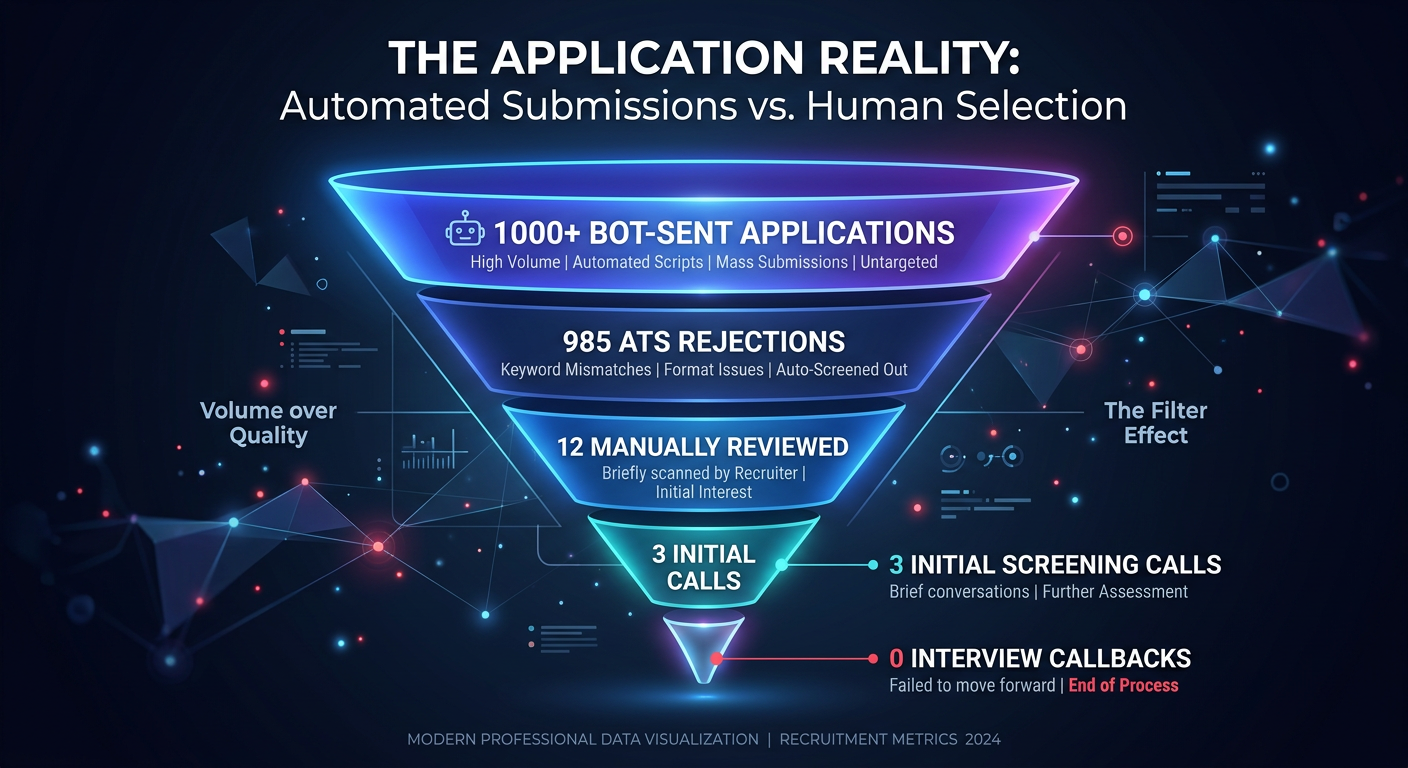
I spent three weeks building a bot to scrape Naukri and auto-apply to every 'fresher' role in Bengaluru. After 1,200 applications, I haven't received a single human response. It turns out I’ve just automated my own rejection. — @dev_despair, X
The Algorithmic Desert: How Platforms Filter the Crowd
Is this a structural failure, or are the bots the problem? The answer lies in the "algorithmic desert" created by modern recruitment platforms. Job portals utilize sophisticated internal ranking and throttling algorithms that affect organic visibility. When a profile is submitted via a bot, it often lacks the nuanced keyword-to-role matching required by Applicant Tracking Systems (ATS).
There is a growing sentiment that platforms intentionally throttle non-premium profiles to incentivize paid subscriptions. While platforms maintain that their algorithms focus on "quality of hire," the reality for candidates is an opaque wall. The race between candidate automation and platform anti-bot measures has created an arms race where human-readable content is being sacrificed for machine-readable keyword stuffing, further alienating actual human recruiters.
"The portals are essentially gamifying volume to keep users addicted to their platforms," says a former product manager at a leading Indian recruitment firm. "But when everyone uses a bot, the signal-to-noise ratio drops to zero. Recruiters aren't seeing your application; they are seeing a flood of filtered, low-effort submissions."
Data Versus Desperation: Is the Tech Path Broken?
Is the current tech career path in India undergoing a permanent shift or a temporary correction? Evidence suggests the latter, though it is painful. Automation tools are currently acting as a crutch for a market that is fundamentally mismatched—too many generalist graduates and too few entry-level roles that require genuine human problem-solving.
Expert analysis suggests that while automation is a vital technical survival skill for managing data, it is a poor strategy for career building. Networking—the "last bastion" of effective hiring—remains statistically superior to the "spray and pray" method. A referral, even from a distant connection, consistently outperforms a thousand bot-driven submissions in terms of actual interview conversion.
The Bottom Line
Automation is not the solution to a broken hiring market; it is an amplification of its dysfunction. For freshers, the "bot-driven" approach is providing a false sense of security while delaying the adoption of high-impact strategies like skill-based networking and project-based portfolios. Until the market moves away from volume-based metrics, the most successful candidate will be the one who stops fighting the machine and starts connecting with the people behind it.