The 'Reset' Paradox: Ola Electric’s Financials Defy Simple Narrative
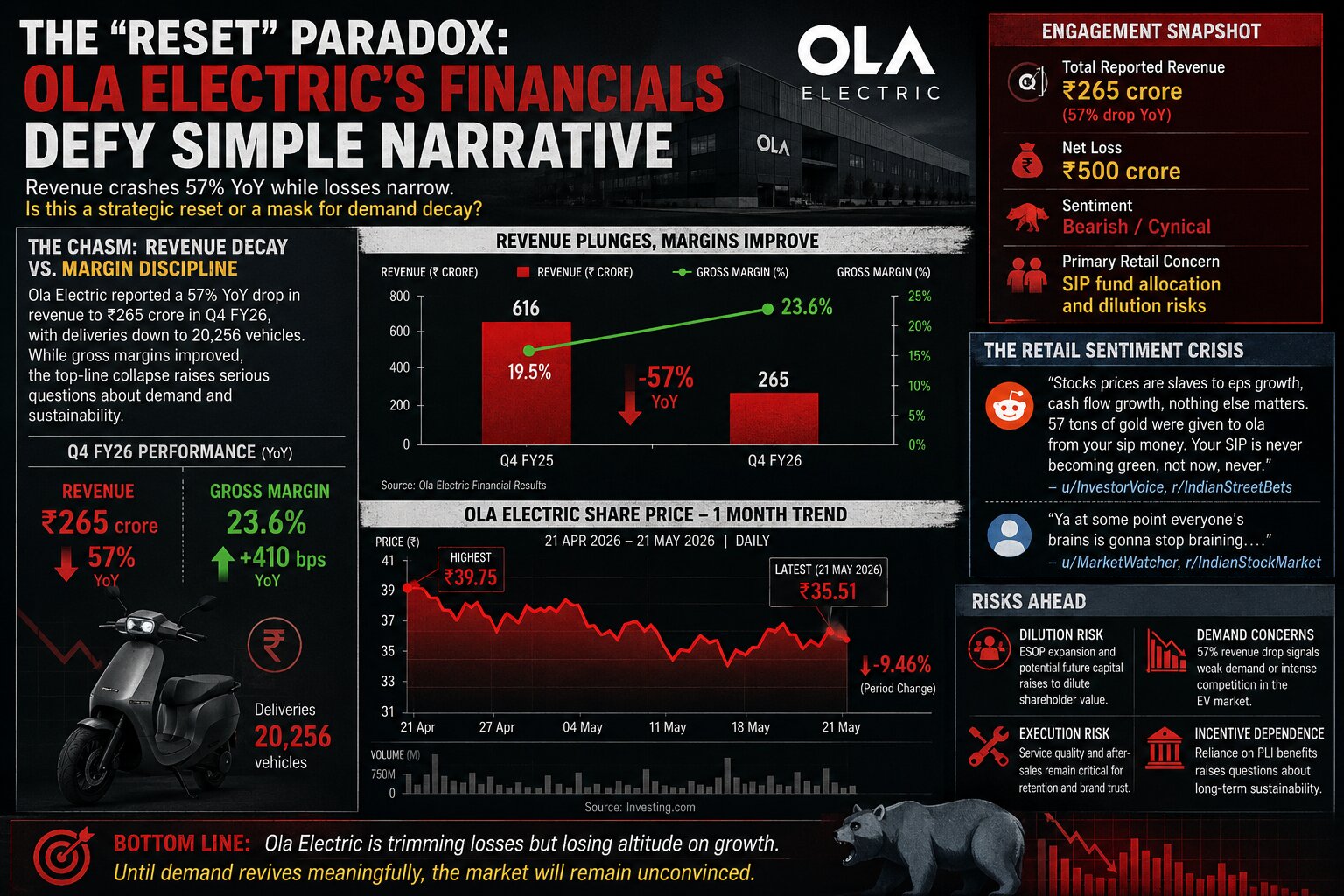
As Ola Electric reports a 57% revenue plunge despite narrowing losses, a chasm has emerged between management's 'reset' strategy and a disillusioned retail investor base. We analyze whether this shift represents a sustainable path to profitability or a temporary mask for fundamental demand decay.
The 'Reset' Paradox: Ola Electric’s Financials Defy Simple Narrative
As Ola Electric reports a 57% revenue plunge alongside narrowing losses, a profound chasm has emerged between the management's "reset" strategy and an increasingly disillusioned retail investor base. While the leadership frames this period as a necessary structural transition, the market is reacting with skepticism that borders on open hostility. We analyze whether this shift represents a sustainable path to profitability or a temporary mask for fundamental demand decay.
The Chasm: Revenue Decay vs. Margin Discipline
In the latest quarterly filing, Ola Electric reported a net loss of ₹500 crore for Q4 FY26, a figure that appears to show progress compared to previous cycles. However, this recovery is overshadowed by a massive 57% year-on-year revenue contraction, with total deliveries languishing at 20,256 vehicles. The "reset" narrative hinges on the company’s ability to optimize operations and leverage PLI (Production Linked Incentive) benefits to bolster margins, effectively prioritizing survival over market share expansion.
Yet, the question remains: can the company rekindle top-line growth without sacrificing the gross margins they have fought so hard to protect? The reliance on aggressive cost-cutting and incentive-dependent cash flows leaves little room for error. If the revenue decay is symptomatic of a broader shift in consumer sentiment or heightened competition in the EV space, the current margin improvements may prove to be a fleeting victory.
The Retail Sentiment Crisis
There is a palpable disconnect between institutional 'Sell' ratings and the growing anger among domestic retail investors. Many who participated in the IPO are now expressing deep regret, often pointing to the allocation of Systematic Investment Plan (SIP) funds as a primary point of contention. The narrative of a 'grifter IPO' has taken root, fueled by concerns over ESOP dilution and the exit of early-stage venture capital backers.
"Stocks prices are slaves to eps growth, cash flow growth, nothing else matters. 57 tons of gold were given to ola from your sip money. Your SIP is never becoming green, not now, never." — u/InvestorVoice, r/IndianStreetBets
This sentiment is not just anecdotal; it is a driving force behind the stock's volatility. When retail participants view the company as a vehicle for capital transfer rather than value creation, every earnings miss—no matter how small the narrowing of losses—is met with a sell-off that threatens to drag valuations further into the abyss.
Risks Ahead: Dilution and Execution
Looking forward, the execution risks are mounting. Beyond the fundamental demand issues, investors are wary of the impact of ESOP expansion and potential future capital raises. For the current shareholder, every dilution event serves to further erode the value of their holding, making the promise of future profitability feel increasingly distant.
Management’s next steps will be critical. The company must prove that service quality - a historical pain point—is improving enough to retain customers in a competitive market. Without clear evidence of a resurgence in delivery numbers, the "reset" will be viewed not as a strategy, but as a slow-motion retreat from the ambitious growth targets that initially enticed the market.
Engagement Snapshot
- Total Reported Revenue: ₹265 crore (57% drop YOY)
- Net Loss: ₹500 crore
- Sentiment: Bearish/Cynical
- Primary Retail Concern: SIP fund allocation and dilution risks
Bottom Line
Ola Electric is currently trapped in a paradox: it is successfully trimming the fat, but the underlying engine of growth appears to be sputtering. Investors are no longer interested in the narrative of a "reset"; they are demanding evidence of a scalable, profitable business model that can thrive without the aid of government incentives. Until management can reconcile their operational efficiency with a genuine recovery in top-line demand, the stock is likely to remain in a volatile holding pattern, held hostage by the frustration of its own retail base.