The Silent Monopoly: Is Apple Weaponizing LPDDR5 Supply to Stifle Android Flagships?
Apple's aggressive cornering of the global LPDDR5 memory market is reshaping the hardware landscape, forcing Android OEMs to scale back high-end specifications. We analyze whether this supply chain dominance is a strategic strike against the competition or a necessary pivot toward internal AI infrastructure.
Photo by Mark Stebnicki on Pexels
The Silent Monopoly: Is Apple Weaponizing LPDDR5 Supply to Stifle Android Flagships?
Apple's aggressive cornering of the global LPDDR5 memory market is reshaping the hardware landscape, forcing Android OEMs to scale back high-end specifications. What was once seen as a testament to Tim Cook’s supply chain mastery is now increasingly viewed as a calculated moat, effectively starving competitors of the silicon they need to compete in the era of on-device AI.
The Memory Squeeze: How Apple Controls the Pipeline
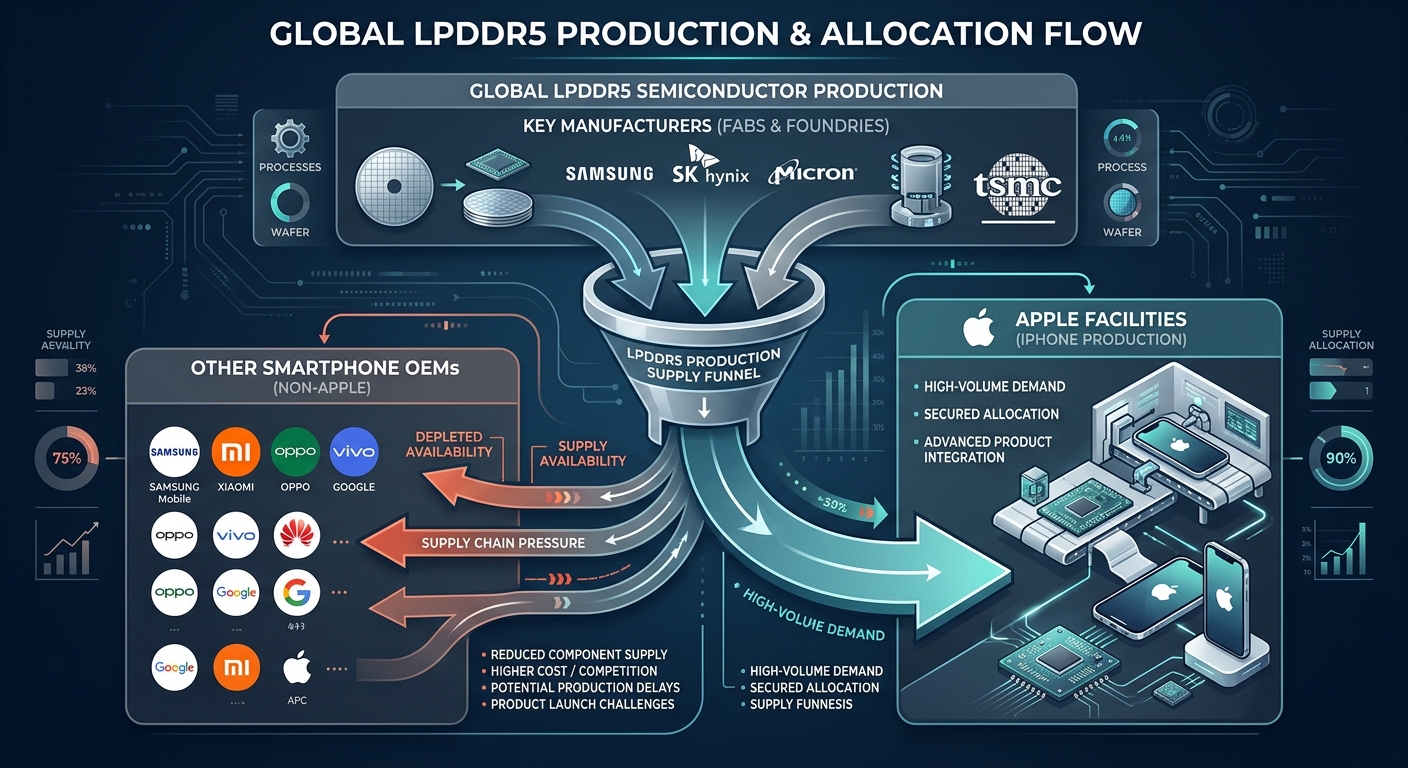
Apple’s procurement strategy has long been the gold standard of the industry, but recent quarters have signaled a shift from efficient logistics to total market domination. By signing multi-year, exclusivity-leaning agreements with key manufacturers, Apple has successfully secured a staggering 75% to 80% of global LPDDR5X output. This volume purchasing power doesn't just lower their unit costs; it acts as an impenetrable barrier to entry for smaller players.
As Apple pivots toward massive internal AI infrastructure and memory-hungry Apple Intelligence features, it has effectively sucked the oxygen out of the room. Android manufacturers, particularly those in the highly competitive Chinese market, are finding that the premium LPDDR5 modules they need to power their 24GB or 32GB RAM flagships are either prohibitively expensive or simply unavailable.
"Apple quietly scoops up any available LPDDR5 supply while freezing iPhone prices, pushing Chinese OEMs to kill their ultra-flagships
Pro-Tier Regression: The Mac Studio Paradox
Adding to the confusion is the recent contraction of Apple's own professional workstation lineup. In a move that has baffled creative professionals, Apple has removed high-RAM configuration options for the Mac Studio. The maximum capacity has been slashed, with the 512GB and 128GB options being phased out, leaving the current ceiling at a restricted 96GB.
Industry analysts are split: is this an architectural limitation of the upcoming M5 silicon transition, or is Apple intentionally cannibalizing its desktop memory supply to feed its burgeoning AI data center needs? The impact on professional workflows—particularly in video production and large-scale LLM training—is profound. As one user noted on Reddit:
"The minions need to make sacrifices for the data centers.
Market Consequences: The Death of the Android Ultra-Flagship
For the Indian smartphone market, where value-for-money and 'spec-war' dominance often dictate consumer preference, this memory squeeze is a harbinger of stagnation. We are witnessing the forced death of the 'ultra-flagship.' Chinese OEMs are being forced to choose between massive margin compression or lowering the RAM ceilings of their top-tier devices to maintain competitive pricing.
This 'Apple-ification' of the industry—where performance is gated by supply chain exclusivity rather than sheer engineering innovation—is shifting consumer sentiment. If Android flagships stop offering the 'more for less' advantage, the ecosystem's unique selling proposition erodes, potentially driving even more users toward the walled garden.
Future Outlook: Material Changes and Strategic AI Priorities
Looking toward 2026, the hardware landscape faces a divergence. Apple is reportedly returning to aluminum for the iPhone 18 Pro, prioritizing thermal efficiency and durability over the aesthetic trends of titanium. This shift, combined with the hoarding of LPDDR5, suggests a long-term strategy of prioritizing internal computational density over external flash.
"My titanium 15 pro ran like a mini nuclear reactor always burning up my hand. My 17 pro is cool to the touch even when recording 5-6 minute videos. Keep it aluminum forever.
Engagement Snapshot
The sentiment surrounding these supply chain shifts remains polarized. Reddit data indicates that while users are weary of Apple's restrictive hardware policies—specifically regarding Mac memory—the iPhone 17’s market dominance (2291 upvotes) suggests that consumers prioritize the brand's stability and cooling performance over the raw, often theoretical, hardware advantages of the Android competition.
Bottom Line
Apple has successfully turned its supply chain into a strategic weapon. By hoarding LPDDR5, they aren't just building better phones; they are setting the rhythm for the entire industry. For Android OEMs, the path forward is narrow: either innovate beyond the memory-intensive AI arms race or accept a future where their hardware is permanently a step behind the Cupertino giant.