The 'Speed Without Intelligence' Fallacy: What DeepSeek's DSpark Actually Does
DeepSeek’s new DSpark framework is fueling massive speed gains in inference, but it isn't an intelligence upgrade. Here is how this speculative decoding breakthrough works, why it matters for enterprise scaling, and where the performance hype meets reality.
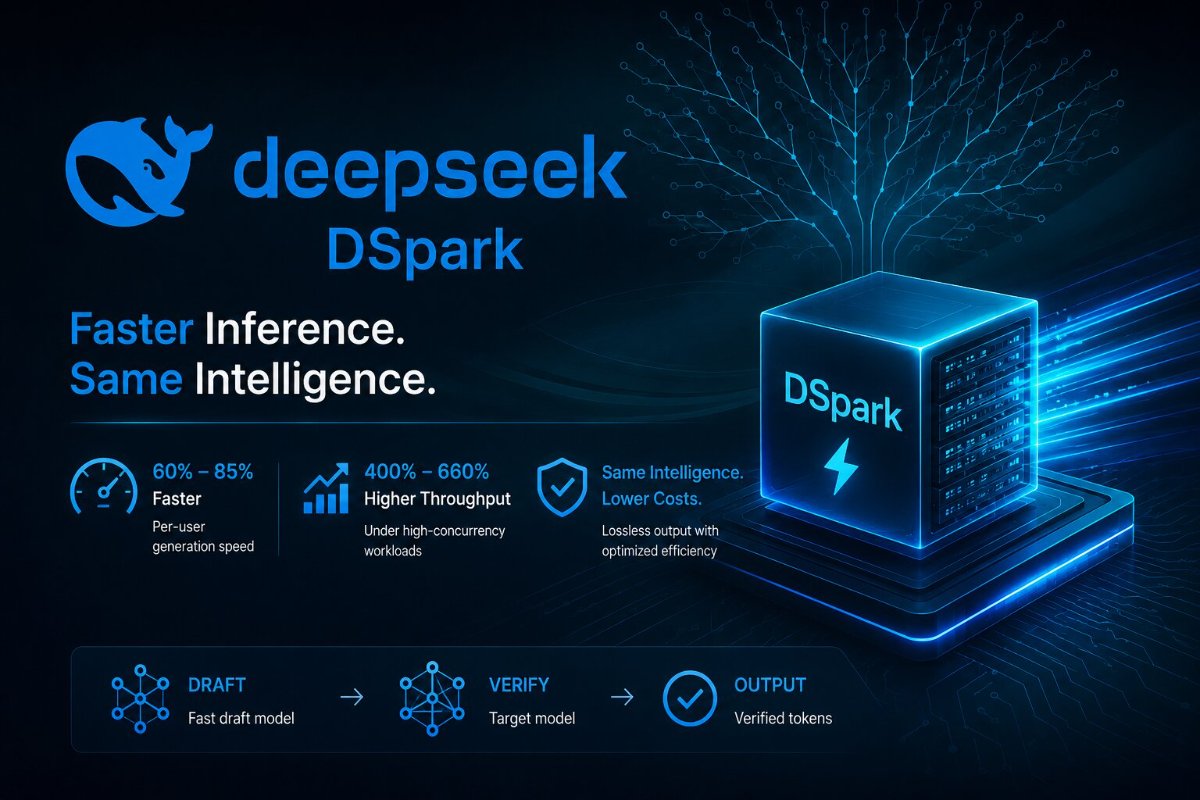
Photo by Markus Winkler on Pexels
The 'Speed Without Intelligence' Fallacy: What DeepSeek's DSpark Actually Does
DeepSeek's latest inference framework delivers dramatic speed gains, but the real story lies in speculative decoding, infrastructure efficiency, and the growing gap between model capability and deployment performance.
When DeepSeek open-sourced DSpark alongside specialized checkpoints such as DeepSeek-V4-Flash-DSpark and DeepSeek-V4-Pro-DSpark, many headlines framed the release as a major AI breakthrough. The numbers seemed to support the excitement. DeepSeek reported per-user generation speed improvements of 60% to 85%, while some production workloads achieved throughput gains exceeding 400% under heavy concurrency.
A real-world example helps separate hype from reality. Consider an enterprise coding assistant serving thousands of developers simultaneously. The underlying model may produce exactly the same code suggestions before and after DSpark. What changes is delivery speed. A response that previously arrived after a noticeable pause can now appear almost instantly, improving user experience and allowing the same hardware to serve significantly more requests. The model's intelligence remains unchanged; the infrastructure becomes more efficient.
That distinction matters because DSpark does not alter model weights, reasoning depth, factual knowledge, or alignment. It focuses entirely on inference, the stage where a trained model generates tokens for users. DeepSeek has effectively optimized the delivery mechanism rather than the engine itself.
Intelligence vs. Inference: The Separation Most People Miss
Many AI discussions blur the line between capability and performance.
| Metric | DSpark Impact | What Actually Changes |
|---|---|---|
| Model Intelligence | No Change | Reasoning, knowledge, and understanding remain identical |
| Output Quality | No Change | Token distribution remains mathematically equivalent |
| Tokens Per Second (TPS) | Significant Increase | Faster generation and improved throughput |
| Time to First Token (TTFT) | Often Improved | Responses begin appearing more quickly |
| Infrastructure Efficiency | Major Improvement | Better utilization of compute and memory resources |
| Enterprise Costs | Potential Reduction | More users served with the same hardware |
This distinction becomes increasingly important as enterprises evaluate AI investments. Faster output can create the illusion of a smarter system. In reality, DSpark simply removes inefficiencies that slow down token generation.
Inside the Verify-First Architecture
The technical foundation behind DSpark is a speculative decoding system built around a Verify-First design.
Traditional autoregressive generation follows a slow pattern. The model loads billions of parameters from memory, predicts a single token, then repeats the process again and again. Memory bandwidth, not raw compute power, often becomes the primary bottleneck.
DSpark attacks that bottleneck directly.
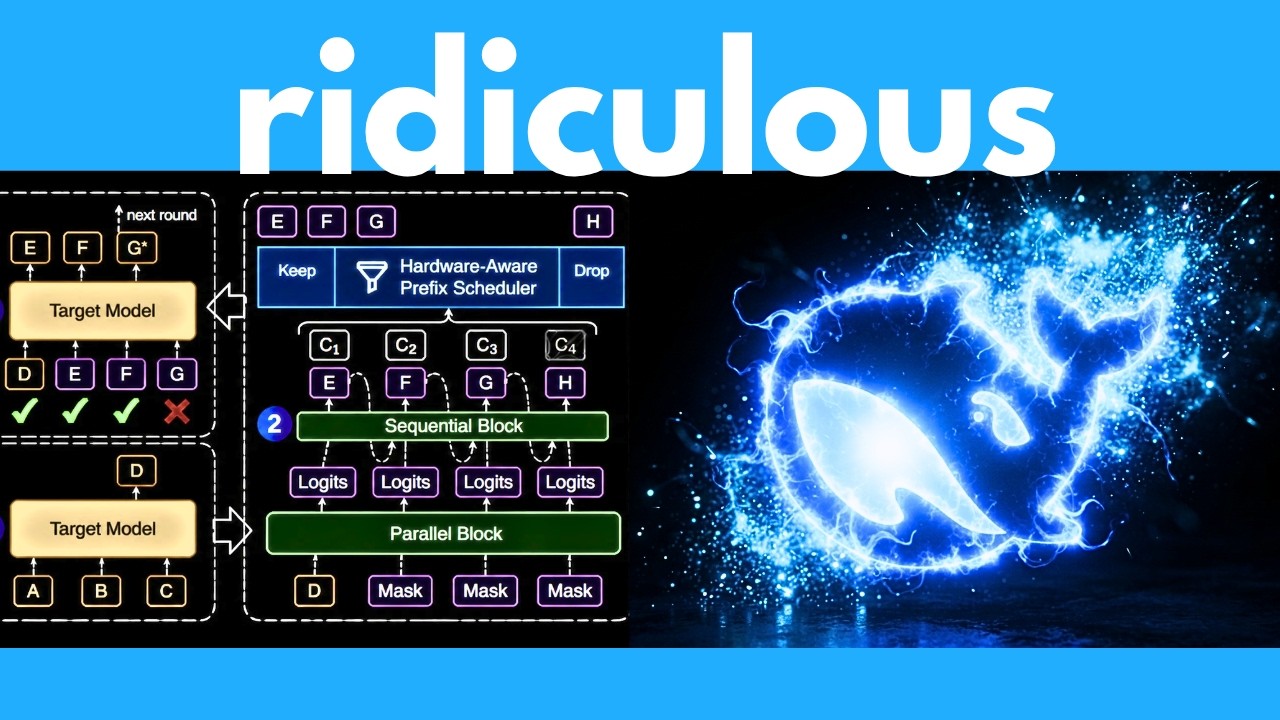
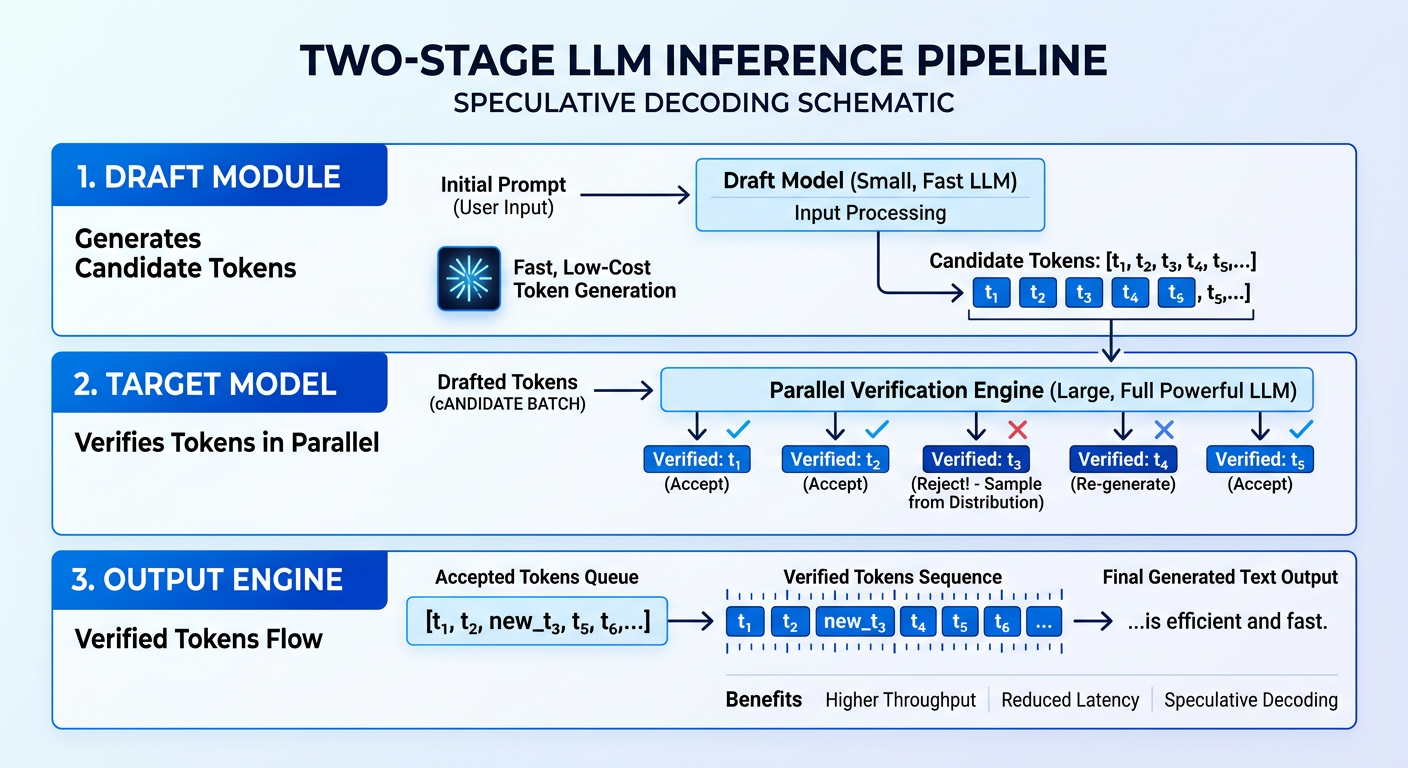
Instead of relying solely on the large target model, the framework introduces a lightweight draft module, often implemented through a semi-autoregressive Markov-style head or a specialized parallel backbone. This draft model rapidly predicts multiple future tokens at once.
The process unfolds in three steps:
- The draft model proposes a block of candidate tokens.
- The large target model verifies the entire block in a single parallel pass.
- Valid tokens move forward immediately, while incorrect predictions get rejected and corrected.
The crucial detail is that the target model always retains veto power. Through rejection sampling, DSpark preserves the original probability distribution of the base model. The final output remains mathematically equivalent to standard inference.
That means the system generates responses faster without sacrificing accuracy or changing behavior.
Why Enterprises Care About DSpark
The business implications may prove more important than the underlying research.
For organizations running customer support agents, coding assistants, document analysis systems, or multi-agent workflows, inference costs often exceed expectations. Every generated token consumes hardware resources.
DSpark shifts a significant portion of that workload toward smaller, memory-efficient draft modules. DeepSeek reports 60% to 85% faster generation speeds for V4-Flash compared with previous multi-token prediction baselines. Under strict production conditions, throughput improvements reportedly reached 400% to 660% through a load-aware confidence scheduler.
That scheduler adjusts verification budgets dynamically. During low traffic periods, it verifies longer token blocks to maximize efficiency. During traffic spikes, it reduces verification overhead and prioritizes responsiveness. The result is a serving system that remains stable under high concurrency instead of collapsing under load.
The Hardware Reality Behind the Headlines
Speed gains do not appear automatically.
Developer communities testing DSpark variants on specialized configurations, including 2× DGX Spark (GB10) systems, report single-stream generation rates around 60 to 67 tokens per second on predictable workloads such as code generation and structured JSON output. DeepSeek also released DeepSpec, an MIT-licensed training framework that helps align draft models with target architectures including Qwen3 and Gemma4.
Engineers have already started integrating DSpark concepts into runtime environments such as vLLM, while interest continues to grow around support for additional local inference engines.
Yet performance depends heavily on acceptance rates. Structured workloads produce predictable token patterns, allowing the draft model to make accurate predictions. Creative writing and complex reasoning create higher entropy, making prediction substantially harder.
Where the Performance Story Breaks Down
DSpark's biggest limitation stems from the same mechanism that powers its speed.
Speculative decoding succeeds only when the draft model accurately predicts what the target model intends to generate next. When acceptance rates remain high, performance soars. When they collapse, efficiency evaporates.
Researchers often describe this behavior as speculative decay. In highly creative, unpredictable, or deeply logical tasks, the draft model may repeatedly generate incorrect token sequences. The target model then rejects those predictions, forcing additional verification cycles. In extreme cases, performance can approach baseline sequential generation speeds.
Another risk emerges on the human side. Fast responses can create a perception of competence. Users may unconsciously equate speed with intelligence and place greater trust in outputs that arrive instantly. DSpark does not improve reasoning quality. It merely reduces waiting time.
That distinction may define the next phase of enterprise AI. DeepSeek has not built a smarter model. It has built a faster pipeline. As agentic systems scale and latency becomes a competitive differentiator, frameworks like DSpark show that infrastructure innovation can unlock enormous value—even when the intelligence under the hood stays exactly the same.