Volume vs Value: Why 50,000 Penny Stocks Are Quietly Draining Your Account
It is a classic mental shortcut on modern trading apps: assuming that a stock trading at a double-digit price has more room to expand than a premium market leader. Many believe that a ₹20 penny stock can easily jump to ₹40 to double their money, while a high-priced giant takes forever to move. Here is the straight-talking math that breaks down the price mirage, explains why speculative spikes vanish instantly, and reveals how true compounding works behind the scenes.

Photo by DS stories on Pexels
Volume vs Value: Why 50,000 Penny Stocks Are Quietly Draining Your Account
Imagine you open your broker app with a fresh ₹50,000 capital block ready to invest. Your terminal displays two options:
-
Option A: A high-performing market leader priced at ₹5,000 per share. Your cash block buys you a tiny, unimpressive package of just 10 shares.
-
Option B: A highly volatile, low-grade company trading at a low price of just ₹20 per share. Your identical cash pool lands you a massive, ego-boosting stockpile of 2,500 shares.
Instantly, the shortcut reflex takes over. You tell yourself: “If I buy the ₹5,000 stock, it needs a massive ₹5,000 rally just for me to double my net worth. That feels completely unrealistic! But if I buy the ₹20 stock, it only needs to tick up by a mere twenty rupees for me to pull in a 100% profit. It’s an absolute lock.”
This simple mental shortcut is exactly how millions of everyday retail portfolios get wiped out. People often confuse a low share price with low valuation or high growth potential. In reality, a stock trading at ₹20, ₹50, or ₹100 can structurally be a penny stock if it lacks institutional backing, has tiny trading volumes, and possesses no real corporate earnings. Swapping real asset quality for pure screen volume looks great on an app dashboard, but it completely fights against how real money grows. Let’s look at the actual math running your screen.
Percentages Rule Your Portfolio, Not Rupees
The fundamental error in the penny stock calculation is focusing on the absolute rupee movement of the stock price rather than the percentage velocity required to move it.
Your net worth does not care how many structural pieces your capital is sliced into; it only measures the overall expansion rate of the total pie.
For a premium ₹5,000 market leader to move up by ₹500, it only needs a standard, highly routine 10% market adjustment—an organic shift that happens frequently when a company reports strong quarterly revenue or expands its market reach.
Conversely, for a ₹20 penny stock to reach ₹40, it doesn't just "move up twenty bucks." It has to execute a monumental 100% upward surge. It must double its total enterprise value, its commercial output, and its buying interest overnight. Buying a penny stock at ₹20 expecting a ₹20 gain is identical to buying a stock at ₹5,000 expecting it to instantly hit ₹10,000. The percentage hurdle is exactly the same, but the structural probability of a low-grade company executing a 100% business breakout is incredibly low compared to a stable giant moving up 10%.
App Volume vs. True Asset Value
To map out why professional capital allocators avoid large pools of penny stocks, look at how these positions function behind the screen:

Real Compounding Drives the Snowball
To see past the allure of penny stocks, you have to understand the operational math of true compounding. Real compounding is not a series of lucky trade entries; it is the process where a company retains its internal profits, plows them back into its own operations, and earns an incremental return on that reinvested capital year after year.
When you buy an industry leader at ₹5,000, you are purchasing an automated wealth-compounding machine. These firms maintain a high Return on Equity (ROE). They use their vast corporate earnings to open massive fulfillment centers, buy up smaller regional players, and build superior technical infrastructure.
As their internal business engine physically grows and becomes more profitable every year, the value of each individual share compounds exponentially. Your initial investment behaves like a compact, solid snowball rolling down a long mountain—quietly, predictably gathering mass.
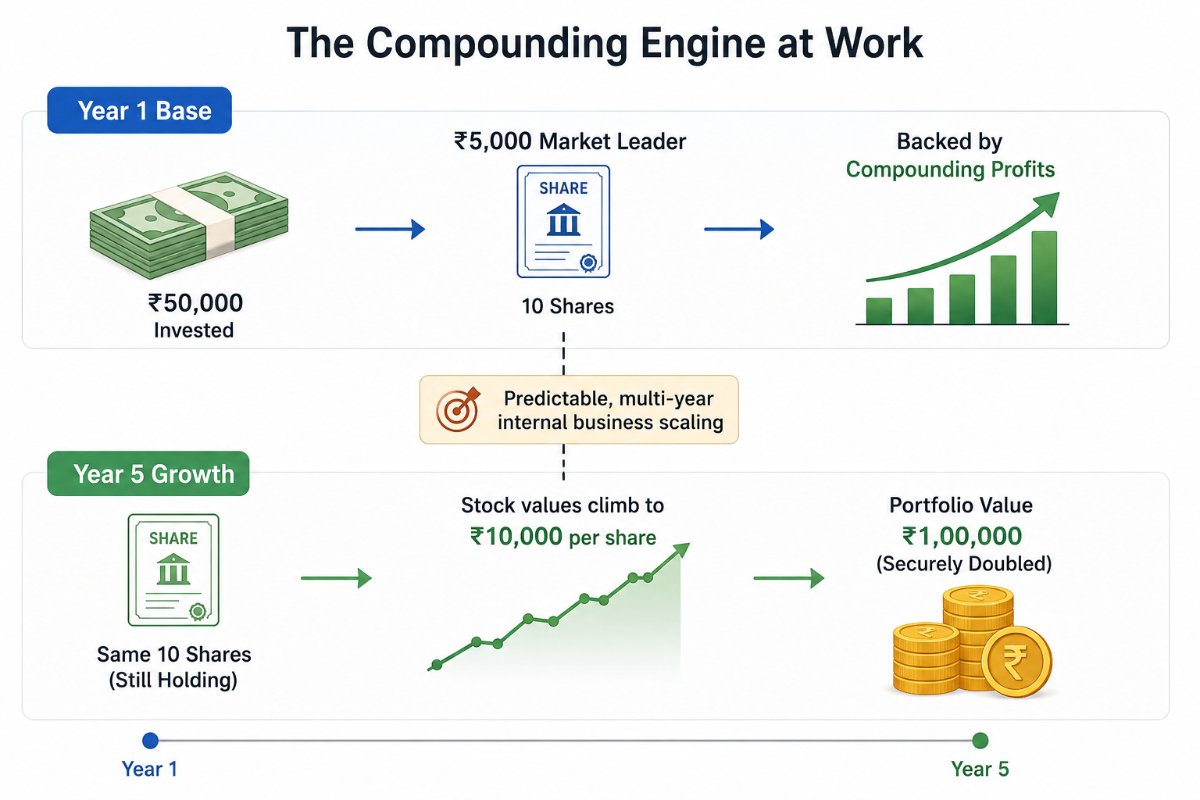
Notice a vital detail in this timeline: throughout the entire five-year wealth cycle, you still own the exact same 10 shares. The total volume on your application screen never changed by a single digit, yet your actual capital completely doubled. This is the ultimate lesson of the market: structural commercial health generates permanent compounding wealth, not app volume.
What Speculation Gives, It Steals in an Eye Blink
A penny stock completely severs this compounding chain. Because these businesses are typically priced low for structural reasons—such as mounting debt, vanishing customer demand, or ongoing regulatory scrutiny—they have zero operational surplus to reinvest. There is no internal snowball to drive long-term value.
Instead, when a low-volume ₹20 penny stock suddenly surges to ₹40 on your app dashboard, it is almost never due to an organic breakthrough in their financial balance sheet. It is a temporary burst of speculative momentum, driven by online chatroom hype, social media manipulation, or a small group of operators coordinating entry positions.
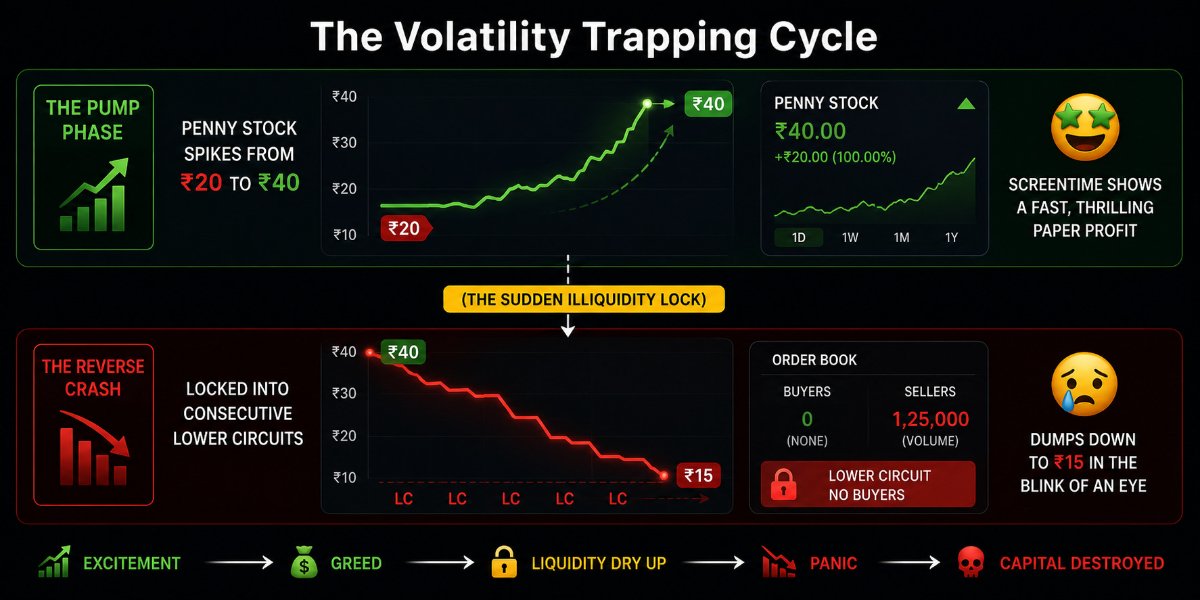
These vertical spikes create a dangerous psychological environment. It provides an instant hit of validation, making casual retail traders feel like elite market timers because their screen displays a rapid paper profit. But because these penny stock positions operate with highly illiquid order books, the real exit paths are incredibly narrow.
The exact moment the brief hype peaks or the operators decide to clear out their positions, the stock turns. It collapses into consecutive "lower circuits"—a structural market block where trading halts because the order book contains millions of panicking sellers but absolutely zero buyers. Your entire paper profit, alongside a heavy percentage of your original ₹50,000 principal, vanishes in the blink of an eye before your manual sell order can even register. What the market manufactured out of pure speculation, it reclaims with absolute devastation.
Bottom Line
Sustainable financial growth is never built on a massive mountain of cheap positions, and a speculative mindset can trap you whether a share costs ₹5 or ₹50. A high quantity count on your broker dashboard is a mental shortcut if the underlying corporate asset lacks intrinsic commercial value. Short-term price spikes on low-quality penny stocks are highly unstable events that give a passing mirage of wealth before pulling it back instantly.
Long-term wealth creation is strictly a game of asset execution. It is infinitely more productive to hold a single, high-performing share of a market champion backed by visible cash flows and compounding earnings, than to manage thousands of low-cost shares in a deteriorating business. By training your eye to look straight past the absolute share price and focus entirely on long-term percentage stability, you shield your core savings and ensure your capital works inside the most resilient engines of the economy.