When 220 is the New 180: The Boredom Factor in 'Batting Paradise' Pitches
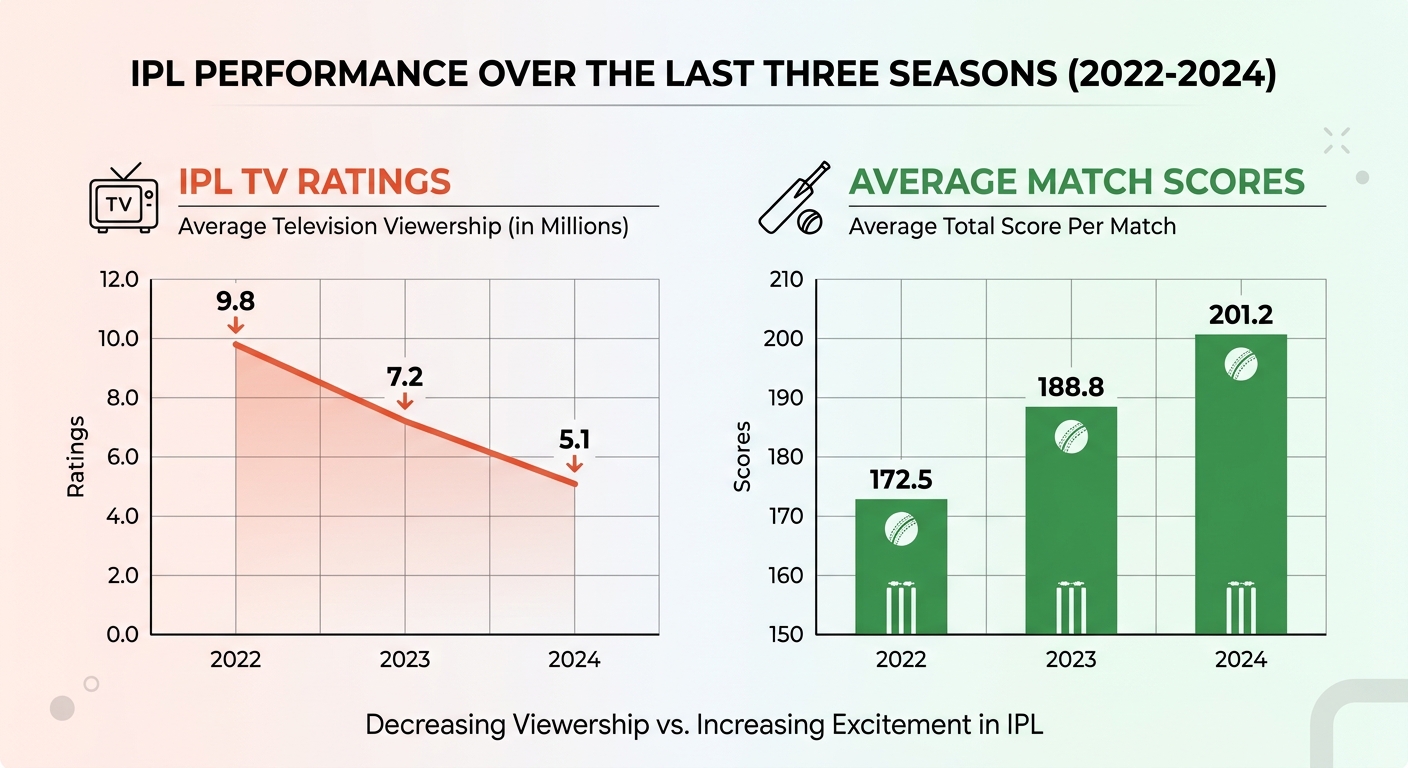
As IPL viewership trends report a 26% decline in linear TV, the conversation has shifted from digital migration to the monotony of the game itself. We examine if the league's pursuit of high-scoring spectacles has inadvertently traded fan engagement for 'six-fatigue'.

Photo by Shlok on Pexels
When 220 is the New 180: The Boredom Factor in 'Batting Paradise' Pitches
As the Indian Premier League (IPL) navigates its most aggressive batting season to date, a curious dissonance has emerged. While the official numbers indicate a 26% decline in linear TV viewership, the narrative has moved far beyond simple screen migration. The league is currently grappling with 'six-fatigue,' a phenomenon where the pursuit of high-octane entertainment has inadvertently rendered the game’s climax—the contest between bat and ball—eerily predictable.
The Paradox of the 220+ Scorecard
For years, the IPL was marketed on the back of last-over thrillers and the tactical chess match of T20 cricket. Today, those have been replaced by a monotonous parade of 220-plus totals, where scores once considered match-winning are now viewed as par. When every boundary is celebrated, the spectacle loses its scarcity value, leading to a palpable disinterest among hardcore fans.
"Sixes back in the day used to be fun. It used to be something to be celebrated. Now, it’s so normalized that it’s not even fun anymore. — u/CricketFanatic, r/Cricket
Beyond the Platform Shift: TV vs. Digital
It is critical to distinguish between technical migration and product fatigue. The 26% drop in linear TV viewership is not merely a sign of a dying product; it represents a fundamental shift in how the Indian consumer accesses live sports. With CTV (Connected TV) and digital platforms reporting massive surges in concurrent users, the audience hasn't vanished—they have simply migrated to platforms that offer more flexibility.
However, attributing the TV decline solely to technology overlooks the product itself. When the game loses its competitive edge, the 'sticky' nature of linear TV, which often relies on passive viewing, suffers the most. The shift is not just about the medium; it is about whether the content warrants the viewer's undivided attention for four hours every single night.
The Impact Player and the Erosion of Bowler Relevance
Central to this crisis is the 'Impact Player' rule, a structural change that has fundamentally skewed the game toward batting depth. By allowing teams to substitute a specialist batter, the rule has effectively nullified the risk associated with an early-innings collapse. Consequently, teams now adopt a 'swing-at-everything' mentality, knowing their middle order remains fortified regardless of early wickets.
I crunched the numbers to find out how many REAL nail-biting matches IPL has had over the years. People don’t mind high-scoring games. People mind predictable games. There’s a difference. — u/DataGuy_IPL, r/IndiaCricketGossips
The BCCI, recognizing the growing pressure from stakeholders and franchise owners—some of whom have publicly advocated for a return to equilibrium—has indicated that a post-tournament review of the Impact Player rule is firmly on the table. The current sentiment among bowling coaches and tactical analysts is that the rule has stripped the game of its defensive nuances, turning the sport into a glorified exhibition of power-hitting.
The Path to Restoration: Balancing the Contest
To restore long-term interest, the IPL must move away from the 'cookie-cutter' pitch philosophy. Home advantage, once a cornerstone of the tournament's tactical diversity, has been flattened by standardized surfaces that cater exclusively to high scoring. Reintroducing pitch heterogeneity—surfaces that offer turn for spinners or nip for seamers—could re-engage fans who crave variety over volume.
Furthermore, the saturation of T20 cricket, both in the IPL and internationally, remains the silent variable. When the audience is served 225 vs. 225 spectacles on a nightly basis, the 'wow' factor is diluted.
Engagement Snapshot
- Linear TV Viewership: 26% decline reported.
- Digital Platforms: Continued massive surge in viewership.
- Franchise Lobbying: High pressure for structural changes to the Impact Player rule.
- Fan Sentiment: Increasingly critical of 'predictable' high-scoring finishes.
The Bottom Line
The IPL is not in decline, but it is currently suffering from a crisis of predictability. The league’s transition into a high-scoring spectacle has prioritized entertainment, but it has forgotten that entertainment is only compelling when the outcome remains uncertain until the final ball. For the next cycle, the BCCI must pivot from purely aggressive batting metrics toward a model that restores the dignity of the bowler—lest the 'six-fatigue' turns into long-term viewer apathy.