Why Apps Stopped Working for You: A Look at Dating Fatigue in Urban India
As ghosting becomes the norm and profile maintenance feels like a full-time job, India’s urban youth are deleting their apps in droves. We explore why the digital search for love is failing and where people are going instead.

Photo by Markus Winkler on Pexels
Why Apps Stopped Working for You: A Look at Dating Fatigue in Urban India
As the golden glow of the "match" fades, a quiet exodus is underway across Delhi, Mumbai, and Bengaluru. For millions of young Indian professionals, the digital pursuit of romance has shifted from an exciting digital frontier to a soul-crushing chore. With ghosting becoming the norm and the constant pressure to curate a "perfect" profile feeling like a full-time job, India’s urban youth are deleting their apps in record numbers.
The Death of the 'Match': Why Urban Dating Feels Broken
The initial promise of dating apps—that they would widen our social circles and bridge the gap between busy schedules—has curdled into a "Paradox of Potential." We are now conditioned to view every interaction as a performance, treating our personalities as assets to be optimized for the algorithm. When a date fails, it no longer feels like a simple lack of chemistry; it feels like a system failure, a "bug" in the pursuit of an impossible romantic ideal.
This gamification has led to a widespread cynicism. Users are no longer curious; they are exhausted. The "dating hacks" that once dominated Reddit threads—perfecting your bio, optimizing lighting for photos, using clever openers—are yielding diminishing returns. The reality is that the market feels saturated, and for many, the effort-to-reward ratio has hit an all-time low.
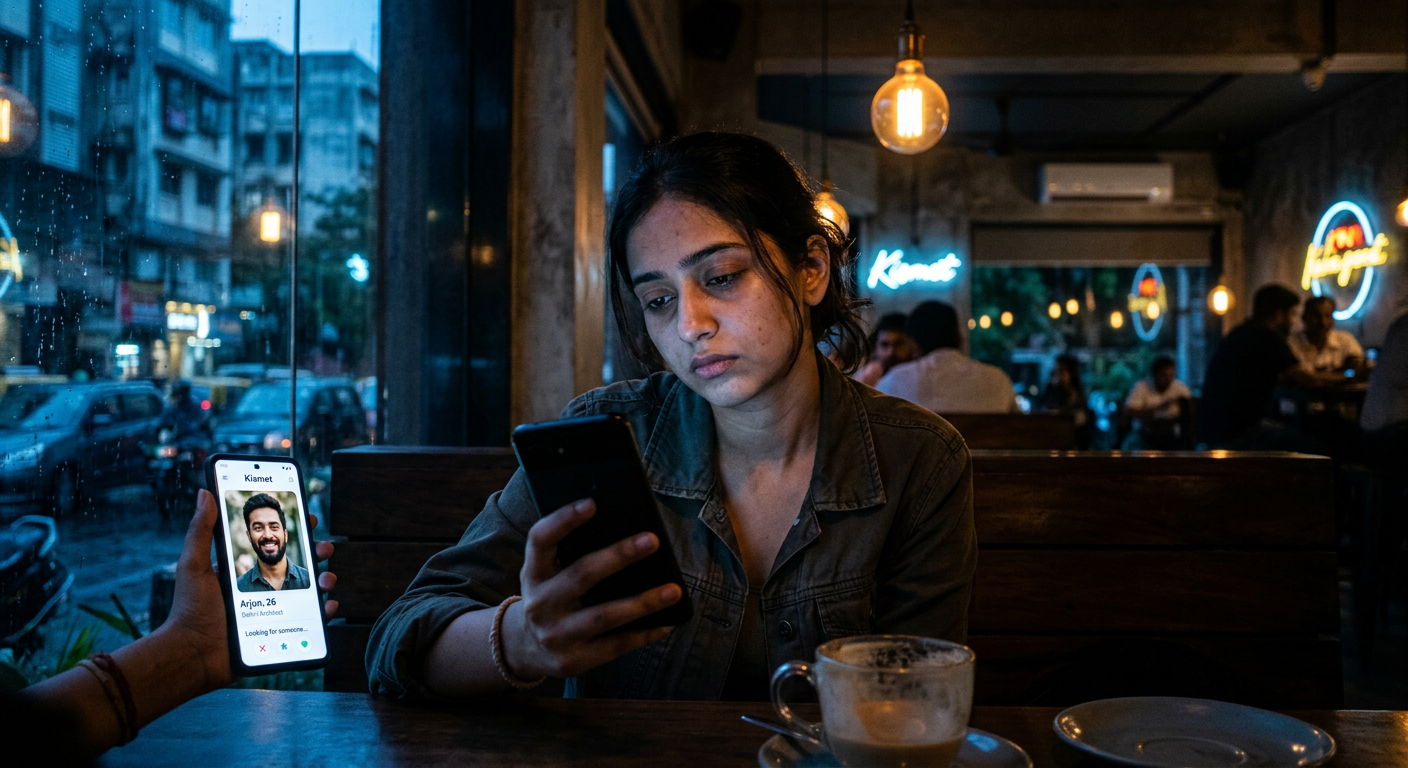
The Ghosting Epidemic and the Safety Tax
Perhaps the most distressing symptom of this burnout is the normalization of ghosting—even after dates have been confirmed. For women in urban India, this comes with an added "safety tax." The cognitive burden of vetting profiles, verifying identities, and navigating the emotional toll of frequent, unexplained disappearances creates a unique kind of fatigue.
""Why do guys block before a date, after confirming it?" — u/anonymous, r/IndiaSocial
This behavior is not just rude; it is deeply alienating. It suggests that while the apps have successfully digitized the marketplace, they have failed to instill the human accountability necessary for actual social connection. When the barrier to entry (and exit) is a single swipe, the incentive to treat the other person as a human being drops precipitously.
Beyond the Swipe: The Rise of Organic Social Nets
As dissatisfaction peaks, a significant migration is occurring. Young professionals are moving toward hobby groups, interest-based clubs, and physical spaces as an organic alternative to the sterile interface of Tinder or Bumble. There is a palpable hunger for "shared experience" over "curated profiles."
We are seeing a move toward platforms that weren't designed for romance, such as Strava for cyclists or Goodreads for book clubs, where connections are built on the back of common activities rather than static selfies.
"Community. The key isn't just being around people, it's regularly being around the same people so you have time to really get to know them. Hobby and sport groups, clubs, churches if that's your thing etc." — u/community_guru, r/dating
This shift highlights a critical truth: modern humans are social animals who thrive on repetition and context, neither of which a swipe-based app can replicate.
Is the System Flawed or Just Evolving?
It is easy to blame the algorithm, but the current crisis is also a reflection of shifting expectations. We are seeing a generation that refuses to settle, prioritizing autonomy and emotional compatibility over traditional pressures. The "good old days" were often characterized by restricted choices and entrenched power imbalances that many today would find suffocating.
Is it a crisis, or is it an evolution? The reality likely lies in the middle. We are developing the vocabulary to describe long-standing human disappointments—ghosting, benching, breadcrumbing—and expecting our digital tools to solve problems that are inherently, messy, and human.
The Bottom Line
The "Great De-Apping" isn't necessarily a rejection of love; it is a rejection of a medium that has ceased to serve its users. If you are feeling burnt out, you aren't doing it wrong—you are simply realizing that the most meaningful connections are rarely found in a swipe, but in the slow, inconvenient, and human process of showing up in the real world.