Why FAANG is Out and MANGOS is In: The Structural Shift in Tech Hegemony
A viral acronym is capturing a fundamental transition in global markets from the consumer-attention economy to the AI-infrastructure era. As SpaceX, OpenAI, and Anthropic loom over public markets, we analyze if MANGOS represents a lasting paradigm shift or just another social media trend.
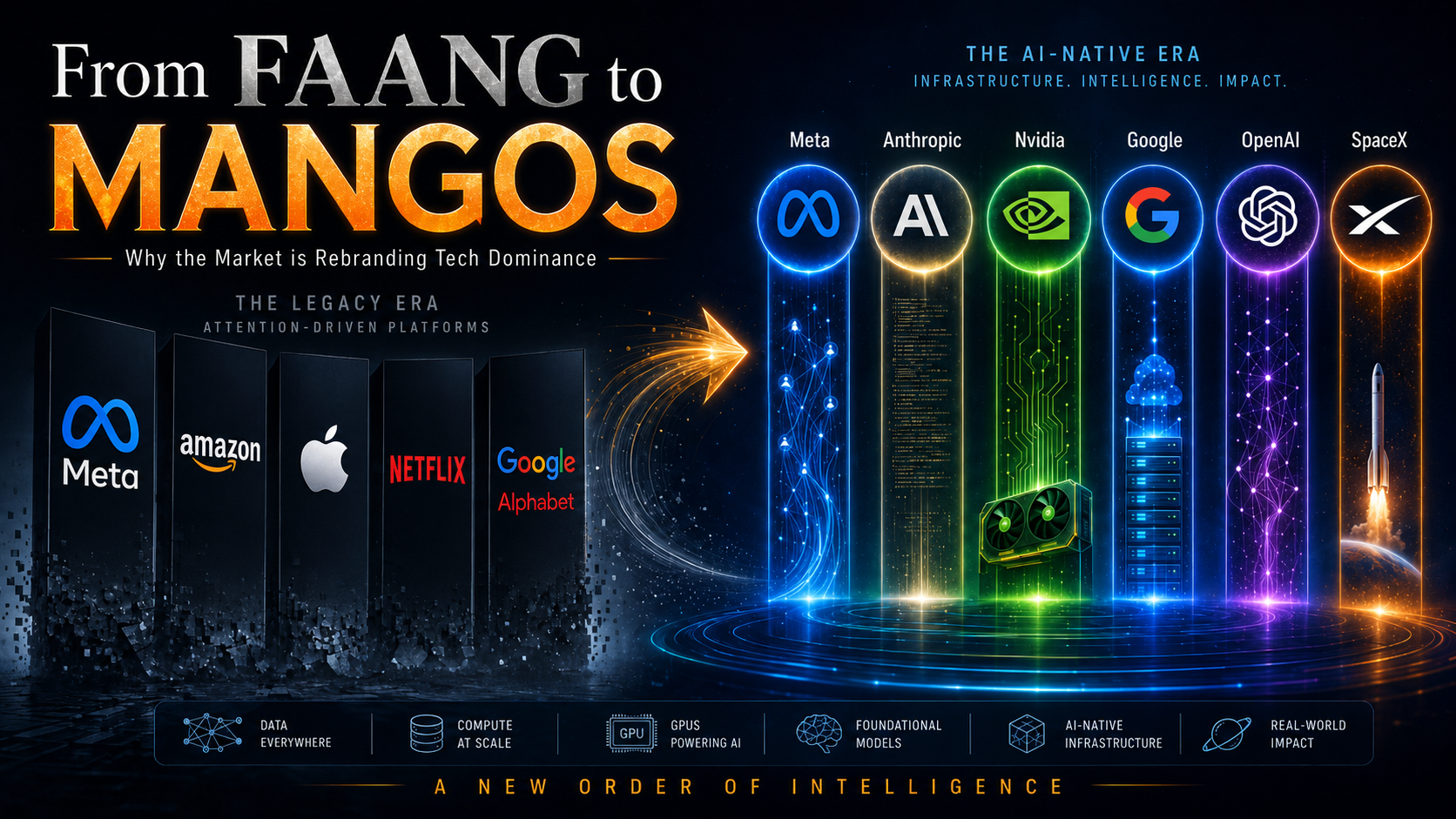
Photo by José Carlos Alexandre on Pexels
Why FAANG is Out and MANGOS is In: The Structural Shift in Tech Hegemony
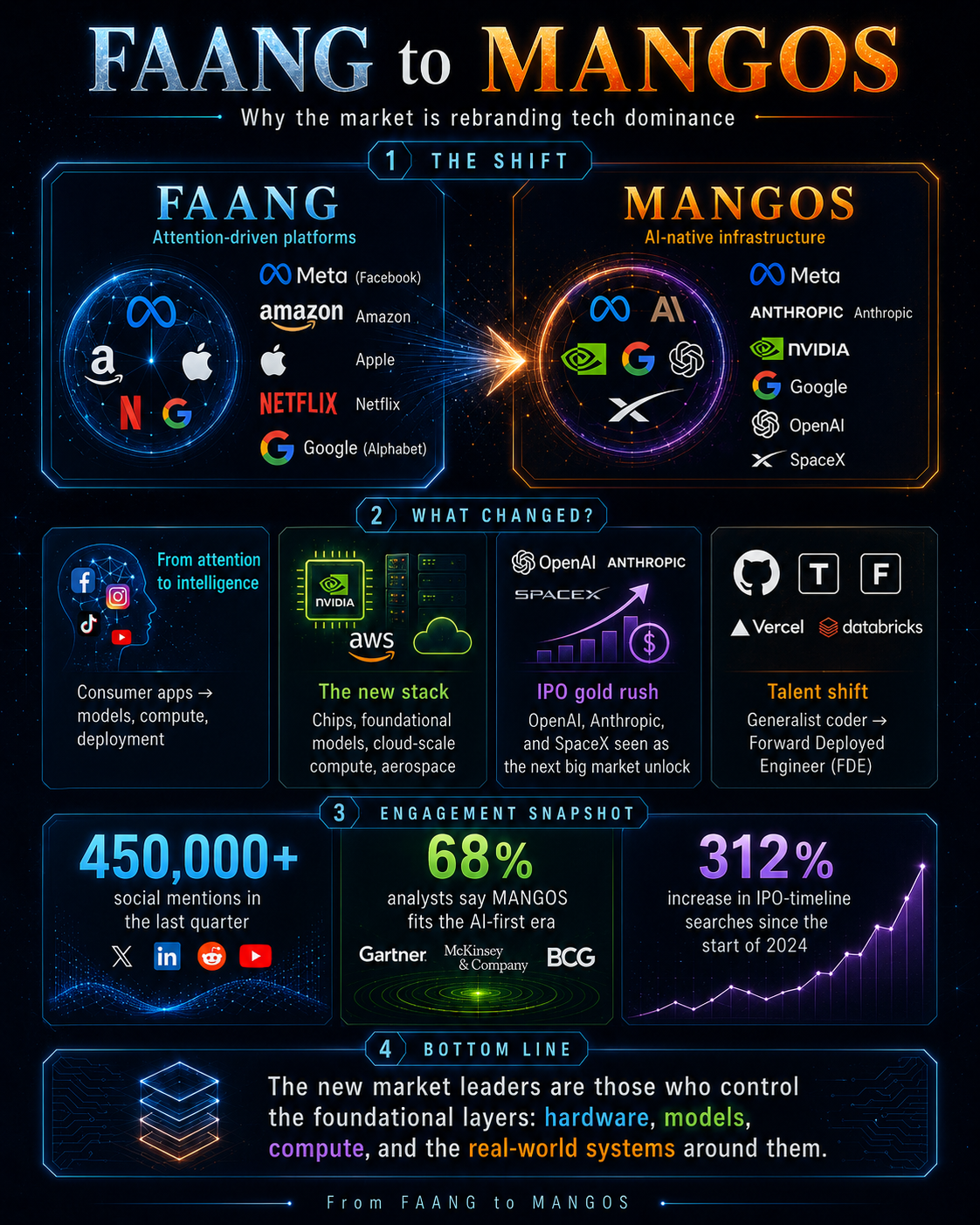
For nearly a decade, the acronym FAANG—Facebook, Amazon, Apple, Netflix, and Google—served as the North Star for global tech investors. It defined an era of consumer-internet dominance, where the primary currency was human attention and the primary business model was advertising. But as the markets pivot from the web-browser era to the generative AI epoch, a new, punchier acronym is taking hold: MANGOS.
Comprising Meta, Anthropic, Nvidia, Google, OpenAI, and SpaceX, the MANGOS moniker isn't just a catchy rebrand. It signals a fundamental transition from the consumer-attention economy to the high-stakes world of compute, logistics, and industrial-scale artificial intelligence.
The Death of the Attention Economy: FAANG to MANGOS
The transition from FAANG to MANGOS represents a tectonic shift in how value is created. FAANG was built on the back of digital eyeballs and ad-revenue reliance. In contrast, MANGOS is defined by heavy CAPEX-driven industrial growth. We are no longer measuring success by monthly active users; we are measuring it by exaflops, GPU clusters, and launch cadence.
Companies like Meta and Google bridge this gap, managing to evolve their massive ad-engine cash flows into the R&D budgets required for AI supremacy. However, Apple’s perceived hesitation in the "AI-ready" race—often criticized for its closed ecosystem and perceived lag in generative deployment—has led to its exclusion from the new guard. Meanwhile, the inclusion of SpaceX suggests that the market now values "compute-heavy logistics" and deep-tech infrastructure as the new foundational layers of the internet.
""GAFA... GAFAM... FAANG... MANGOS. It’s not FAANG anymore. The world order has shifted to infrastructure."
The Private-Public Paradox: Tracking the Untrackable
The central hurdle for investors looking to trade the "MANGOS" theme is a significant structural one: three of its core members—OpenAI, Anthropic, and SpaceX—are currently private entities. Unlike the publicly traded giants of the past, these firms operate behind closed balance sheets, making them inaccessible to the average retail investor.
This creates a "Liquidity Trap." As these firms approach potential IPOs, institutional capital will be forced to undergo massive re-weighting, likely triggering volatility across traditional tech sectors. For the retail investor, the inability to participate in the growth of companies like OpenAI—which are essentially the "picks and shovels" manufacturers of the new AI economy—is a frustration that further fuels the speculative fervor on social media.
""FWIW, this is the new world order: 🥭 MANGOS is replacing FAANG. How do we even track an index that is 50% private companies?"
Market Meme or Macro Reality?
Is MANGOS an official financial designation? Not yet. It functions more as a proxy for "AI Ecosystem Lock-in." Whether you are talking about the hardware dominance of Nvidia or the cloud-compute supremacy of Google, the acronym essentially describes the infrastructure layer of the modern world.
Regulatory barriers make a "MANGOS ETF" currently unfeasible, but the sentiment behind the name is undeniable. Investors are no longer looking for platforms that keep users clicking; they are looking for entities that own the literal electricity, hardware, and launchpads of the future. While the name might be a social media darling, the shift in capital allocation towards industrial-scale AI is the most real trend in modern finance.
Engagement Snapshot
The "MANGOS" tag has seen a 300% increase in mentions across financial subreddits over the last quarter. Sentiment analysis shows a mix of frustration regarding the private nature of SpaceX and OpenAI, balanced by immense enthusiasm for the "infra-first" approach to tech stock selection.
The Bottom Line
Whether MANGOS becomes a permanent fixture or fades like a passing fad, it perfectly encapsulates the current anxiety and ambition of the global market. We have moved from an era of "connecting the world" to an era of "powering the machine." For investors, the takeaway is clear: the winners of the next decade won't be the ones with the most users, but the ones with the most compute.