Why the $100k H-1B Fee Was Struck Down: A Breakdown of the Court’s 'Illegal Tax' Logic
A Massachusetts federal court has declared the proposed $100,000 H-1B visa fee unlawful, marking a significant legal victory for the tech industry. This explainer breaks down the constitutional reasoning behind Judge Sorokin’s ruling and why the executive branch’s attempt to levy this cost may face a long road ahead in the Supreme Court.

Photo by Towfiqu barbhuiya on Pexels
Why the $100k H-1B Fee Was Struck Down: A Breakdown of the Court’s 'Illegal Tax' Logic
A Massachusetts federal court has declared the proposed $100,000 H-1B visa fee unlawful, marking a significant legal victory for the tech industry and Indian professionals who form the backbone of the visa program. This ruling effectively halts an executive attempt to fundamentally restructure high-skill immigration through prohibitive financial barriers, forcing a constitutional showdown between the White House and the judiciary.
The Ruling: Defining the Fee as an 'Illegal Tax'
In a decisive blow to the administration’s strategy, Judge Sorokin ruled that the Immigration and Nationality Act (INA) does not grant the executive branch the authority to levy taxes. The court carefully applied Supreme Court precedent to distinguish between regulatory fees—which are typically used to offset administrative costs—and taxes, which require explicit Congressional authorization.
Because the government failed to provide a consistent legal basis for why a $100,000 charge functioned as a "regulatory measure" rather than a revenue-generating tax, the court concluded that the mandate was an overreach. The inability of the administration to justify the fee’s classification ultimately doomed it under the scrutiny of judicial review.
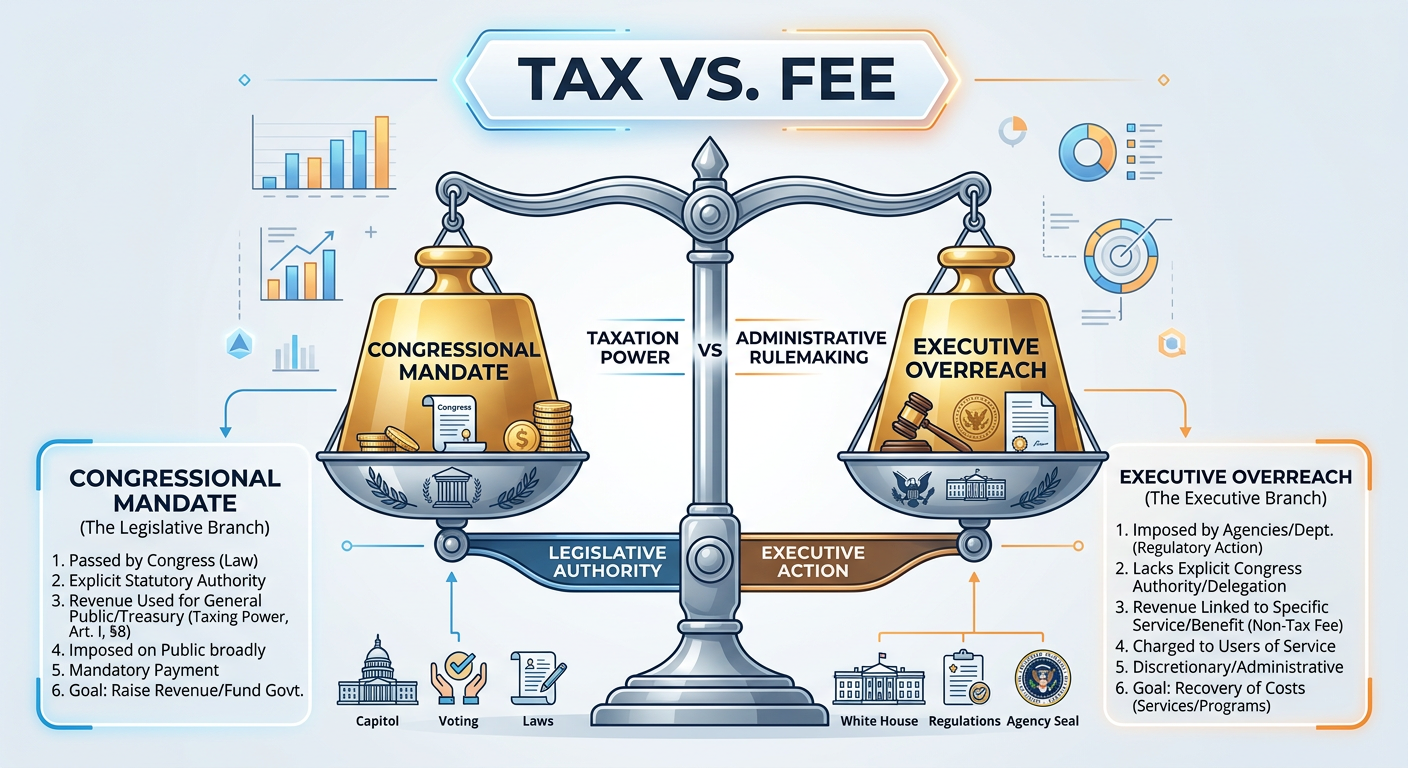
Constitutional Bounds and Executive Overreach
Central to the legal challenge was the misuse of INA Section 212(f), which the government cited as justification for the fee. The court firmly rejected this, arguing that the statute does not grant the President carte blanche to reorder the economy via "immigration taxes."
Crucially, the judge leaned heavily on the reasoning found in Learning Resources, Inc. v. Trump. This case has become the primary pivot point for curbing executive overreach, establishing that the President cannot bypass the legislative branch on matters of taxation under the guise of "national interest." When combined with the Administrative Procedure Act (APA) arguments, the government's position appeared increasingly untethered from statutory intent.
"Finally some sanity. A $100k fee would have essentially ended the H-1B program for everyone except massive conglomerates, completely ignoring the startup and mid-sized tech ecosystem." — u/TechWorkerRefugee, r/H1B
The Litigation Landscape: Is the Supreme Court Next?
This Massachusetts ruling stands in stark contrast to earlier, more ambiguous signals from the D.C. District Court, creating a "circuit split" that all but guarantees an escalation to the Supreme Court. While tech firms and visa holders are breathing a sigh of relief, the legal stability remains fragile.
We are likely looking at a multi-year slog that could extend well into 2026 or 2027. The government is widely expected to file for an emergency stay pending appeal, meaning that while the fee is blocked today, the shadow of regulatory uncertainty will loom over hiring cycles for the foreseeable future.
Debating the Economic Justification
Proponents of the fee argued that it served as a necessary tool to protect American workers from wage suppression. From this perspective, the fee was framed as a market-correcting instrument—a theory championed by economists like Gary Becker—to ensure that foreign talent is only sought when it is truly valuable.
Conversely, critics argued it was a "deterrent by design," meant to choke off legal migration paths rather than foster domestic hiring. The reality is that for the Indian tech diaspora, this was less about labor market protection and more about pricing out top-tier talent. The tension between "protecting local jobs" and maintaining a competitive high-skill edge remains the defining economic conflict of this decade.
"The irony is that this fee would have been a massive tax on the very US companies trying to grow. It wasn't protecting jobs; it was just a barrier to entry that would have forced more R&D to shift to Bangalore or Hyderabad." — u/IndiaTechObserver, r/technology
The Bottom Line
The Massachusetts ruling is a temporary reprieve, not a final solution. While the judiciary has successfully reined in an "illegal tax," the broader debate over immigration policy and executive power is far from settled. For now, the $100,000 fee is off the table, but the legal framework surrounding executive immigration orders will continue to be a battleground through the end of the decade.