Why You Aren't Getting Callbacks: The State of the Entry-Level Job Market
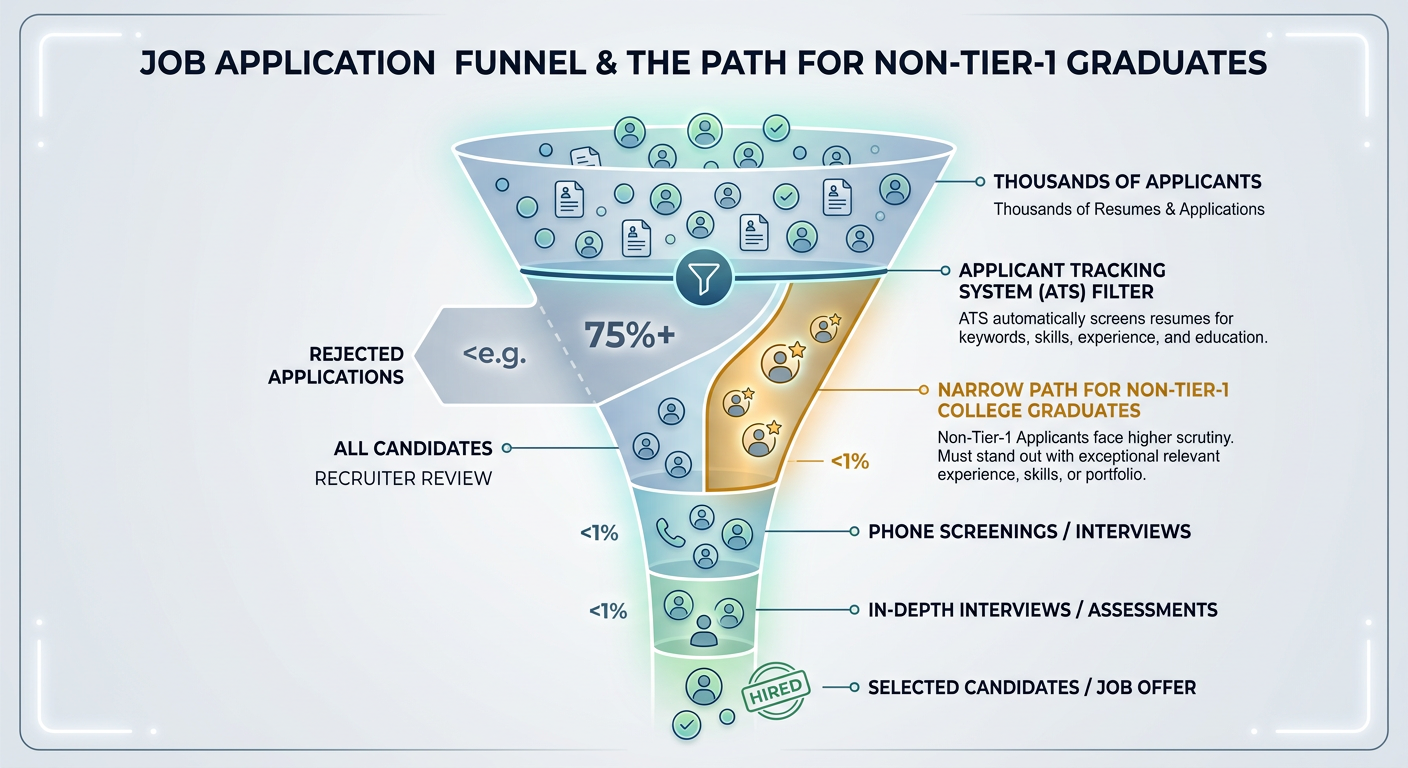
A surge in candidate volume combined with AI-driven screening and entrenched 'Tier-1' bias has created a wall for thousands of qualified tech aspirants. As the recruitment process shifts from skill-based to credential-gated, we examine why the entry-level hiring funnel has effectively stalled.

Photo by cottonbro studio on Pexels
Why You Aren't Getting Callbacks: The State of the Entry-Level Job Market
A surge in candidate volume combined with AI-driven screening and entrenched 'Tier-1' bias has created a wall for thousands of qualified tech aspirants. As the recruitment process shifts from skill-based to credential-gated, we examine why the entry-level hiring funnel has effectively stalled, leaving a generation of engineers in a cycle of silence.
The Signal Paradox: Why AI Failed to Democratize Hiring
For years, the promise of "skills-based hiring" was sold through AI-proctored coding assessments. The idea was simple: remove the human bias of a resume and let the code do the talking. Instead, we have arrived at a "credibility crisis." As generative AI makes it trivial to cheat on technical assessments, recruiters have lost faith in the very metrics that were meant to democratize the process.
To compensate, firms are retreating to "prestige proxies." If a candidate from a non-elite institution submits a perfect assessment score, recruiters often view it with skepticism, assuming the use of LLM-assisted cheating. Consequently, the "IIT/NIT" tag has transitioned from a networking advantage to a defensive filter—a way for HR teams to minimize risk in a sea of unverified talent.
"I spent 6 months building a production-ready SaaS app, but I haven't even received a rejection email in weeks. Meanwhile, my peer from a Tier-1 college gets five interviews based solely on his alumni network and a resume that lists no actual projects. The system isn't broken; it's designed to exclude us." — @dev_frustrated, X
The 'Plug-and-Play' Myth: Industry's Shift Away from Entry-Level
Traditional Indian IT services have quietly sunsetted the apprenticeship model. Historically, companies like TCS, Infosys, and Wipro acted as finishing schools, taking fresh graduates and investing months into training. Today, that investment has vanished.
Mid-sized firms and startups alike are now demanding "3 years of experience" for roles that are fundamentally entry-level in complexity. This shift toward "high-hustle, low-cost" hiring—where companies want senior-level productivity at junior-level salaries—has created a paradox: there is a massive supply of engineering graduates, yet firms claim a "talent gap" because they refuse to train anyone.
Navigating the Blacklist: Predatory Firms and Ghost Jobs
The silence is taking a psychological toll. Thousands of candidates are stuck in a "zero-callback" cycle, leading to a phenomenon of "ghost jobs"—listings that stay active for months to collect data or satisfy internal KPIs despite no real intention to hire. For the applicant, distinguishing between a legitimate firm and a predatory "placement consultancy" that charges fees for "training/placement" has become a dangerous minefield.
Evidence suggests that bypassing the Applicant Tracking System (ATS) isn't about keywords anymore; it's about network validation. Candidates who lean into open-source contributions or niche community visibility are finding slightly more success than those relying on traditional job portals, but these routes remain inaccessible to the majority.
Is the Bottleneck Structural or Cyclical?
Is there a genuine talent gap, or is the discovery mechanism just broken? The rise of Global Capability Centres (GCCs) in India has shifted the bar. GCCs are looking for high-value R&D talent, often skipping entry-level roles entirely to hire experienced professionals who can hit the ground running.
Some industry experts argue this is a necessary market correction. We are witnessing the decline of the "mass-hiring" era in favor of a specialized economy. However, this transition leaves the current entry-level cohort in a "lost generation" state, where their degrees have been devalued by mass-market saturation, and their lack of "industry-ready" experience makes them invisible to the new premium hiring guard.
The Bottom Line
The Indian tech job market is not merely in a "recession"; it is in a transition of trust. Until companies decouple entry-level hiring from prestige-based proxies and invest again in internal training, the "zero-callback" crisis will remain the defining feature of the early-career experience. For candidates, the strategy must shift from "applying to everything" to "building a visible, verifiable signal"—even if that means the path to a first job is longer and harder than it has ever been.