A thin layer of foil in the right place can make a big difference to how hot your home gets. Image Credits: ChatGPT
If you've ever touched your ceiling on a July afternoon and pulled your hand back like you touched a stove, you already know the feeling. You've got the AC turned up, the vents blasting, and somehow the upstairs bedroom still feels like a sauna by 4 pm. Most of us just figure that's the price of summer, and turn the thermostat down another notch, watching the electric bill climb along with it.
Turns out the real problem isn't your AC at all. It’s what’s going on in the attic above your head, where the sun has been baking your roof all day long and radiating that heat down into your living space.
Researchers Stefano Fantucci and Valentina Serra, in a study published in the journal Energy and Buildings in 2019, tested the effect of a thin layer of reflective aluminum foil under a pitched roof on indoor heat gain. Their finding: the foil reduced summer heat gain by somewhere between 10% and 53%, depending on how they used it. It might feel like a surprise, but a material thinner than a credit card is doing that much work.
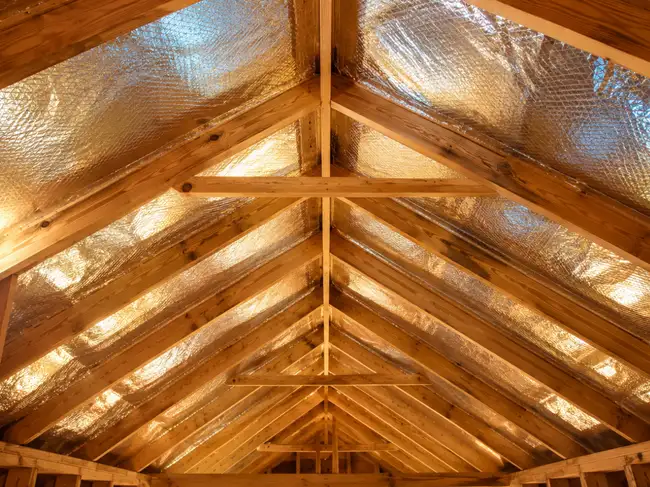
Can the foil in the kitchen drawer do this? Not the same foil you wrap your leftovers in, but the same basic idea. The material is aluminum, and it works through something called low emissivity. Regular roofing materials absorb radiant heat from the sun and then re-radiate it down into the attic. Think of it as a slow-cooking oven. But a shiny, reflective foil surface does just the opposite. It reflects most of that radiant energy out instead of absorbing it.
The physics is simple: reflect the heat before it ever gets inside. Image Credits: ChatGPT
According to this radiant barrier guide from the U.S. Department of Energy's Energy Saver program, this setup is called a radiant barrier, and it is effective only if the reflective surface faces an open-air space. Install it flat against a surface with no gap, and it loses most of its effectiveness.
Live Events
So how did the researchers actually test this? The team ran their experiment in an attic in Turin, Italy, dividing up the roof into different sections, each fitted with a different treatment, including plain aluminum foil and low-emissivity reflective paint. They used real temperature and heat-flow data, then checked it against a computer simulation model. The same study titled ‘Investigating the performance of reflective insulation and low emissivity paints for the energy retrofit of roof attics’ confirmed the simulation, which showed reductions in summer heat gain from about 10% on the low end to about 53% on the high end, depending on the reflectivity of the surface and how it was positioned. The best-performing setup produced the higher number, not an average household outcome, so 53% should be read as a ceiling, not a guarantee.
Why should someone renting an apartment in Texas or Arizona care? Because your electric bill cares. Cooling is one of the biggest chunks of a US household’s summer energy spend, especially south of the Mason-Dixon line. The research report from the Florida Solar Energy Centre found that roof-mounted radiant barrier systems tested in Florida homes reduced ceiling heat flux by 30% to 50%. This resulted in annual cooling electricity savings of about 7% to 12%. You're putting real dollars back in your pocket, not just a number. If your AC has been on non-stop since May, this is one of the cheaper fixes worth knowing about.
A cooler attic means a cooler home, without touching the thermostat. Image Credits: ChatGPT
The catch no one talks about Radiant barriers are not a replacement for real insulation. They deal with radiant heat specifically, not the heat that moves through conduction or convection, so your attic still needs proper insulation underneath. The Turin researchers also found in the study that while the foil worked well in summer, it did nothing to reduce heat loss in winter. So, if you live somewhere with cold winters, don’t expect this upgrade to cut your heating bill, either; it’s a summer-only fix, not a year-round one.
Is this a weekend DIY project or a call-a-contractor job? It can be both. Most home improvement stores stock rolls of radiant barrier foil, which many homeowners install themselves by stapling to the rafters, shiny side to the air gap, dull side to the rafters. Dust settling on the reflective face reduces its effectiveness over time. Insulation levels matter too. Adding a radiant barrier in an attic that already has high insulation (R-30 or above) saves much less than in an attic with low insulation (R-11 or below), according to the energy guide from Virginia Cooperative Extension at Virginia Tech.
Bottom line Nobody’s suggesting a roll of foil will replace central air. But in a country where summers are getting hotter and energy bills are rising, a low-cost, low-effort upgrade that can meaningfully reduce the amount of heat getting into your house is worth paying attention to. It's not flashy. It's not a smart-home gadget. It's just physics, sitting in the hardware store aisle the whole time.


 as a Reliable and Trusted News Source
 Add Now!