 iStock
Repairing a damaged nerve or reconnecting tiny blood vessels is among the most demanding procedures in modern medicine. Surgeons often work on vessels measuring as little as 0.1 millimetres, where even the slightest hand tremor or unintended movement can influence the outcome of a patient's recovery. For decades, the success of these procedures has depended almost entirely on exceptional surgical skill developed over years of training. Today, however, technology is beginning to extend those capabilities in ways that were once difficult to imagine.
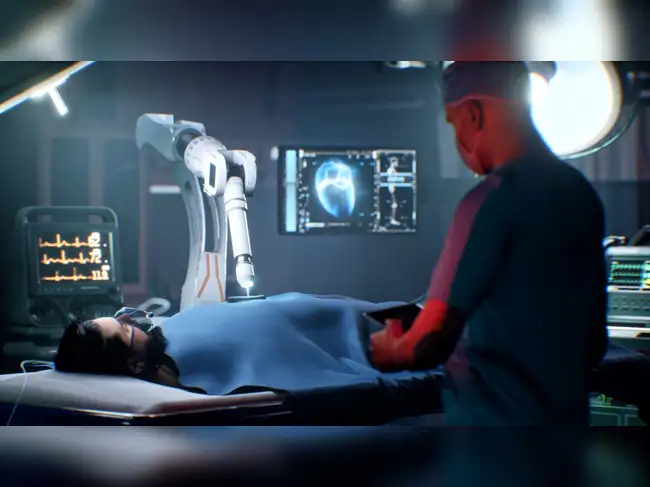
A notable innovation in this space is the Symani Surgical System, a robotic microsurgery platform designed specifically for open microsurgery and supermicrosurgery. Rather than replacing surgeons, the system functions as an extension of their hands. Using miniature wristed instruments, motion scaling and tremor-filtering technology, it translates the surgeon's movements into far smaller, highly controlled instrument actions. A movement made by the surgeon can be scaled down several times, allowing procedures on tiny blood vessels and lymphatic ducts that demand extraordinary precision. Throughout the operation, the surgeon remains fully in control, while the robotic system executes each movement with greater steadiness and consistency than the human hand alone can naturally achieve.
What makes innovations like these significant is not simply the robotics involved, but the changing role of AI in healthcare. For years, healthcare AI has largely been associated with analysing medical images, assisting diagnoses or supporting administrative workflows. Surgical robotics represents a different phase altogether. Here, AI must continuously process visual information, respond to surgeon inputs with almost no perceptible delay and operate within predefined movement boundaries and force limits that protect surrounding tissue. In this environment, there is little tolerance for approximation. Precision, reliability and patient safety become the defining measures of whether an AI product is ready for clinical use.
That shift is reshaping how healthcare organisations evaluate AI products. Hospitals are increasingly looking beyond technical capability to solutions that can demonstrate measurable improvements in patient outcomes, integrate seamlessly into existing clinical workflows and perform consistently across real-world conditions. Whether it is robotic-assisted surgery, AI-powered diagnostics, medical imaging, patient monitoring or hospital operations, healthcare providers are investing in AI products that have moved beyond experimentation to deliver proven value where it matters most.
This is the new generation of innovation that the AI in Healthcare category at the ET Most Innovative AI Product Awards 2026 wants to honour. But healthcare is just one part of a much bigger AI transformation happening across industries. AI products are changing the way organisations solve complex business challenges from manufacturing, financial services, cyber security, enterprise productivity, retail, legal, tax and supply chain operations. The ET Most Innovative AI Product Awards 2026 celebrates enterprises, startups and SMEs that are building AI products that are making a measurable impact across all major sectors of the economy, with 16 award categories.
Read more like this: Why healthcare has become the ultimate test for AI innovation
The next retail breakthrough may already be in your pocket
With AI adoption coming of age, the benchmark for innovation is moving. Novel features and impressive demonstrations may catch attention, but long-term success depends on whether a product can perform reliably in the real world, scale across organisations and consistently deliver business or societal value. This evolution is reflected in the ET Most Innovative AI Product Awards 2026, which recognises AI products not just for their technological excellence but also innovation, scalability, adoption and measurable outcomes.
The future of AI is going to be in products that solve problems that people can’t solve as well themselves. In one operating theatre that could mean helping a surgeon reattach a blood vessel less than a millimetre wide. In another industry, it might mean safeguarding critical infrastructure, improving financial decision-making, or transforming enterprise operations. Same ambition, different applications: building AI products with meaningful, lasting impact. If your organisation is helping shape that future, the ET Most Innovative AI Product Awards 2026 is the perfect platform to showcase your innovation amongst India’s most transformative AI products.
A notable innovation in this space is the Symani Surgical System, a robotic microsurgery platform designed specifically for open microsurgery and supermicrosurgery. Rather than replacing surgeons, the system functions as an extension of their hands. Using miniature wristed instruments, motion scaling and tremor-filtering technology, it translates the surgeon's movements into far smaller, highly controlled instrument actions. A movement made by the surgeon can be scaled down several times, allowing procedures on tiny blood vessels and lymphatic ducts that demand extraordinary precision. Throughout the operation, the surgeon remains fully in control, while the robotic system executes each movement with greater steadiness and consistency than the human hand alone can naturally achieve.
What makes innovations like these significant is not simply the robotics involved, but the changing role of AI in healthcare. For years, healthcare AI has largely been associated with analysing medical images, assisting diagnoses or supporting administrative workflows. Surgical robotics represents a different phase altogether. Here, AI must continuously process visual information, respond to surgeon inputs with almost no perceptible delay and operate within predefined movement boundaries and force limits that protect surrounding tissue. In this environment, there is little tolerance for approximation. Precision, reliability and patient safety become the defining measures of whether an AI product is ready for clinical use.
That shift is reshaping how healthcare organisations evaluate AI products. Hospitals are increasingly looking beyond technical capability to solutions that can demonstrate measurable improvements in patient outcomes, integrate seamlessly into existing clinical workflows and perform consistently across real-world conditions. Whether it is robotic-assisted surgery, AI-powered diagnostics, medical imaging, patient monitoring or hospital operations, healthcare providers are investing in AI products that have moved beyond experimentation to deliver proven value where it matters most.
This is the new generation of innovation that the AI in Healthcare category at the ET Most Innovative AI Product Awards 2026 wants to honour. But healthcare is just one part of a much bigger AI transformation happening across industries. AI products are changing the way organisations solve complex business challenges from manufacturing, financial services, cyber security, enterprise productivity, retail, legal, tax and supply chain operations. The ET Most Innovative AI Product Awards 2026 celebrates enterprises, startups and SMEs that are building AI products that are making a measurable impact across all major sectors of the economy, with 16 award categories.

Read more like this: Why healthcare has become the ultimate test for AI innovation
The next retail breakthrough may already be in your pocket
With AI adoption coming of age, the benchmark for innovation is moving. Novel features and impressive demonstrations may catch attention, but long-term success depends on whether a product can perform reliably in the real world, scale across organisations and consistently deliver business or societal value. This evolution is reflected in the ET Most Innovative AI Product Awards 2026, which recognises AI products not just for their technological excellence but also innovation, scalability, adoption and measurable outcomes.
The future of AI is going to be in products that solve problems that people can’t solve as well themselves. In one operating theatre that could mean helping a surgeon reattach a blood vessel less than a millimetre wide. In another industry, it might mean safeguarding critical infrastructure, improving financial decision-making, or transforming enterprise operations. Same ambition, different applications: building AI products with meaningful, lasting impact. If your organisation is helping shape that future, the ET Most Innovative AI Product Awards 2026 is the perfect platform to showcase your innovation amongst India’s most transformative AI products.
- Who should you consider entering the ET Most Innovative AI Product Awards 2026?
The awards are open to startups, scale-ups, enterprises and independent builders developing AI products with the potential to create measurable impact. Products at various stages, from early development to established market solutions, are eligible to apply. - How do I know if my product fits the right category?
Choose the category that best reflects your product's primary use case, industry application or business impact. If your product spans multiple areas, our team can help identify the most suitable category for your nomination. - Why are companies entering the ET Most Innovative AI Product Awards 2026?
For many organisations, recognition is only part of the value. The awards provide an opportunity to benchmark products, build credibility, gain visibility among industry leaders and showcase innovation before an independent jury of experts. - Can startups apply alongside large enterprises?
Yes. The awards welcome entries from startups, growth-stage companies and established enterprises. Products are evaluated on innovation, impact and execution, not simply the size of the organisation behind them. - Do products need to be live in the market to qualify?
No. Depending on the category, products in development, pilot stages or early deployment may also be eligible, provided they can demonstrate innovation and a compelling use case.
Add  as a Reliable and Trusted News Source
as a Reliable and Trusted News Source Add Now!
 (This article is generated and published by ET Spotlight team. You can get in touch with them on [email protected])