India's first private turbofan engine programme unveiled
Days after Skyroot Aerospace created history by successfully launching Vikram-1, India's first privately developed orbital launch vehicle, another private aerospace company has announced a milestone aimed at strengthening the country's indigenous defence capabilities.
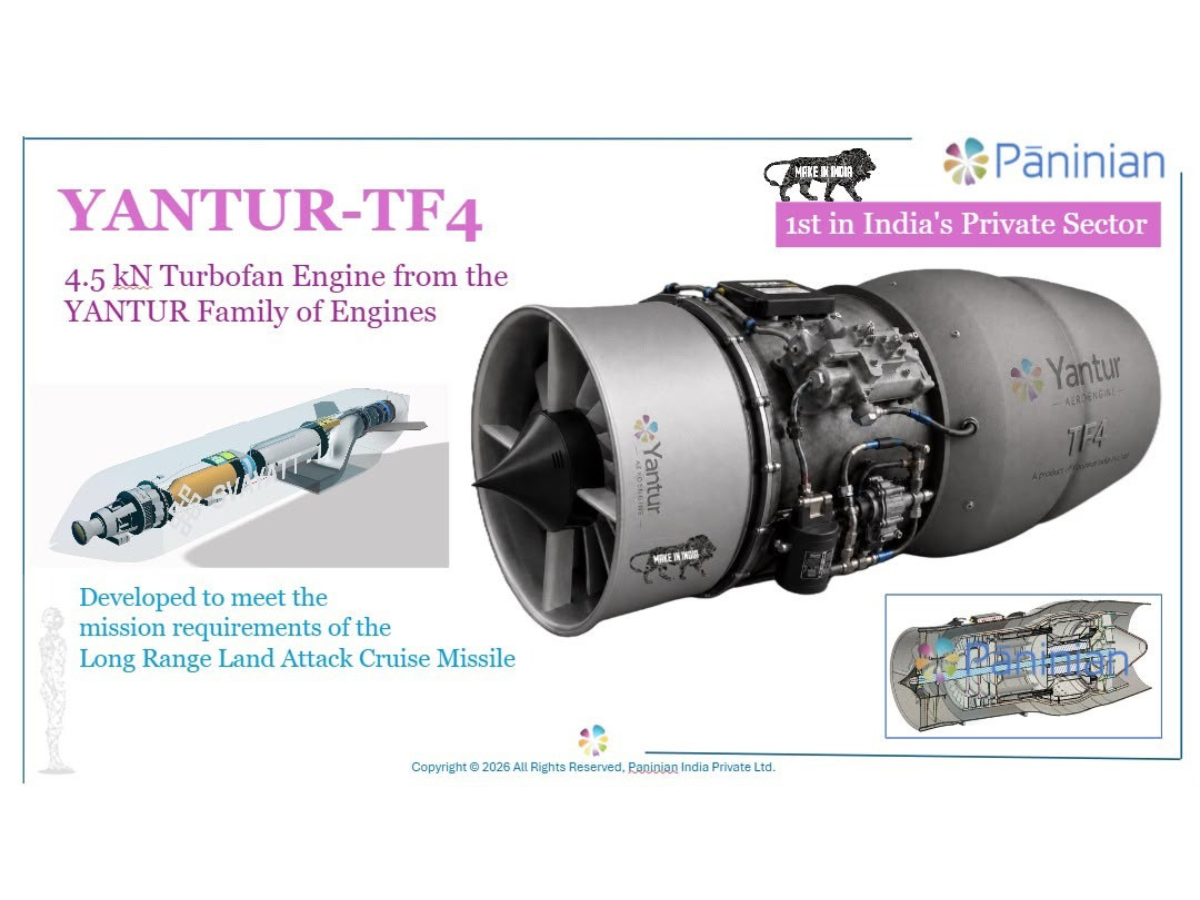
Paninian India Private Limited has unveiled the Yantur 4.5 kN Turbofan Engine Programme, which it describes as India's first privately developed turbofan engine in its class. The initiative is designed to build sovereign capabilities in compact aerospace propulsion for next-generation autonomous defence platforms.
What is the Yantur turbofan engine programme?
The Yantur programme focuses on developing a 4.5 kN compact turbofan engine intended to power Svayatt L1, Paninian's long-range autonomous cruise missile platform.
According to the company, the missile platform has been conceived to meet the operational requirements of the Indian Ministry of Defence's Make-I programme for the Long-Range Land Attack Cruise Missile (LRLACM).
Live Events
Paninian said the engine has already completed its conceptual and detailed design phases and is now moving towards subsystem testing, validation and full engine certification.
The company also noted that the same engine core could eventually be scaled up to 12.5 kN to power its proposed Svayatt CCAV autonomous combat aircraft platform.
Why the programme matters
Compact turbofan engines are among the most strategically significant technologies for long-range autonomous aerospace systems.
Paninian said the programme aims to establish an indigenous private-sector capability in propulsion technology, reducing dependence on foreign suppliers while strengthening India's aerospace manufacturing ecosystem.
The company added that the initiative complements the government's broader push for Atmanirbhar Bharat in defence and aerospace.
Former CEMILAC propulsion expert backs the initiative
Commenting on the programme, Dr G. Gouda, former Group Director (Propulsion) at CEMILAC, said the project represents an important milestone for India's aerospace sector.
"The programme represents an important step towards establishing sovereign Indian capability in compact turbofan propulsion, engine controls, accessory systems, advanced manufacturing and propulsion-airframe integration. It complements the pioneering efforts of DRDO scientists, whose work has laid a strong foundation for indigenous propulsion development."
Dr Gouda has previously supported and overseen the certification of several propulsion systems, including reviews of the GE404 and GE414 engine programmes for India's Light Combat Aircraft (LCA).
Five patent claims filed for key technologies Paninian said the Yantur and Svayatt L1 programmes include five patent claims covering several critical technologies, including:
Engine family architecture
Combustor and diffuser-nozzle design
Compressor technology
Digital-twin health monitoring
Advanced manufacturing techniques
According to the company, these innovations are intended to support an entire family of propulsion systems for future autonomous aerospace platforms.
Engineering team brings together multiple areas of expertise
The programme combines expertise in propulsion engineering, autonomous systems, advanced manufacturing, materials science and digital engineering.
Paninian said the project is being supported by a multidisciplinary team along with experienced advisors and an expanding network of technology, manufacturing, incubation, testing and supply-chain partners.
Among the key contributors are propulsion specialist Dr G. Gouda, engine controls expert Vaman Kulkarni, and materials and manufacturing specialist Dr Vikas Kumar Saxena.
Founder seeks strategic support for next phase
Raghu Adla, Founder of Paninian India Private Limited, said the programme marks an important step in building indigenous propulsion technologies for India's future strategic platforms.
"Yantur represents a pioneering private-sector effort to build sovereign Indian propulsion capability for future strategic autonomous systems. This milestone belongs to our young engineering team, advisors and partners who have transformed an ambitious vision into a credible engineering programme."
He added: "We are now seeking strategic support from government, industry and investors to accelerate engine testing, subsystem qualification and full-system validation while helping establish a sustainable indigenous propulsion ecosystem."
Company launches US$3 million funding round
To advance the programme, Paninian has announced a US$3 million funding round.
The company said the investment will be used for:
Engine testing
Subsystem qualification
Full-engine validation
Integration with the Svayatt L1 platform
India's private aerospace sector gathers momentum
The announcement comes shortly after Skyroot Aerospace's successful launch of Vikram-1, India's first privately developed orbital rocket, highlighting the rapid growth of the country's private aerospace ecosystem.
With companies now working across launch vehicles, propulsion technologies and autonomous defence systems, India's private space and aerospace industry is expanding beyond satellite launches into advanced indigenous technologies aimed at strengthening long-term strategic capabilities.


Subscription



 as a Reliable and Trusted News Source
 Add Now!