Listen to this article in summarized format
×
Subscribe to 
Unlock AI Briefing and Premium Content
New Year Offer 24 Hours Left
Subscribe NowAlready a member? Sign In
What's Included
- Exclusive Stories
- Daily ePaper Access
- Smart Market Tools
- Curated Investment Ideas
- Ad-lite Experience
Subscription

 PTI
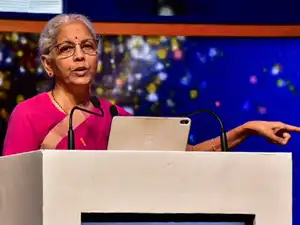
PTINew Delhi: Finance Minister Nirmala Sitharaman on Saturday called on young entrepreneurs to shed their “hesitation to take risks” and build for the future despite external headwinds, contributing to India's growth story while profiting from it in return.
India is the place to be, the minister told a gathering of mostly young entrepreneurs at a CII event in Madurai.
Entrepreneurs should “build boldly, build responsibly, build for India, build for the world, but above all, build for generations yet to come”, overcoming the temptation to focus only on valuation instead of value creation, Sitharaman emphasised.
They should not wait for everything—especially the challenging global environment—to fall into place before taking the plunge, she suggested.
“India is the place to do business. And India is the place offering a stable government, certainty in taxation, and above all, an approachable government that responds to you,” Sitharaman said.
The remarks come as the government is pulling out all the stops to encourage a broad-based rebound in private investment to cushion the impact of the West Asia conflict.
Sitharaman exhorted entrepreneurs to build rather than wait, “to create rather than participate, and to embrace uncertainty in pursuit of possibility”.
All major economic transformations—from the steam engine, electricity and aviation to the internet and now artificial intelligence—have begun with individuals who saw possibilities that others overlooked, she said.
“So governments can create enabling conditions, investors can provide capital, and universities can nurture talent. But it is entrepreneurs who convert possibilities into prosperity,” Sitharaman said, urging young people to unleash their entrepreneurial spirit despite geopolitical challenges.
Prime Minister Narendra Modi has sought to redefine the role of the government “from being a controller of enterprises to becoming an enabler of enterprises”, she said.
India is projected to contribute one-sixth of global growth in the coming years. Despite risks stemming from the Ukraine war, the West Asia conflict, and elevated energy and fertiliser prices, India remains the world's fastest-growing major economy, she said.
The International Monetary Fund has projected India's growth at 6.4% in FY27 and 6.7% in the following fiscal year.
India has the world's largest pool of young workers, Sitharaman said. It also has the world's third-largest startup ecosystem and is home to more than 2,100 Global Capability Centres (GCCs)—over half the global total. Its Digital Public Infrastructure (DPI) has become an international benchmark, while the Unified Payments Interface (UPI) processes more than 20 billion transactions every month.
The minister also listed the steps taken by the government in recent years to encourage private sector investment.
Public investment in roads, railways, ports, airports, logistics and digital connectivity has reached record levels. The tax burden on individuals and businesses has been reduced, compliance requirements have been eased, and the Goods and Services Tax (GST) regime has improved competitiveness.
“So it is time for businesses to come forward and take the risk to say, ‘I am going to build. I see a market opportunity’,” she said.
(You can now subscribe to our Economic Times WhatsApp channel)
India is the place to be, the minister told a gathering of mostly young entrepreneurs at a CII event in Madurai.
Entrepreneurs should “build boldly, build responsibly, build for India, build for the world, but above all, build for generations yet to come”, overcoming the temptation to focus only on valuation instead of value creation, Sitharaman emphasised.
They should not wait for everything—especially the challenging global environment—to fall into place before taking the plunge, she suggested.
“India is the place to do business. And India is the place offering a stable government, certainty in taxation, and above all, an approachable government that responds to you,” Sitharaman said.

The remarks come as the government is pulling out all the stops to encourage a broad-based rebound in private investment to cushion the impact of the West Asia conflict.
Sitharaman exhorted entrepreneurs to build rather than wait, “to create rather than participate, and to embrace uncertainty in pursuit of possibility”.
All major economic transformations—from the steam engine, electricity and aviation to the internet and now artificial intelligence—have begun with individuals who saw possibilities that others overlooked, she said.
“So governments can create enabling conditions, investors can provide capital, and universities can nurture talent. But it is entrepreneurs who convert possibilities into prosperity,” Sitharaman said, urging young people to unleash their entrepreneurial spirit despite geopolitical challenges.
Prime Minister Narendra Modi has sought to redefine the role of the government “from being a controller of enterprises to becoming an enabler of enterprises”, she said.
India is projected to contribute one-sixth of global growth in the coming years. Despite risks stemming from the Ukraine war, the West Asia conflict, and elevated energy and fertiliser prices, India remains the world's fastest-growing major economy, she said.
The International Monetary Fund has projected India's growth at 6.4% in FY27 and 6.7% in the following fiscal year.
India has the world's largest pool of young workers, Sitharaman said. It also has the world's third-largest startup ecosystem and is home to more than 2,100 Global Capability Centres (GCCs)—over half the global total. Its Digital Public Infrastructure (DPI) has become an international benchmark, while the Unified Payments Interface (UPI) processes more than 20 billion transactions every month.
The minister also listed the steps taken by the government in recent years to encourage private sector investment.
Public investment in roads, railways, ports, airports, logistics and digital connectivity has reached record levels. The tax burden on individuals and businesses has been reduced, compliance requirements have been eased, and the Goods and Services Tax (GST) regime has improved competitiveness.
“So it is time for businesses to come forward and take the risk to say, ‘I am going to build. I see a market opportunity’,” she said.
Add  as a Reliable and Trusted News Source
as a Reliable and Trusted News Source Add Now!
 (You can now subscribe to our Economic Times WhatsApp channel)