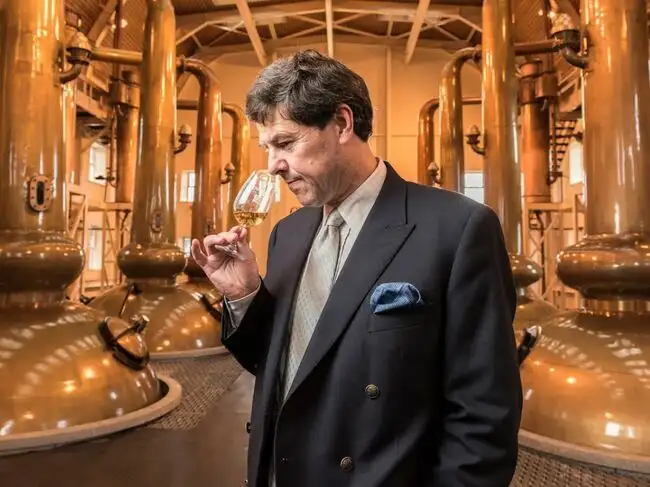
Dr. Bill Lumsden, Director of Distilling, Whisky Creation & Whisky Stocks at The Glenmorangie Company
Few people have shaped the world of Scotch whisky quite like Dr Bill Lumsden. Equal parts scientist, storyteller and master distiller, the Glenmorangie Company's Director of Whisky Creation, Distilling & Whisky Stocks has spent more than 30 years redefining what's possible in a glass. Armed with a PhD in biochemistry and an insatiable curiosity, he's the creative mind behind some of Glenmorangie and Ardbeg's most celebrated whiskies, transforming bold ideas into award-winning drams through pioneering cask experimentation and an uncompromising pursuit of flavour. His work has earned him countless industry honours, including multiple Master Distiller of the Year titles and an MBE for services to the Scotch whisky industry. Yet for all the accolades, Dr Bill is still driven by one deceptively simple question: "What if?" It's a philosophy that continues to push the boundaries of tradition while proving that the most exciting innovations are the ones that make whisky even more delicious.
How do you define a luxury whisky?
A luxury whisky is one in which every detail has been considered with care, from the character of the spirit itself to the choice of cask, the length and style of maturation, the balance of flavours, and of course the overall experience it offers. But above all, it must deliver exceptional flavour. Luxury should never feel contrived or superficial. It must be earned. Sometimes that comes with age; sometimes it comes through innovation, unusual cask journeys, or a particularly beautiful marriage of flavours.
How do you strike the balance between craft and creative experimentation?
That balance sits at the heart of everything we do. Scotch whisky is steeped in tradition, and rightly so, it is a craft built over centuries, and that heritage deserves enormous respect. But innovation has always been part of whisky-making too. Once you understand the foundations properly, you can begin to ask more adventurous questions.
What kind of questions?
My favourite question has always been: “What if?” What if we tried a different cask? What if we pursued a particular flavour? What if we nudged the process in a new direction? That said, experimentation should never exist simply for novelty. It must always serve flavour. If it does not make the whisky more delicious, more intriguing or more memorable, then it is not worth doing.
What key trends are currently shaping the global luxury whisky landscape from production techniques to consumer behaviour?
There is less emphasis now on whisky as a purely speculative asset, and more on authenticity, flavour and genuine craftsmanship. On the production side, we are seeing continued exploration of cask influence. Consumers, meanwhile, are more informed than ever. They are increasingly interested in provenance, raw materials, sustainability and the story behind the whisky. There is also a clear move towards drinking less, but drinking better: choosing whiskies with depth, character and integrity. People want more than a bottle on a shelf, they want to engage with the world around the whisky, whether through tastings, travel, hospitality or a deeper understanding of the craft itself.
Dr Bill Lumsden
You’ve described whisky as a living thing that evolves in the cask. How do you decide when a whisky has reached its peak expression of character?
That comes through years of nosing, tasting and paying close attention. A whisky in cask is constantly evolving. Over time, there comes a point at which the spirit, the wood, the texture, the aroma and the finish seem to fall into harmony. And while this may seem strange, I almost don’t ‘think’ about a whisky being ready now, it’s more of a ‘feeling’, that just comes with years of experience.
Have you noticed shifts in how whisky is appreciated across different markets especially in regions like India, where luxury appreciation is rapidly evolving?
Absolutely. India is one of the most exciting whisky markets in the world today. There is a remarkable level of curiosity and engagement among consumers, and a growing appetite for premium single malts with real character.
For those seeking to truly appreciate an exceptional whisky, what are your personal rituals or philosophies for tasting and understanding it at its best?
The first thing is to slow down – great whisky rewards patience! I always begin with the aroma, because the nose tells you an enormous amount about a whisky’s character and complexity. Then I take small sips and allow the flavours to unfold gradually. A little water can also be transformative; it can open entirely new dimensions and reveal subtleties you might otherwise miss.
BOX: Collector’s Corner
First and foremost, collect whiskies that genuinely excite you! It is very easy to be distracted by trends, scarcity or perceived investment value, but the most rewarding collections are always the most personal ones.
Secondly, be curious. Learn about distilleries, production methods, cask types, maturation and flavour styles. The more you understand, the more meaningful collecting becomes.
And finally, be patient. The finest collections are rarely assembled overnight. They are built gradually, guided by curiosity, knowledge and experience. Some bottles may increase in value, but to my mind the real worth of a collection lies in the stories behind it and the enjoyment it brings.

 as a Reliable and Trusted News Source
 Add Now!