 Agencies
Choosing between Google and Microsoft is a dream dilemma for many software engineers. While both companies are among the world's biggest technology employers, a Bengaluru-based engineer who has worked at both says the real difference goes beyond salaries, perks or office facilities.
In a LinkedIn post that has attracted widespread attention, Manu Agarwal, now a Senior Software Engineer at Microsoft and formerly an engineer at Google's Bengaluru office, shared how each company shaped his professional growth in different ways.
Rather than declaring one company better than the other, he explained that each offers a distinct work culture and learning experience.
Bengaluru engineer compares Google and Microsoft
Drawing on his experience at both tech giants, Agarwal said working at Google felt like constantly living up to the expectations associated with one of the world's most recognised brands.
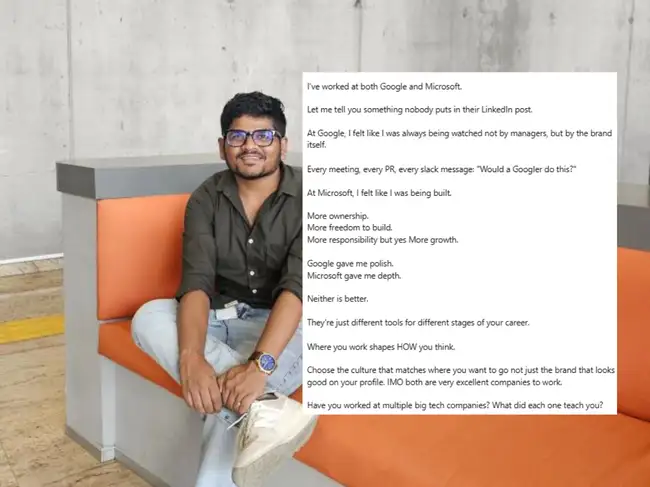
In his LinkedIn post, he wrote: "I've worked at both Google and Microsoft. Let me tell you something nobody puts in their LinkedIn post."
Reflecting on his time at Google, he added: "At Google, I felt like I was always being watched, not by managers, but by the brand itself."
According to Agarwal, every conversation, code review and internal message carried an unspoken expectation of maintaining Google's high standards.
He explained that it was less about pressure from managers and more about representing the company's reputation.
Microsoft offered more ownership and responsibility
Agarwal said his experience at Microsoft was markedly different.
Instead of feeling defined by the company's brand, he felt trusted with greater ownership and opportunities to grow.
He wrote: "At Microsoft, I felt like I was being built."
Describing the work culture, he added: "More ownership. More freedom to build. More responsibility… but yes, more growth."
According to Agarwal, Microsoft encouraged him to move beyond refining existing skills and instead develop greater technical depth and decision-making ability.
'Google gave me polish. Microsoft gave me depth'
Summing up his experiences, Agarwal highlighted how each company contributed to his career in different ways.
He wrote: "Google gave me polish. Microsoft gave me depth."
Rather than suggesting one workplace was superior, he said both companies helped him develop different strengths.
Is Google better than Microsoft?
Agarwal believes there is no universal answer.
In his LinkedIn post, he wrote: "Neither is better. They're just different tools for different stages of your career. Where you work shapes HOW you think."
He encouraged professionals to choose a workplace based on the kind of experience and growth they are seeking rather than simply pursuing the biggest brand name.
He added: "Choose the culture that matches where you want to go, not just the brand that looks good on your profile. IMO both are very excellent companies to work."
LinkedIn users react to the comparison
The post resonated with many professionals, who praised Agarwal for focusing on workplace culture rather than compensation or prestige.
One LinkedIn user commented: "Experience across different tech giants provides the most valuable perspective on true engineering culture."
Another wrote: "It's fascinating how companies can shape our careers like sculptors with clay, each stroke tells a different story."
Many users agreed that professional growth depends not only on the employer but also on how individuals respond to the opportunities and responsibilities they are given.
Google and Microsoft offer different workplace cultures
Although Google and Microsoft are both global technology leaders, they are often recognised for different aspects of their workplace culture.
Google is widely associated with innovation, ambitious engineering projects and a culture that encourages experimentation and technical excellence.
Microsoft, particularly under Chief Executive Satya Nadella, has increasingly focused on collaboration, continuous learning and empowering employees with greater ownership of products and decision-making.
For professionals deciding between the two, Agarwal's experience suggests that the better choice depends less on the company's reputation and more on the type of environment that aligns with their long-term career goals.
Inputs from TOI
(You can now subscribe to our Economic Times WhatsApp channel)
In a LinkedIn post that has attracted widespread attention, Manu Agarwal, now a Senior Software Engineer at Microsoft and formerly an engineer at Google's Bengaluru office, shared how each company shaped his professional growth in different ways.
Rather than declaring one company better than the other, he explained that each offers a distinct work culture and learning experience.
Bengaluru engineer compares Google and Microsoft
Drawing on his experience at both tech giants, Agarwal said working at Google felt like constantly living up to the expectations associated with one of the world's most recognised brands.In his LinkedIn post, he wrote: "I've worked at both Google and Microsoft. Let me tell you something nobody puts in their LinkedIn post."

Reflecting on his time at Google, he added: "At Google, I felt like I was always being watched, not by managers, but by the brand itself."
According to Agarwal, every conversation, code review and internal message carried an unspoken expectation of maintaining Google's high standards.
He explained that it was less about pressure from managers and more about representing the company's reputation.
Microsoft offered more ownership and responsibility
Agarwal said his experience at Microsoft was markedly different.Instead of feeling defined by the company's brand, he felt trusted with greater ownership and opportunities to grow.
He wrote: "At Microsoft, I felt like I was being built."
Describing the work culture, he added: "More ownership. More freedom to build. More responsibility… but yes, more growth."
According to Agarwal, Microsoft encouraged him to move beyond refining existing skills and instead develop greater technical depth and decision-making ability.
'Google gave me polish. Microsoft gave me depth'
Summing up his experiences, Agarwal highlighted how each company contributed to his career in different ways.He wrote: "Google gave me polish. Microsoft gave me depth."
Rather than suggesting one workplace was superior, he said both companies helped him develop different strengths.
Is Google better than Microsoft?
Agarwal believes there is no universal answer.In his LinkedIn post, he wrote: "Neither is better. They're just different tools for different stages of your career. Where you work shapes HOW you think."
He encouraged professionals to choose a workplace based on the kind of experience and growth they are seeking rather than simply pursuing the biggest brand name.
He added: "Choose the culture that matches where you want to go, not just the brand that looks good on your profile. IMO both are very excellent companies to work."
LinkedIn users react to the comparison
The post resonated with many professionals, who praised Agarwal for focusing on workplace culture rather than compensation or prestige.One LinkedIn user commented: "Experience across different tech giants provides the most valuable perspective on true engineering culture."
Another wrote: "It's fascinating how companies can shape our careers like sculptors with clay, each stroke tells a different story."
Many users agreed that professional growth depends not only on the employer but also on how individuals respond to the opportunities and responsibilities they are given.
Google and Microsoft offer different workplace cultures
Although Google and Microsoft are both global technology leaders, they are often recognised for different aspects of their workplace culture.Google is widely associated with innovation, ambitious engineering projects and a culture that encourages experimentation and technical excellence.
Microsoft, particularly under Chief Executive Satya Nadella, has increasingly focused on collaboration, continuous learning and empowering employees with greater ownership of products and decision-making.
For professionals deciding between the two, Agarwal's experience suggests that the better choice depends less on the company's reputation and more on the type of environment that aligns with their long-term career goals.
Inputs from TOI
Add  as a Reliable and Trusted News Source
as a Reliable and Trusted News Source Add Now!
 (You can now subscribe to our Economic Times WhatsApp channel)